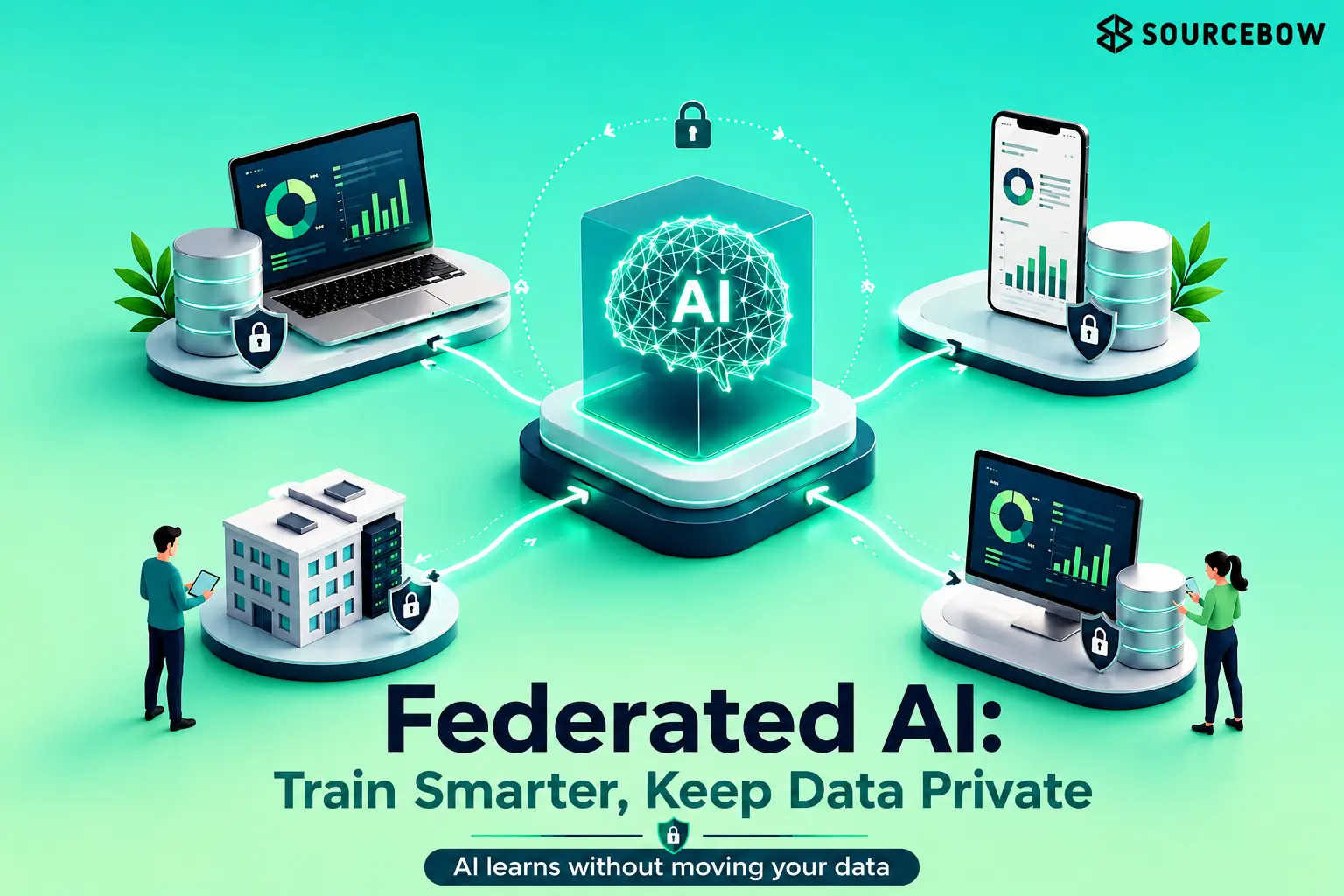
Federated AI sounds a little technical at first, but the idea is honestly pretty simple once you strip away the jargon. Instead of pulling everyone’s data into one giant server, the model learns where the data already lives. That shift is a big deal, especially when the data is sensitive, private, or just too valuable to move around casually.
And that’s why people keep talking about it in healthcare, finance, and mobile apps. Federated AI privacy-preserving training is one of those ideas that feels both practical and slightly futuristic at the same time. It keeps data local, improves security, and still lets models get better over time.
Quick Highlights
- Data stays on devices instead of moving to one place.
- Only model updates travel, not raw user data.
- It’s already useful in healthcare, finance, and phones.
- Real-world challenges still make it hard to scale.
Introduction
Federated AI privacy preserving training keeps data local, improves security, and powers real-world use in healthcare, finance, and mobile apps. That’s the short version. The longer version is that it tries to solve a very modern problem: AI wants lots of data, but a lot of that data shouldn’t be copied, centralized, or exposed in the first place.
The basic tension is simple. Models get smarter when they see more examples. But the whole point here is not to collect everything in one place. So instead of treating data like something to be gathered and stored centrally, federated AI flips the script and lets learning happen closer to the source. That’s where it gets interesting, because the privacy benefits are real, but the engineering tradeoffs are real too.
What federated AI actually is, in plain terms
Federated AI is a decentralized machine learning method: the model goes to the data instead of pulling the data into a central server. That’s the cleanest way to think about it. A device trains on its own local information, then shares only small updates with the larger system. The raw information itself stays put.
The coach-and-player analogy helps make this feel less abstract. Imagine a coach who wants to improve a team’s performance, but instead of bringing every player to one stadium to practice, the coach sends a training plan to each player individually. The players practice on their own, then send back what worked. In federated AI, those returned pieces are model updates, not secret videos or raw user records. That distinction matters a lot.
That idea changes the default shape of AI training from centralized extraction to local learning. And once you start thinking that way, a lot of the privacy conversation starts making more sense. It’s not perfect, but it’s a pretty meaningful shift.
Why the “model goes to your device” idea changes the privacy tradeoff
Your phone, not a server farm, does the local training, and the personal data stays on the device. That’s the core tradeoff. You still get model improvement, but you’re not sending your messages, usage patterns, or private records to a remote data lake just so the system can learn.
That framing is the reason federated learning is presented as a practical answer to privacy concerns rather than a minor optimization. It doesn’t just tweak the workflow. It changes who has access to what, and that’s a much bigger deal than it may sound like on paper.
How the federated learning workflow moves model updates without moving raw data
The workflow is iterative: a central server sends out a generic model, devices train locally, and encrypted updates return for aggregation. Then the refined model goes back out again, and the loop repeats. It’s a bit like sending a rough draft around a group, collecting edits, and slowly shaping a better version without ever making one person hand over all their notes.
The five steps are pretty straightforward once you see them together: distribution, local training, encrypted update, secure aggregation, and iteration. Each one is part of the loop that makes the model better over time. And each one also has privacy implications, which is why federated AI isn’t just “machine learning with a nicer name.” It’s a whole different operating logic.
That cycle is where the privacy story and the engineering story meet. The privacy part says, “Don’t move the raw data.” The engineering part says, “Okay, but how do we still learn efficiently?” Federated AI lives right in that overlap.
| Step | What happens | Why it matters |
|---|---|---|
| Distribution | A central server sends a generic AI model to multiple client devices. | Everyone starts from the same base model. |
| Local training | Each device trains on its own local data. | Raw data stays on the device. |
| Encrypted update | Devices send model parameter updates, not the underlying data. | The system learns without exposing private inputs. |
| Secure aggregation | The server combines many encrypted updates into one global model. | Individual contributions are harder to inspect. |
| Iteration | The refined model goes back to devices and the process repeats. | The model improves gradually over time. |
Where secure aggregation and differential privacy fit into the process
Secure aggregation is the step that combines encrypted updates, while differential privacy adds another layer of protection against leakage. Think of secure aggregation as the part that keeps the group contribution blended together, and differential privacy as the part that intentionally makes it harder to trace a single person’s influence. They solve slightly different problems, but together they make the whole setup much more robust.
Still, it’s worth being careful here. The raw content is careful not to claim this is perfectly safe, and that’s wise. Federated AI lowers the privacy risk, but it doesn’t erase it. The protections help, but they don’t magically remove every attack path.
Why companies use federated AI anyway: privacy, security, collaboration, and cost
The appeal is not just ethical; it’s practical. Keeping raw data localized reduces exposure, lowers infrastructure load, and makes collaboration possible across organizations that cannot share data directly. That combination is the real reason the idea has stuck around. It solves a business problem as much as a technical one.
The sensitive-data examples are easy to understand once you think about them in everyday terms. Medical records are personal. Financial transactions are private. Private messages are private for obvious reasons. In a centralized setup, all of that has to be gathered, stored, and protected in one place. Federated AI reduces that pressure by leaving the raw data where it starts.
It also helps on the cost side. When you’re not hauling around petabytes of centralized data, bandwidth and storage demands can drop quite a bit. That’s especially appealing for companies with huge user bases. So, yes, privacy matters here. But so do efficiency and operational sanity.
| Benefit | What changes | Example |
|---|---|---|
| Privacy by design | Raw data stays on the device | Medical records, financial transactions, private messages |
| Security | Only small aggregated updates move | Secure aggregation and differential privacy |
| Collaboration across silos | Organizations can train together without sharing datasets | Hospitals and competing banks |
| Efficiency | Less bandwidth and storage pressure | Petabytes of user data no longer need central storage |
Where federated AI is already being used
The strongest examples are everyday ones: smartphones, hospitals, banks, and autonomous vehicles. And that’s part of why federated AI feels less like a research curiosity and more like something already quietly shaping products you use all the time.
On smartphones, it can help with predictive keyboards, voice recognition, and personalized content feeds without uploading private conversations or usage patterns. In healthcare, hospitals can jointly train a cancer detection AI while preserving patient confidentiality under HIPAA. In finance, banks can improve fraud detection without revealing customer transaction data. And with autonomous vehicles, fleets can learn from real-world driving data without transmitting vast raw sensor logs everywhere.
Those examples make an important point: privacy-preserving AI models matter most when the data is both valuable and sensitive. If the data isn’t sensitive, federated learning may not be worth the complexity. But when it is, the tradeoff starts looking a lot more attractive.
- Smartphones: Google’s Gboard, voice recognition, and personalized content feeds without uploading private conversations or usage patterns.
- Healthcare: hospitals jointly train a cancer detection AI while preserving patient confidentiality under HIPAA.
- Finance: banks improve fraud detection without revealing customer transaction data.
- Autonomous vehicles: fleets learn from real-world driving data without transmitting vast raw sensor logs.
What makes federated AI difficult in practice
The hard part is not the concept; it’s dealing with the messiness of real devices and real data. In theory, the flow sounds elegant. In practice, devices behave differently, data is uneven, connections drop, and security threats don’t disappear just because the architecture is smarter.
The big challenges are pretty consistent: Non-IID data, communication bottlenecks, security and privacy vulnerabilities, and systems heterogeneity. Those four issues are the reason federated learning isn’t a simple replacement for centralized training. It’s more like a trade: you get privacy and decentralization, but you have to work harder to make the system stable and useful.
That can sound frustrating, but it’s also normal. Most useful technologies are slightly annoying under the hood. Federated AI is no exception.
- Statistical heterogeneity: Non-IID data varies in distribution, quantity, and content.
- Communication bottlenecks: millions of devices can create bandwidth, latency, and transfer-cost problems.
- Security and privacy vulnerabilities: inference attacks and data poisoning can still happen.
- Systems heterogeneity: different CPUs, memory, network stability, and battery life create “stragglers” and dropouts.
Why Non-IID data and stragglers slow everything down
When device data is uneven and hardware is inconsistent, training becomes biased, slower, or both. Non-IID data means each device’s data looks different from the next device’s data, so the model may overlearn from one group and underlearn from another. That can quietly hurt performance.
The straggler problem is even more immediately annoying. One weak device can delay the whole round of cross device model training. If a few phones are old, low on battery, or on flaky networks, the server has to wait or adapt. It’s a reminder that federated AI doesn’t run in a clean lab. It runs in the real world, where everything is a little messy.
FAQ
These are the smaller doubts readers usually still have after they understand the workflow and the tradeoffs.
Q: What is the main difference between federated AI and traditional AI?
Traditional AI collects data centrally. Federated AI sends the model to the data, so raw data stays on the device instead of being uploaded to one place.
Q: Is federated AI completely secure and private?
No. It is much more private than centralized training, but it still needs secure aggregation updates, differential privacy, and other defenses because inference attacks and poisoning are still possible.
Q: Which companies use federated learning?
The raw content names Google for Gboard, Apple for Siri, Sherpa.ai, and NVIDIA with its Clara platform for healthcare.
Q: What does Non-IID data mean in federated learning?
It means the data on different devices is not evenly distributed, which can bias the model and slow training.
Conclusion
Federated AI makes the privacy-preserving case for machine learning clear: keep data local, train collaboratively, and reduce exposure without giving up model improvement. That’s the real promise of the approach, and it’s easy to see why so many teams are interested in it.
At the same time, non IID data challenges, communication limits, and security risks still need to be handled carefully. So the story isn’t “problem solved.” It’s more like “we’ve found a better path, but the path still has a few bumps.” If you’re looking for a practical way to train AI without centralizing everything, federated AI is one of the most important ideas worth watching.