Multi-Agent AI Systems for Workflow Automation: How Specialized Agents Coordinate Complex Business Tasks
Businesses are moving beyond single-model automation, and that shift matters most when a workflow has too many moving parts for one model to handle cleanly.
Businesses are moving beyond single-model automation, and multi-agent AI systems are the reason the conversation is changing so fast. The big idea is pretty simple, even if the tech underneath it gets a little tangled: when one model starts to feel like it’s juggling too many tasks at once, splitting the work across specialized agents can make everything run smoother. That’s especially true in workflows where timing, handoffs, and consistency matter.
The real issue isn’t whether AI can do the work — it’s whether it can coordinate lead routing, approvals, updates, and execution without the process falling apart. And honestly, that’s where a lot of automation projects either become genuinely useful or quietly turn into a mess no one wants to touch.
Quick Highlights
- One model is fine for simple tasks.
- Complex workflows need coordination, not just generation.
- Specialized agents can reduce bottlenecks.
- Good orchestration matters as much as the agents themselves.
- Multi-agent systems work best when roles are clear.
Introduction
Businesses are moving beyond single-model automation, and multi-agent AI systems are the reason the conversation is
changing so fast.
The real issue isn’t whether AI can do the work — it’s whether it can coordinate lead routing, approvals, updates, and execution without the process falling apart.
That’s why this topic matters now. A lot of teams already know that AI can draft, summarize, classify, or answer questions. But once you ask it to manage a workflow with several dependent steps, the cracks show. So the discussion is no longer about whether automation is possible. It’s about whether the system can keep up when the work gets messy.
Look at it like this: a single person can sometimes run a small errands list. But once you’ve got pick-ups, deadlines, confirmations, and a few things that have to happen in the right order, you’d probably want a team. Multi-agent systems are the AI version of that team.
Why one AI model stops working once a workflow gets messy
Single-agent setups are fine when the task is narrow, but they start to fail when the workflow has dependencies, tool calls, and branching decisions.
A sales process is the clearest example here: lead identification, enrichment, qualification, outreach, follow-ups, and CRM updates all depend on one another.
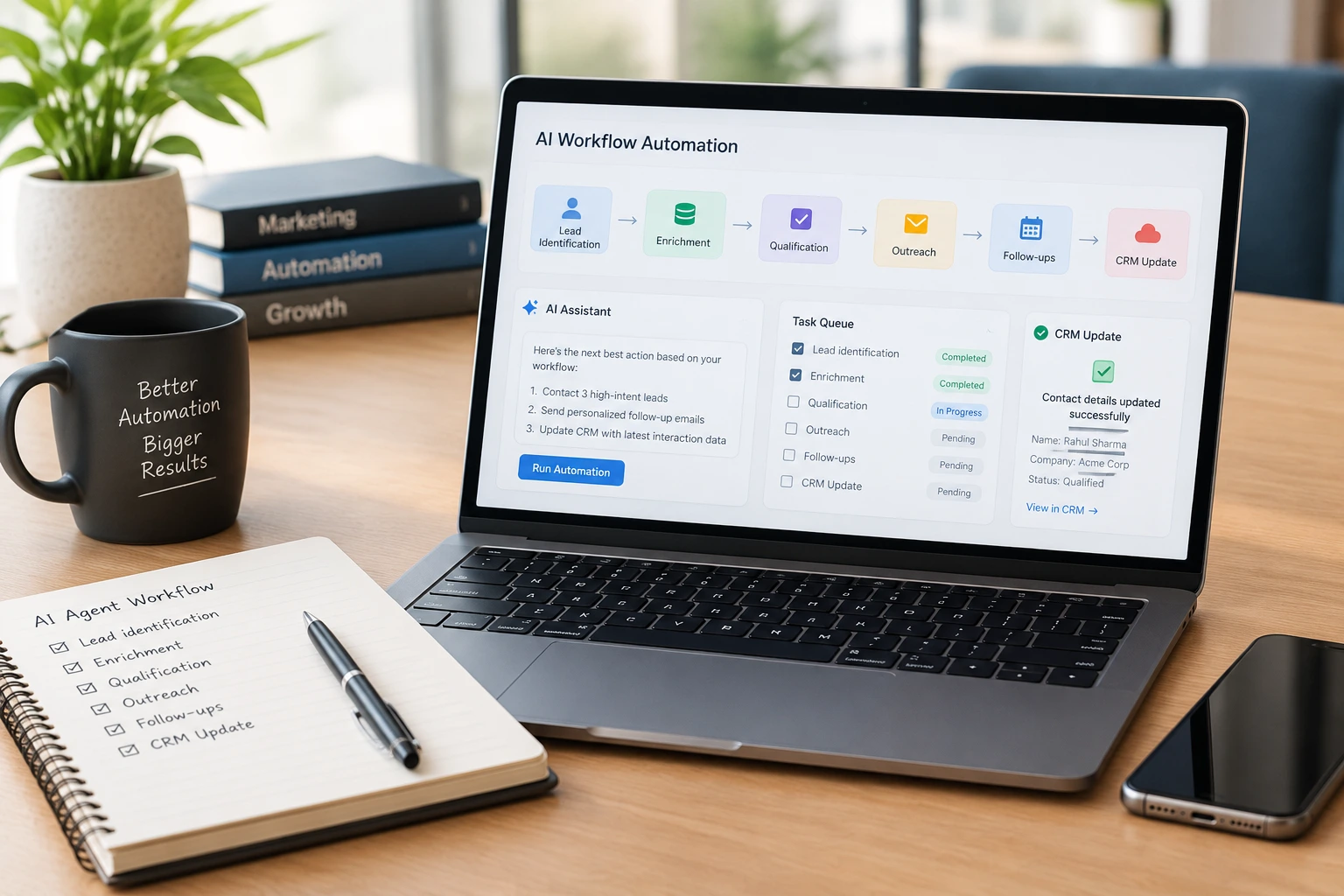
The same pressure shows up in contract writing, proposal writing, and other work where a single model gets overloaded fast.
Here’s the thing: a model doesn’t just need to be “smart.” It needs to stay organized while a process changes shape underneath it. If one step depends on a previous one being done correctly, then a small mistake can ripple forward. That’s fine for a simple assistant task. It’s much less fine when the output affects customer communication, finance, legal steps, or a sales pipeline.
In practice, this is where people notice that automation starts to feel fragile. Maybe the AI wrote a good email, but the record in the CRM didn’t update. Or maybe the lead was qualified, but the next step never triggered. These are not huge failures in isolation, but together they create friction. And friction is usually what makes teams give up on automation projects.
What breaks first in a single-agent workflow
The failure points are usually predictable: multi-step reasoning, juggling multiple APIs, adapting to changing inputs, and keeping dependent steps consistent.
Once those pressures stack up, the system becomes either too rigid or too error-prone when scaled.
That’s usually when the limits become obvious. The model may be able to complete one step brilliantly, but struggle to hold the whole chain together. It’s a bit like asking one person to be the analyst, coordinator, operator, and quality checker all at once. Something’s going to slip.
And when that happens in a business workflow, the problem isn’t just accuracy. It’s trust. People stop believing the automation will behave reliably, so they start checking everything manually again. That defeats the whole point.
How multi-agent AI systems actually divide the work
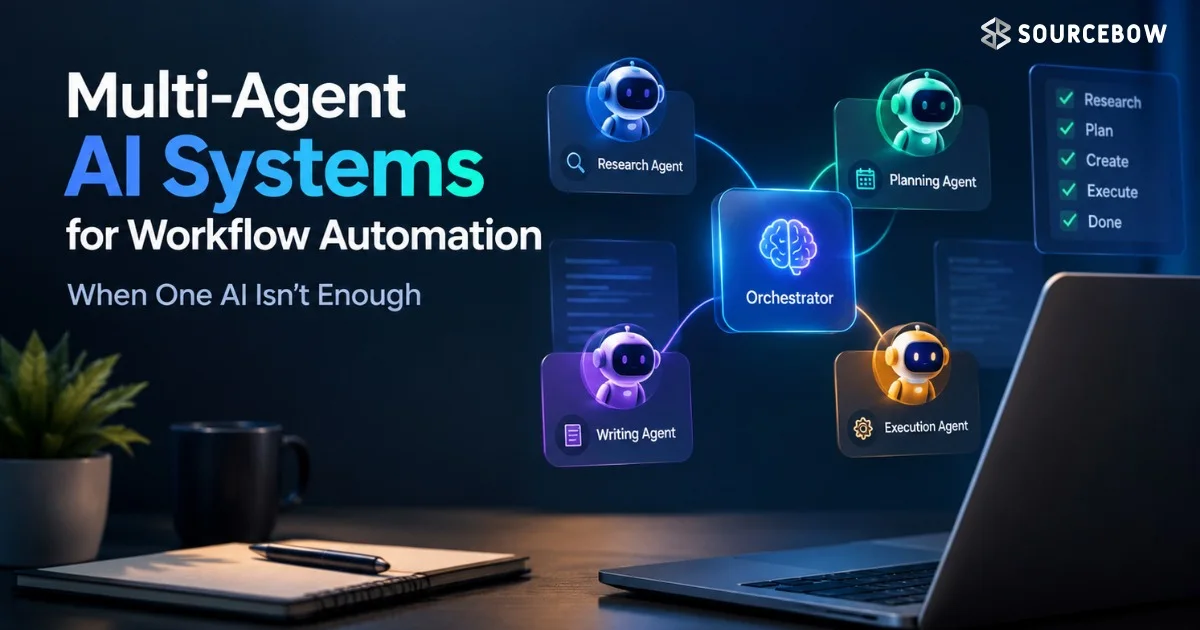
A multi-agent AI system splits a workflow into specialized roles instead of asking one model to do everything at once.
That can mean one agent collecting and structuring data, another analyzing patterns and generating insights, a third
making decisions based on rules, and a fourth sending emails or updating systems.
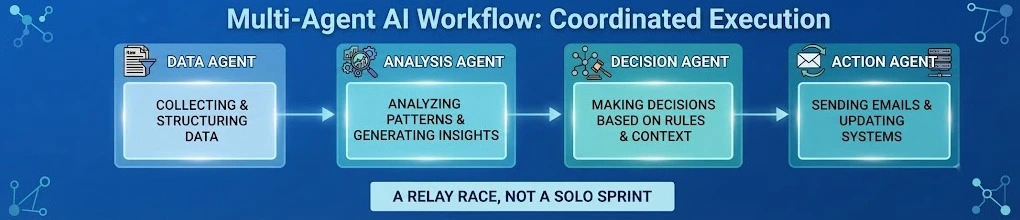
The point is not just separation — it is coordinated execution across smaller units of work.
That structure matters because each agent can stay focused. One doesn’t need to think about everything. It only needs to do its job well and pass the result forward in a usable way. In other words, the system becomes more like a relay race than a solo sprint. Each handoff matters, but the burden on each participant is smaller and more manageable.
This is also why these systems feel so different from basic automation. A rule-based workflow can route a form, sure. But a multi-agent setup can interpret context, make choices, and adjust based on what happened earlier in the chain. That’s a big leap when the workflow isn’t perfectly predictable.
The core building blocks inside a multi-agent workflow
Typical systems use a data-focused agent, a decision-making agent, an execution agent, and a monitoring agent. Each one does a narrower job, which makes the whole workflow easier to scale, update, and debug than a single overloaded model.
The data-focused agent might collect information from forms, documents, or connected apps. The decision-making agent looks at that input and figures out what should happen next. The execution agent takes action, like sending an email or updating a record. Then the monitoring agent watches for errors, exceptions, or things that need escalation.
That last part is easy to overlook, but it’s important. Monitoring is what keeps the workflow from quietly drifting off course. Without it, you can have a system that looks efficient on paper and still fails in the real world because no one noticed the mistake in time.
Where multi-agent AI is already being used
The clearest use cases are the ones with repetitive steps, high volume, and enough complexity that coordination
matters more than raw generation. Customer support, marketing, finance, operations, software development, and DevOps all fit that pattern.
This is where the business value becomes easy to picture. In these areas, the work usually isn’t one big hard problem. It’s lots of smaller tasks that need to happen consistently, often under time pressure. That’s exactly the kind of environment where agent-based systems start to make sense.
It also helps that these teams already use multiple tools. So instead of forcing one model to act like a universal assistant, multi-agent systems can work more naturally with the real structure of the job.
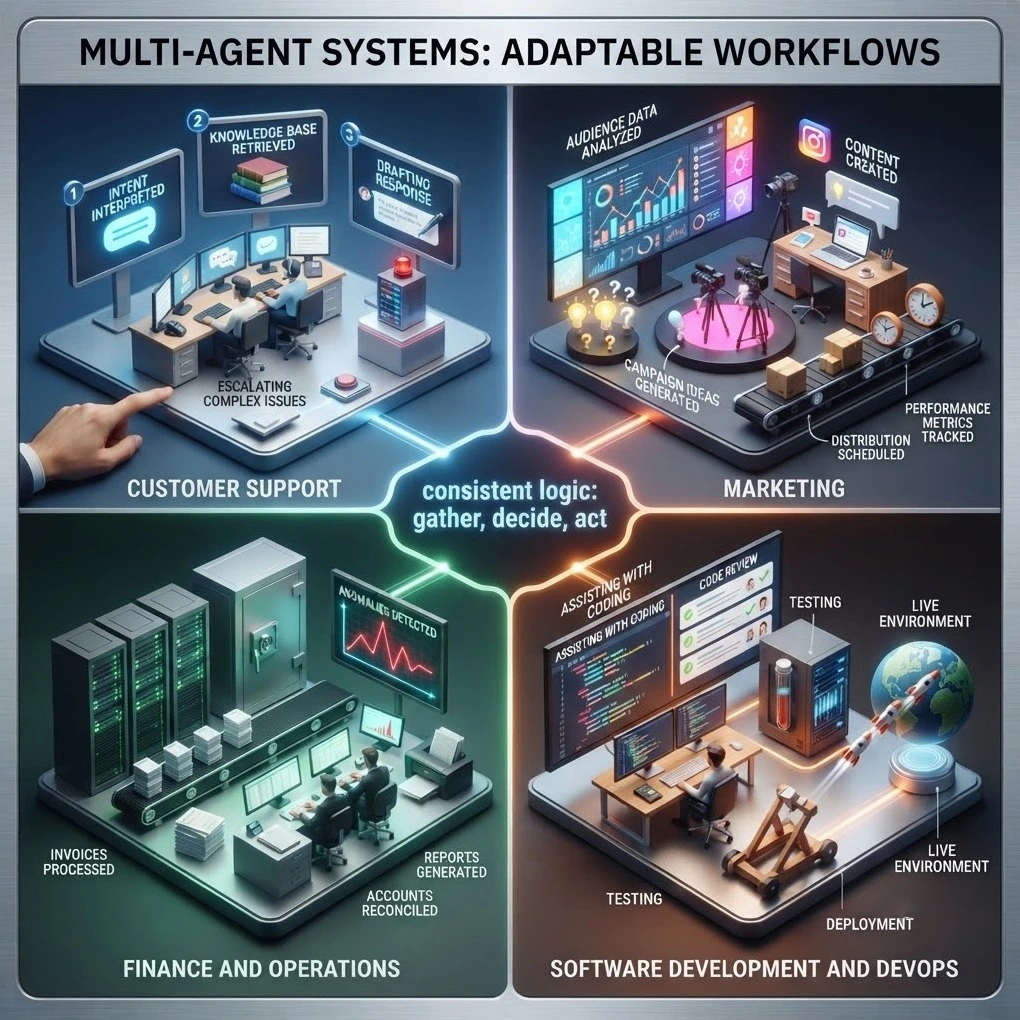
Customer support, marketing, finance, and DevOps each look different
- Customer support: one agent interprets intent, another retrieves knowledge base information, a
third drafts responses, and a fourth escalates complex issues. - Marketing: agents analyze audience data, generate campaign ideas, create content, schedule
distribution across channels, and track performance metrics. - Finance and operations: agents process invoices, detect anomalies, reconcile accounts, and
generate reports. - Software development and DevOps: agents assist with coding, code review, testing, and
deployment.
What’s interesting here is that the pattern stays the same even though the jobs look different. The agents are specialized, but the logic is consistent: gather, decide, act, and watch what happens next. That consistency is part of why the model is so adaptable across departments.
And if you’ve worked in one of these functions, you probably know the pain points already. Support teams deal with context switching. Marketing teams deal with scale and timing. Finance teams need accuracy. DevOps teams need speed without breaking things. Multi-agent systems are appealing because they can be shaped around those different pressures instead of forcing one generic workflow on everyone.
Why the business case is getting stronger now
Adoption is accelerating because enterprises are experimenting with AI agents in operational workflows and seeing cost reductions and efficiency gains.
Research also points to better task completion in complex workflows versus single-agent systems, especially when parallel processing and distributed execution matter.This is the shift from using AI tools to building AI-driven operational ecosystems.
That last phrase matters. A tool helps with a task. An ecosystem changes how the work moves through the business. Once organizations start thinking this way, they stop asking “Can AI write this email?” and start asking “Can AI help this process run end to end?” That’s a much bigger question, and it’s the one driving investment right now.
There’s also a practical reason the business case is strengthening: teams are tired of stitching together one-off automations that work until the first unusual input shows up. A more modular system is easier to maintain over time, especially when the business keeps changing. And businesses always keep changing.
The main gains are modularity, speed, and resilience
| Benefit | What it changes | Why it matters |
|---|---|---|
| Scalability through modular design | Add new agents without redesigning the whole architecture | Makes growth less disruptive |
| Operational flexibility | Update or replace one agent without touching the full system | Lets teams adapt quickly |
| Parallel execution | Multiple agents work at the same time on different parts of a workflow | Reduces total processing time |
| System resilience | One agent can fail without taking everything down | Limits full workflow failure |
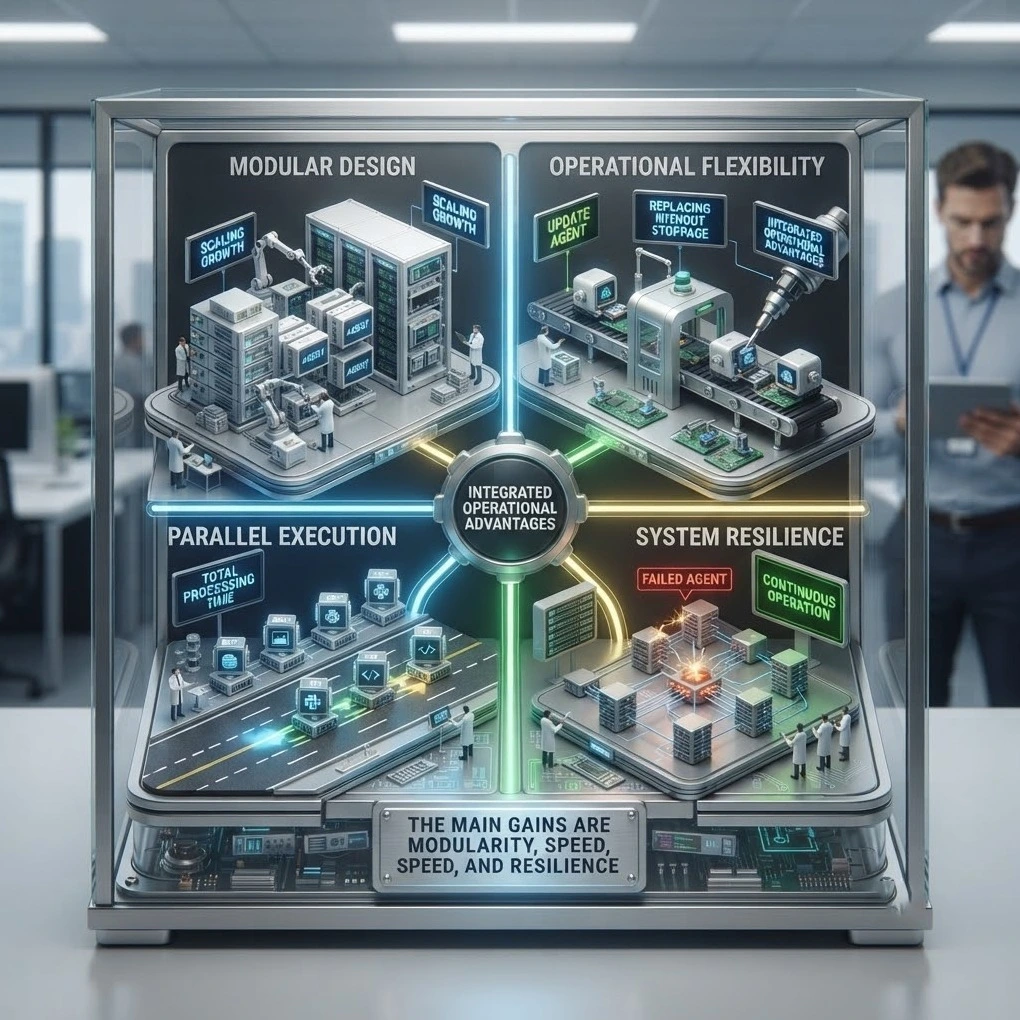
Those four benefits are a pretty good summary of why so many teams are paying attention. Modularity makes systems easier to extend. Flexibility makes them easier to maintain. Parallel execution saves time. Resilience reduces the damage when something goes wrong. Put together, those are not just technical advantages — they’re operational ones. And in a business setting, operational advantages are what get budgets approved.
What gets harder when you move to multi-agent AI
The architecture solves coordination problems, but it also introduces coordination problems of its own. Agents can conflict, errors can spread from one step to the next, and poorly designed roles can drag down performance
instead of improving it.
That is why structured frameworks and enterprise-grade platforms are becoming part of the conversation, not an afterthought.
This is the part people sometimes miss when they hear about agent systems and immediately think “great, more automation.” More automation only helps if the system stays understandable. Once you add more moving parts, you also add more places where handoffs can fail. A decision can be made too early. A message can be interpreted incorrectly. A monitoring step can be skipped. The system may still run, but it may not run well.
So the challenge isn’t just building agents. It’s designing the rules that keep them aligned. That includes clear responsibilities, dependable data flow, error handling, and enough oversight to catch bad behavior before it spreads.
It’s a bit like managing a team of specialists. If everyone knows their role, the work moves fast. If no one knows who owns what, you get confusion, duplicated effort, and missed deadlines. Multi-agent AI is no different.
What comes after automation: AI-driven teams that operate in real time
The direction of travel is toward more autonomous business operations, where AI agents make decisions, execute tasks, and optimize workflows in real time.
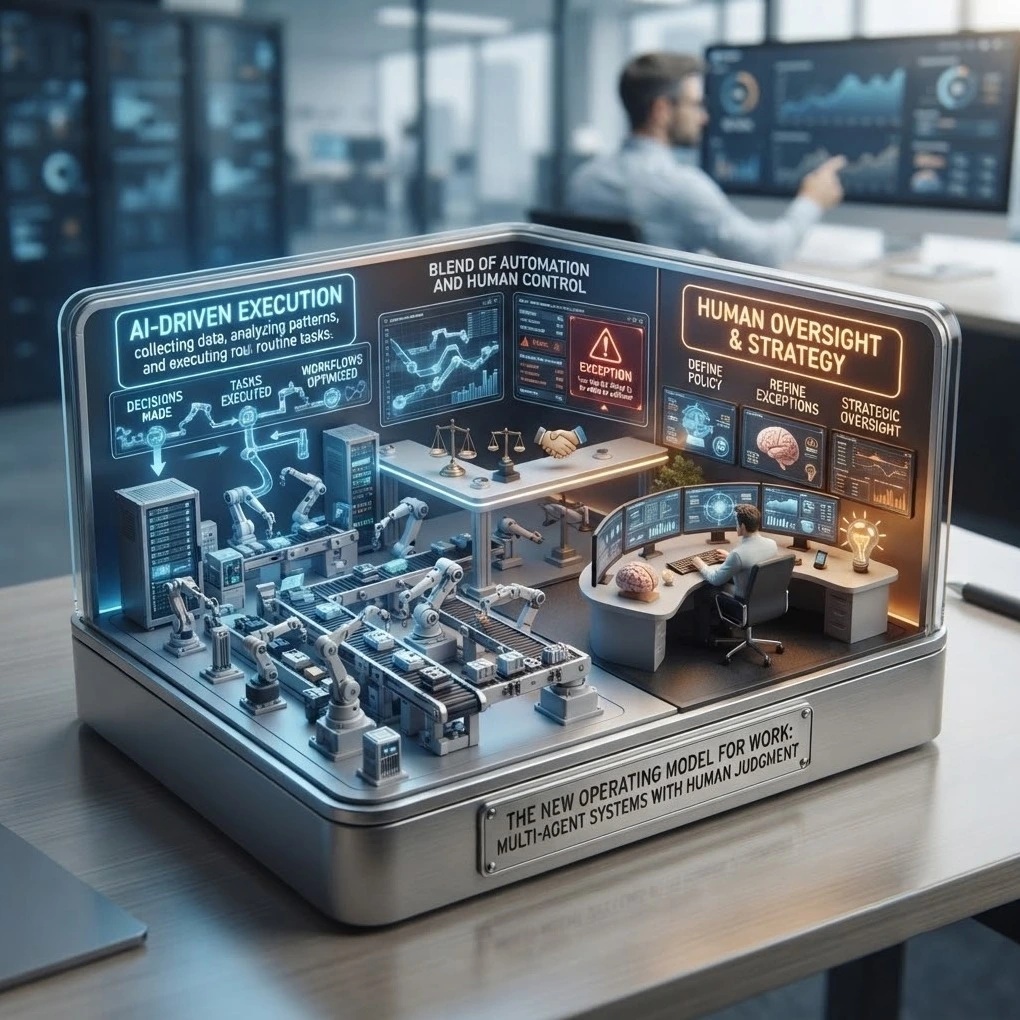
Human work doesn’t disappear in that model; it shifts toward strategy, innovation, and oversight. That future sounds dramatic, but it’s actually a logical extension of what’s already happening. Once you trust the system to handle routine actions, the human role moves up a level. Instead of manually processing every request, people define policy, refine exceptions, and make the strategic calls that software shouldn’t make alone.
Here’s the important part: this isn’t about replacing judgment. It’s about reserving judgment for the moments that really need it. The best systems will probably be the ones that blend automated execution with human control at the right points, rather than pretending one side can do everything.
In that sense, multi-agent systems aren’t just a technical upgrade. They’re a new operating model for work itself.
FAQ
These questions usually come from readers who understand the promise but still want to know where the limits are.
Q: What is the difference between a single AI model and a multi-agent AI system?
A single model tries to handle the whole workflow itself. A multi-agent system splits the work across specialized
agents, which is a better fit for complex, dependent processes.
Q: Why is AI agent orchestration important?
Because the value comes from coordination, not just individual agent capability. Without orchestration, the workflow
fragments instead of becoming more efficient.
Q: Where do multi-agent workflow automation systems make the biggest difference?
They matter most in workflows like customer support, marketing, finance, operations, software development, and
DevOps, where several steps have to happen in the right order.
Q: What is the biggest risk in enterprise AI coordination?
Errors can propagate across agents if the workflow is poorly designed, so the system needs clear roles, structured
handoffs, and monitoring.
Conclusion
Multi-agent AI systems make the most sense when automation has outgrown a single model and needs coordination to stay reliable.
If the work is complex, connected, and repetitive, the next step is usually not a bigger model — it is a better system of agents.
That’s really the core idea. Not every job needs a team of AI agents, and not every workflow needs that much structure. But when the process has too many dependencies for one model to handle gracefully, splitting the work can make the whole thing more practical. The sweet spot is where automation starts to feel less like a shortcut and more like a well-run operation.
So if you’re looking at a workflow that keeps breaking under pressure, the question isn’t just whether AI can do it. It’s whether the workflow deserves to be redesigned around coordination. That’s where multi-agent AI systems often shine.