Most people lump these terms together, but the real differences start with scope, data, and how much the system learns on its own.
That mix-up is understandable. The words get used side by side so often that they start to sound like the same thing, even when they’re not. But once you slow down and look at what each one actually does, the hierarchy gets a lot clearer.
Quick Highlights
- AI is the broad umbrella.
- Machine learning is one branch of AI.
- Deep learning is a subset of machine learning.
- Neural networks are the structure that powers deep learning.
- Data type and layer depth matter more than the buzzwords.
Introduction
Confused by AI vs machine learning? You’re definitely not alone. The biggest tell is that businesses are already using AI in ways that look familiar—object recognition in photos, Alexa, Siri—while the terminology still gets mixed up.
The article is basically about drawing the line between what’s broad, what’s a subset, and what still depends on human input. Once you see that, the whole subject becomes much less mysterious. And honestly, that’s the part most people want: not a giant technical lecture, just a clean mental map.
How AI, machine learning, deep learning, and neural networks fit inside each other
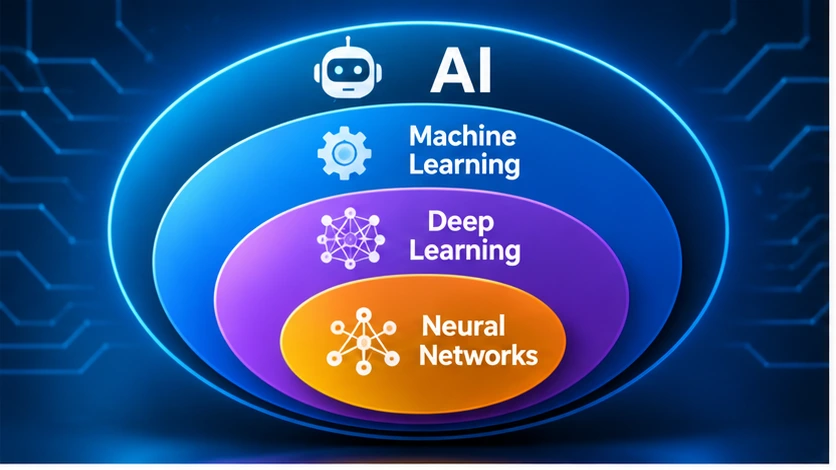
AI is the broadest system, machine learning sits inside it, deep learning sits inside machine learning, and neural networks are the structure that powers deep learning.
The key detail is depth: a neural network with more than three layers can count as deep learning, and that’s where the distinction stops being semantic and starts being technical.
That hierarchy is the backbone of the whole piece, so the rest of the article keeps returning to it in different forms. If you remember nothing else, remember this nesting effect. It’s the easiest way to stop the terms from blurring together.
Why “deep” means more than just a bigger model
The “deep” in deep learning refers to the number of node layers in a neural network, not just general complexity. A network with more than three layers, including input and output, crosses into deep learning territory.
That’s important because people often assume “deep” just means stronger, smarter, or more advanced. But technically, it’s about the layer structure. Think of it like a building: adding more floors changes the design, not just the decoration.
What AI actually means in business terms
AI is the broadest category: machines that mimic human intelligence and cognitive functions like problem-solving and learning.
It shows up in facial and speech recognition, decision-making, translation, and automation, with natural language processing and computer vision sitting inside the weaker, task-specific form of AI.
The article also draws a hard line between weak AI and strong AI, which is useful because people often blur those together too. In real business settings, most of what gets called AI is actually narrow, task-focused, and very practical.
So when someone says their company “uses AI,” they usually mean one or two specific systems that do one job well. That’s still useful. It just isn’t science fiction.
The three categories of AI and why only one is common today
Artificial Narrow Intelligence, or ANI, is the only form that is widely in use today. AGI and ASI are still theoretical, even though research continues.
ANI covers things like chess-playing systems, identifying a person in photos, chatbots, virtual assistants, and self-driving-car components through computer vision.
That’s the reason the phrase what is ai matters so much in practice. Most people imagine a human-like machine, but the current reality is much narrower and much more specific. The systems are impressive, but they’re not general thinkers.
What businesses are actually doing with AI right now
About 35% of businesses globally are using AI, while another 42% are exploring it. IBM also says early generative AI tests have shown time to value up to 70% faster than traditional AI.
That section is less about theory than adoption pressure: customer service, supply chain management, and cybersecurity are where the business case starts to become concrete.
In other words, companies aren’t adopting AI just because it sounds modern. They’re using it because it can save time, reduce repetitive work, and sometimes spot patterns people would miss. That’s where the pressure comes from.
How machine learning works differently from classic AI
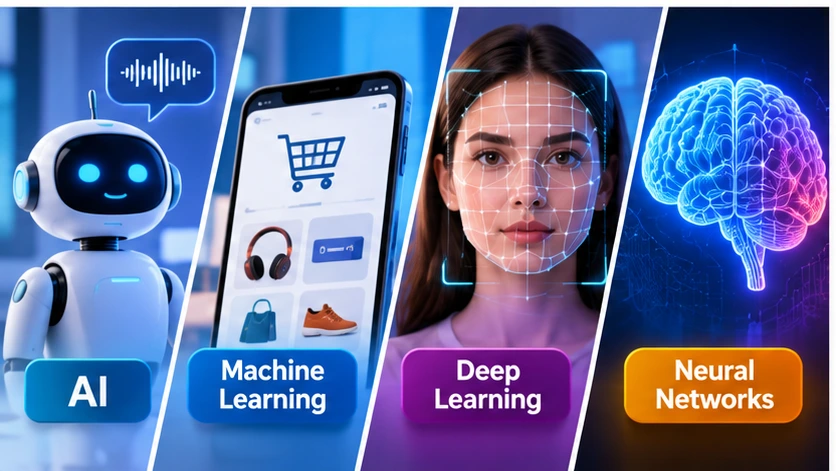
Machine learning is a subset of AI that focuses on prediction and optimization rather than broad human-like reasoning.
Traditional machine learning leans on human experts to define features and usually needs more structured data, while systems like Amazon’s recommendation engine learn from what people have looked at and bought before.
The article also makes room for three ML approaches that often get blurred together in casual conversation. And that blur is understandable, because the words are used so loosely online. But the learning style matters a lot.
Here’s the practical difference: classic rule-based AI follows instructions, while machine learning builds patterns from data. That means the system gets better by seeing examples instead of just obeying hand-written rules.
The three machine learning approaches named in the article
- Supervised learning — uses labeled examples like “pizza,” “burger,” and “taco” to help the model learn.
- Reinforcement learning — the system learns through rewards and penalties from its environment.
- Online learning — the model gets updated as new data becomes available.
Why labeled data is helpful but not always required
The article contrasts supervised learning with models that can work on unlabeled or raw data. That matters because machine learning becomes less dependent on hand-built feature rules as the data gets messier and bigger.
It also points out that more big data is pushing more data scientists toward machine learning in the first place. In real life, that shift makes sense. If you’ve got too much data for humans to sort by hand, letting the system learn patterns automatically starts to look a lot more appealing.
Why deep learning behaves differently from machine learning
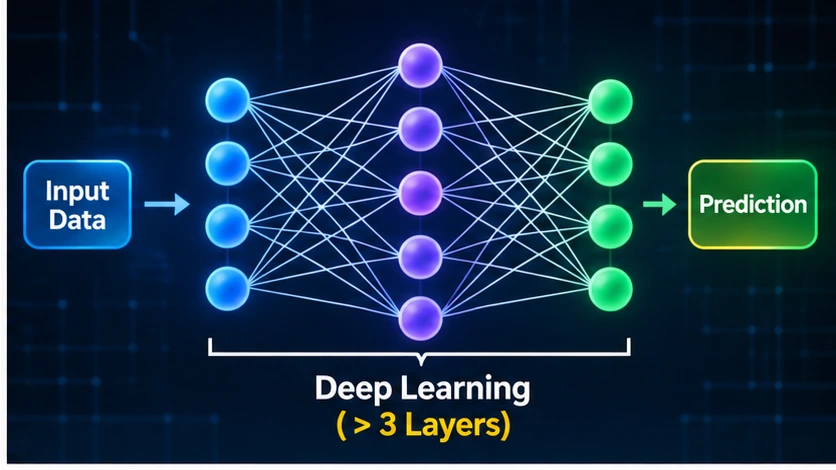
Deep learning is presented as a more scalable form of machine learning because it automates much of the feature extraction step.
That matters most when the data is unstructured: the article says over 80% of an organization’s data is estimated to be unstructured, which is exactly the kind of data deep learning handles well.
It also needs more data points to improve accuracy, which is why it tends to show up in more complex use cases. So even though deep learning is technically a type of machine learning, it behaves differently in practice. It’s less about hand-tuning features and more about letting the model discover them.
That’s why people often connect deep learning with bigger datasets and heavier computation. It’s doing more of the internal work on its own, which is powerful, but not always the easiest or cheapest path.
Where deep learning shows up in real systems
Deep learning is used for more complex tasks like virtual assistants and fraud detection. In the article’s own example, it can cluster images of pizzas, burgers, and tacos based on similarities in the data rather than hand-coded rules.
That image example is helpful because it shows the difference between “being told what to look for” and “figuring out the pattern from examples.” Deep learning is often stronger at the second one, especially when the data is messy or visual.
What a neural network is, and why it matters so much here
Neural networks are the backbone of deep learning and are also a subset of machine learning.
They’re made of an input layer, one or more hidden layers, and an output layer, with each node carrying a weight and threshold value that determines whether data keeps moving through the network.
The article makes the comparison easy to visualize by tying this to how neurons signal one another in the brain. It’s not a perfect one-to-one match, of course, but it gives you a decent mental model. Signals come in, get processed, and then move forward if the conditions are right.
If you’ve ever thought of a filter system, that’s not a bad analogy. Each layer can narrow, reshape, or strengthen the information before passing it along.
What the layers in a neural network do
| Layer or part | What it does | Detail from the article |
|---|---|---|
| Input layer | Receives the starting data | Part of the node-layer structure |
| Hidden layers | Process signals between input and output | One or more hidden layers are required |
| Output layer | Produces the final result | Included in the “more than three layers” definition |
| Weight and threshold | Control whether a node activates | If output clears the threshold, data moves forward |
Why neural networks are useful even outside deep learning
Training data improves accuracy over time, and the article notes that neural networks can classify and cluster data quickly. Speech and image recognition can happen in minutes instead of hours, and Google’s search algorithm is named as a well-known example.
That’s a good reminder that neural networks aren’t only valuable because of deep learning. Even when they’re not “deep,” they can still handle pattern recognition tasks in a way that feels fast and practical.
What makes deep learning different from neural networks in practice

The article’s short answer is that the “deep” part refers to layer depth in a neural network, while a plain neural network may not have enough layers to count as deep learning.
It also mentions feed-forward networks, where data moves from input to output, and backpropagation, where the model moves backward to calculate and assign error so it can be adjusted.
That distinction matters because it’s the point where the terminology stops being interchangeable. A neural network is the structure, but deep learning is the way that structure is used when it gets sufficiently layered and capable. So the difference is real, even if the two are closely related.
Look, this is where a lot of people get stuck. They hear “neural networks” and “deep learning” used in the same conversation and assume they’re identical. They’re not. One is the system, the other is the style of using it at a deeper level.
FAQ
These questions come from the smaller doubts people still have after they understand the hierarchy and the feature differences.
Q: Is machine learning the same as AI?
No. Machine learning is a subset of AI, while AI is the broader category that includes many other approaches.
Q: How many layers does a neural network need to count as deep learning?
More than three layers, including the input and output layers, is the threshold given in the article.
Q: What’s the difference between supervised learning and deep learning?
Supervised learning uses labeled data and explicit guidance, while deep learning can work with unstructured data and learns features more automatically.
Q: What are common examples of AI in business?
Customer service, supply chain management, cybersecurity, virtual assistants, and recommendation systems are all named or implied in the article.
Conclusion
If you’re trying to choose the right approach, start by treating AI as the umbrella, then deciding whether machine learning, deep learning, or neural networks actually fits the job.
The useful next question is not “which term sounds smartest,” but what kind of data you have, how much human feature design you can afford, and whether explainability matters more than scale.
That’s really the whole story. Once you separate the categories, the buzzwords stop feeling vague. And if you’re working on a real project, that clarity helps you make a better call instead of just using the trendiest label.