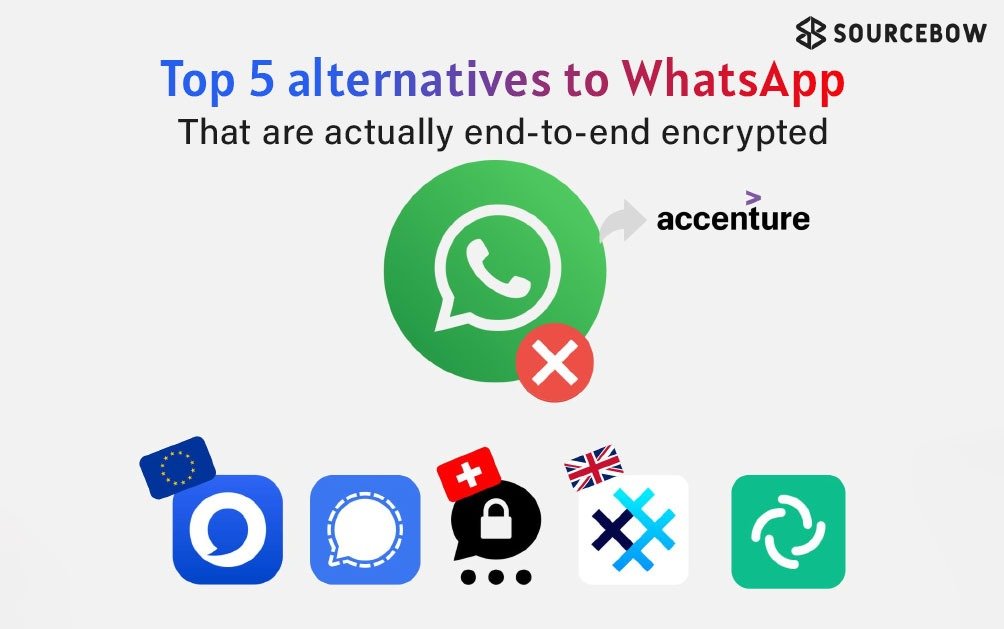
Top 5 WhatsApp Alternatives
WhatsApp says your chats are encrypted, and that’s true. But if you’ve ever wondered whether that actually means private, you’re asking the right question. Encryption protects the message itself, sure. It doesn’t always protect the surrounding stuff — who you talk to, when you talk, what device you use, or where your backups quietly live.
That’s where this gets interesting. A lot of people switch apps thinking they’re getting privacy, only to find out they’ve mostly changed the logo. The better WhatsApp alternatives on this list go further. They’re built with end-to-end encrypted messaging apps in mind from the start, and some of them cut out personal data entirely.
Quick Highlights
Now, before diving into the apps, it helps to clear up one thing: actually end-to-end encrypted doesn’t just mean messages are scrambled in transit. It means only the sender and receiver can read them. But there’s a catch many people miss. Some apps make encryption optional, not default. Others protect message content while still collecting metadata — basically, the digital breadcrumbs around your conversations. That difference is huge if you care about privacy.
And yes, trust matters here. Open-source code, independent audits, and a history of resisting data collection go a long way. So, let’s look at the five apps that stand out for people who want more than the usual privacy marketing.
What “actually end-to-end encrypted” really means
Here’s the simplest version: end-to-end encryption means a message is locked on your device and only unlocked on the other person’s device. Not even the app provider should be able to read it in the middle. That’s the basic idea. But the real world is messier.
For one thing, there’s a difference between default encryption and optional encryption. If an app only encrypts certain chats after you turn the feature on, that’s not the same thing as a system where every conversation is protected by default. Another big difference is between message content and metadata. Even if nobody can read your message, the app may still know who messaged whom, when, how often, and from where. For many users, that’s enough information to paint a pretty detailed picture.
That’s why privacy-focused apps usually earn trust in a few ways. They keep the code open so experts can inspect it. They submit to independent audits. And they avoid collecting more personal information than they need. If an app asks for less, it usually has less to leak. So there are the five whatsapp alternative we should talk about that.
1. Olvid keeps your identity out of the picture
If you want the most identity-light option on this list, Olvid is the one that feels the most different right away. No phone number. No email. No awkward linking of your real-life identity to a chat app account. Instead, it uses cryptographic identity, which is a fancy way of saying your secure identity is built into the system without needing personal details.
That sounds small until you think about what it means in everyday use. With many apps, privacy ends at encryption. With Olvid, privacy starts earlier, at the registration step. There’s less data to hand over, less data to store, and less data to expose later. It’s a very clean approach, and honestly, that’s a big part of its appeal.
Olvid is fully end-to-end encrypted by design, which means it isn’t trying to bolt privacy onto an existing social network style product. It was built with privacy first. That makes it especially useful if you want secure conversations without linking them to your phone number or email address.
Best for: people who want real privacy without tying chats to a personal identity.
Edge over WhatsApp: no personal data dependency at the start.
2. Signal is still the benchmark for everyday secure chat
There’s a reason Signal comes up in almost every serious privacy discussion. It’s open source, widely respected, and designed to collect as little metadata as possible. For most people, it hits the sweet spot between strong security and actual day-to-day usability. You don’t need to be especially technical to use it, which helps a lot.
Signal offers end-to-end encryption for chats, calls, and backups. That’s important, because backups are one of those hidden weak spots many people forget about. If the app protects your live conversation but leaves your stored data exposed somewhere else, the whole privacy story gets shakier. Signal does a better job here than most mainstream messengers.
It still asks for a phone number, so it’s not the most anonymous option. But compared with many secure messaging apps, it keeps the design lean and the tracking light. For a lot of people, that’s enough. You get a familiar messaging experience without a lot of the weird data baggage.
Best for: everyday secure messaging without a steep learning curve.
Edge: trusted encryption protocol and very low metadata collection.
3. Threema offers anonymity without feeling fragile
Threema has a different personality. It’s not trying to be trendy or bloated. It’s just trying to be private and dependable. One of the biggest draws is that you don’t need a phone number to use it, which immediately lowers the amount of identity data tied to your account. That alone makes it stand out among private chat apps.
It’s also based in Switzerland, and that matters more than people think. Swiss privacy laws are strong, and the company’s location adds another layer of confidence for users who care about legal as well as technical safeguards. Combine that with the fact that Threema is a one-time paid app with no ads and no tracking, and you get a pretty straightforward privacy model.
This isn’t an app built to harvest usage patterns or nudge you into endless engagement loops. It feels calmer than that. And in a world where “free” often just means “you are the product,” a paid privacy tool can be surprisingly reassuring.
Best for: anonymous communication with a sense of stability.
Edge over WhatsApp: the legal and technical privacy combo is stronger.
4. XX Messenger looks ahead instead of just catching up
If you’ve never heard of XX Messenger, you’re not alone. It’s one of those names that doesn’t show up in every casual comparison, which is exactly why it deserves attention here. Built on xx network, it’s focused on metadata protection and quantum-resistant encryption. That second part sounds futuristic because it is.
Quantum-resistant encryption is about preparing for a world where today’s encryption methods may be under threat from future computing power. That doesn’t mean your current chats are about to be cracked tomorrow. It does mean this app is designed with a long view, which is pretty rare in consumer messaging. For users thinking years ahead, that’s a real differentiator.
The decentralized infrastructure also matters. Instead of one central system holding everything together, the design spreads trust around more carefully. That makes it harder to create a single point of failure. If you care about long-term privacy, or you just like the idea of technology that isn’t stuck in yesterday’s assumptions, XX Messenger is worth a look.
Best for: advanced users and long-term privacy concerns.
Edge: built for future threats, not just current ones.
5. Element gives you decentralization without locking you in
Element is a strong choice if you want flexibility and control. It’s based on the Matrix protocol, which means it sits inside a decentralized system rather than relying on a single company-controlled backbone. That’s a meaningful difference from WhatsApp, where one central platform still sits in the middle of everything.
Element supports end-to-end encryption, but the setup depends a little more on how it’s used, which is why it can be slightly less beginner-friendly than Signal. Still, for teams, communities, and tech-savvy users, it’s powerful. Organizations and even governments use Matrix-based tools because they like the mix of control, interoperability, and privacy.
The decentralized angle is what really makes Element compelling. You’re not depending on one central operator to decide how the system behaves forever. That kind of structure can feel a little abstract at first, but it becomes very practical when you care about sovereignty over your communications.
Best for: teams and users who like decentralized systems.
Edge over WhatsApp: no central control in the same way.
A quick comparison before you decide
If you’re scanning this and trying to make a fast call, here’s the short version. Different apps win for different reasons. Some are better for anonymity. Some are better for ease. Some are built for future threats. And one or two are simply more honest about privacy than the big mainstream options.
| App | E2EE Default | Phone Required | Open Source | Unique Advantage |
|---|---|---|---|---|
| Olvid | Yes | No | Partial | No identity needed |
| Signal | Yes | Yes | Yes | Trusted standard |
| Threema | Yes | No | Partial | Swiss privacy laws |
| XX Messenger | Yes | No | Yes | Quantum-resistant |
| Element | Optional | No | Yes | Decentralized |
That table makes one thing pretty clear: there isn’t a single winner for everyone. The best choice depends on what you care about most. If anonymity matters more than anything, Olvid and Threema rise to the top. If you want a safe, familiar daily messenger, Signal is still the easy answer. If you’re looking at privacy from a long-term security angle, XX Messenger is the interesting one. And if you want control without central dependency, Element has real appeal.
Which app should you actually choose?
This part is less about specs and more about how you live. Privacy tools only work if you can stick with them, so the “best” app is usually the one that fits your habits without forcing too much friction.
- Want maximum anonymity? Go with Olvid or Threema.
- Want balanced privacy and usability? Signal is the safest bet.
- Want future-proof security? XX Messenger is the smartest niche pick.
- Want decentralized control? Element gives you that flexibility.
If you’re switching from WhatsApp because you’re tired of feeling watched, Signal is often the easiest first move. If your bigger concern is not being linked to a phone number at all, Olvid and Threema are more compelling. And if you’re choosing for a group, workspace, or community, Element may fit the actual use case better than a simple personal chat app.
Common myths that sound right but aren’t
There’s a lot of confusion around messaging privacy, and honestly, most of it comes from assuming encryption solves everything. It doesn’t.
“All messaging apps are equally encrypted” — not even close. Some are encrypted by default, some only in certain modes, and some protect less than they claim.
“Encryption means complete privacy” — also false. Metadata can still reveal a surprising amount about your habits and relationships.
“WhatsApp backups are always secure” — that’s a risky assumption. Backups can create weak spots if they’re not handled carefully.
So when people ask about secure messaging apps, the real question isn’t just “Is it encrypted?” It’s “What else is being collected, stored, or linked to me?” That’s the part many users never see, but it’s often the part that matters most.
So, is WhatsApp still enough?
WhatsApp does still use end-to-end encryption for messages, and that’s worth acknowledging. But it’s not the most privacy-focused option anymore, especially if you care about identity, metadata, and data ownership. That’s the real shift here.
These private chat apps aren’t just more secretive. They give you more control over what you share in the first place. Some hide your identity better. Some keep metadata to a minimum. Some are designed with no central control at all. And one of them is already thinking about security problems that haven’t fully arrived yet.
That’s why this topic matters beyond just app choice. Privacy isn’t about switching apps and calling it a day. It’s about understanding what you’re giving away every time you hit send, log in, or back up a conversation. If that changes how you think about your messaging app, then this list did its job.
FAQ
Is WhatsApp still end-to-end encrypted?
Yes, WhatsApp still uses end-to-end encryption for messages and calls. The bigger concern is what happens around the messages, including metadata and backups.
Which app is safest for private messaging?
For most people, Signal is the safest balance of privacy and usability. If anonymity matters more, Olvid and Threema are stronger picks.
Do encrypted apps track metadata?
Some do, some try not to. Metadata is often the overlooked part of privacy, and it can still reveal who you talk to and when.
What is the most anonymous messaging app?
Olvid and Threema are among the strongest choices if you want to avoid linking a phone number or email to your account.
If you’re thinking about changing apps, maybe start with the question that really matters: do you want just encryption, or do you want actual privacy? That small difference changes everything.