Introduction
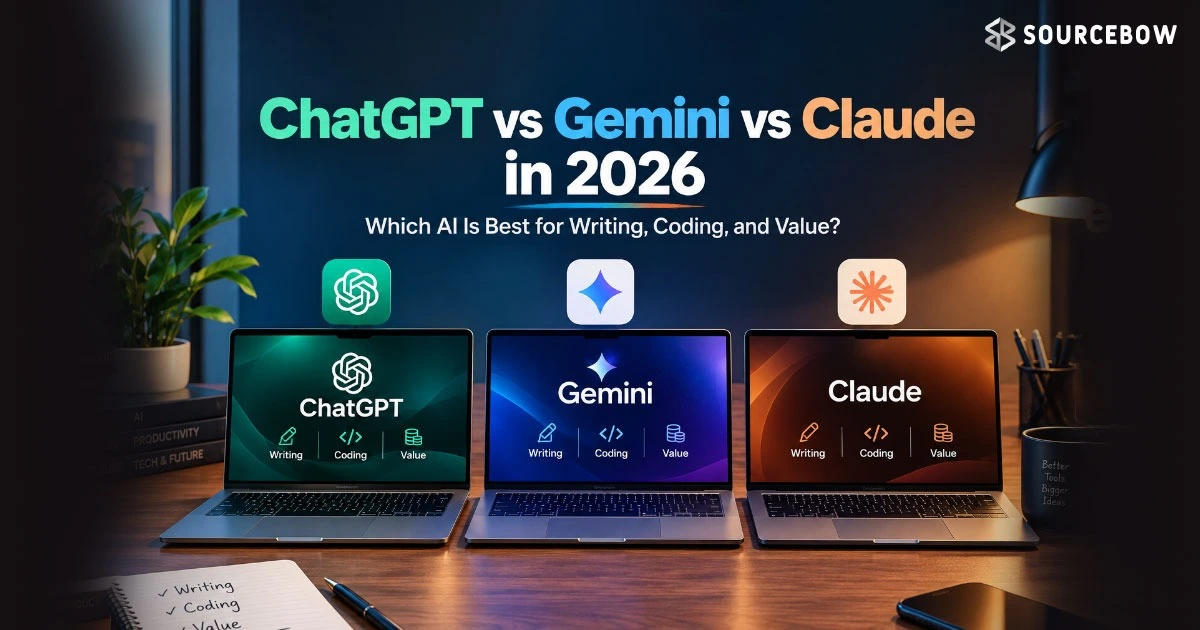
ChatGPT vs Gemini vs Claude is not a three-way tie on paper, especially once you compare writing, coding, research, and pricing side by side.
The useful question is not which one is “best” in the abstract, but which one wins for your job, your workflow, and your budget.
Quick Highlights
- Claude tends to write the cleanest first draft.
- GPT-5.5 still leads on hard reasoning.
- Gemini is strongest for value and multimodal work.
- ChatGPT is the safest all-round default.
That’s really the heart of it. A lot of people ask this question like there has to be one clean champion, but these tools are designed with different strengths in mind. So if you’ve been bouncing between them and feeling a little frustrated, that makes sense. The “best” answer changes depending on whether you’re drafting a blog post, debugging code, digging through sources, or just trying not to overspend every month.
Who built each one, and why that matters for the comparison
These assistants come from three very different companies, and that shows up in the way they’re positioned.
ChatGPT is made by OpenAI, Gemini by Google DeepMind, and Claude by Anthropic, with Microsoft a major investor in OpenAI, Amazon the largest investor in Anthropic, and Google also invested in Anthropic but without control.
The ownership piece matters because the products are tied to different ecosystems: ChatGPT sits beside Microsoft Copilot, Gemini is wrapped around Google Search and Workspace, and Claude has leaned hard into safety and independence.
The companies behind the Big 3, in plain terms
OpenAI became a public benefit corporation, OpenAI Group PBC, after a 2025 restructuring, and Microsoft holds roughly a 27% stake following the October 2025 reorganisation.
Gemini is both Google’s consumer app and its family of multimodal models, while Claude comes from Anthropic, founded in 2021 by former OpenAI staff including Dario and Daniela Amodei.
That background isn’t just trivia. It helps explain why one assistant feels deeply tied to search and documents, why another is built into productivity tools, and why Claude often feels a little more restrained and deliberate. You might not care about the corporate map every day, but once you use these tools regularly, the ecosystem around them starts to matter quite a bit.
Which models are current in mid-2026
The model names moved fast enough that the version number matters here, not just the brand name.
OpenAI’s current flagships are GPT-5.5 Instant and GPT-5.5 / GPT-5.5 Pro, Google’s are Gemini 3.5 Flash and Gemini 3.1 Pro, and Anthropic’s are Claude Haiku 4.5, Sonnet 4.6, and Claude Opus 4.8.

Those releases landed across spring 2026: GPT-5.5 in April 2026, Gemini 3.1 Pro in February 2026, and Claude Opus 4.8 on 28 May 2026.
The exact model versions and release dates
| Provider | Everyday model | Flagship model | Release date |
|---|---|---|---|
| OpenAI / ChatGPT | GPT-5.5 Instant | GPT-5.5 / GPT-5.5 Pro | GPT-5.5 in April 2026; default on 5 May 2026 |
| Google / Gemini | Gemini 3.5 Flash | Gemini 3.1 Pro | Gemini 3.1 Pro in February 2026 |
| Anthropic / Claude | Claude Haiku 4.5 / Sonnet 4.6 | Claude Opus 4.8 | Opus 4.8 on 28 May 2026 |
It’s worth paying attention to the version names, because these products do not sit still for long. A lot of older comparisons online are already stale, and that can lead you to choose based on a model that isn’t really the one people are using now. In practice, mid-2026 is a much more interesting year for this question because all three have matured in different directions.
Where each one actually wins: reasoning, writing, coding, research, and multimodal work
The real comparison only makes sense once you stop treating “AI chatbot” as one category and split it into actual tasks.
GPT-5.5 has the edge on hard reasoning and maths benchmarks like FrontierMath and ARC-AGI-2, Claude is the cleanest writer and the stronger agentic coder, and Gemini is the most complete for images, audio, long video, and live-web research.
That is why the answer keeps changing depending on whether the reader wants prose, code, citations, or a model that can digest screenshots and video in one pass.
Reasoning and maths: where GPT-5.5 still edges ahead
On frontier reasoning, GPT-5.5 leads, with Gemini 3.1 Pro and Claude Opus 4.8 close behind.
The article notes that GPT-5.5 Pro pushes those scores even higher, but also that everyday multi-step logic is good enough across all three that the differences often shrink in normal use.
OpenAI, Google, and Anthropic all offer extended-thinking modes: reasoning models, Deep Think, and extended thinking respectively.
In plain English, this means all three can pause and work through a problem instead of blurting out the first answer that comes to mind. But if the task gets very technical, like a nasty logic puzzle or a difficult chain of math steps, GPT-5.5 is the one that feels most likely to stay steady under pressure. That said, for most people, the practical difference is smaller than the benchmark headlines suggest.
Writing: why Claude gets the cleanest first draft
Claude is the one people praise when they care about tone consistency, coherence, and fewer edits on the first pass.
ChatGPT is more versatile across formats like marketing copy, emails, and scripts, while Gemini has improved enough to compete when the draft needs live-web facts.
The practical split is simple: Claude for polished prose, ChatGPT for flexibility, Gemini when the source material matters.
This is where a lot of writers quietly land after testing all three. Claude often sounds like it has already understood the shape of the piece, which saves time later. ChatGPT can absolutely write well, but it tends to feel more like a flexible generalist. Gemini, meanwhile, is especially handy when your draft depends on recent info and you don’t want to switch tabs just to verify a detail.
Coding: why the decision splits between Claude, GPT-5.5, and Gemini
Claude Opus 4.8 is built for long agentic coding and is cited at around 88.6% on SWE-bench Verified.
ChatGPT is strong for one-shot coding and has mature Codex tooling, while Gemini is the one to reach for when the job involves huge codebases, design files, or screenshots.
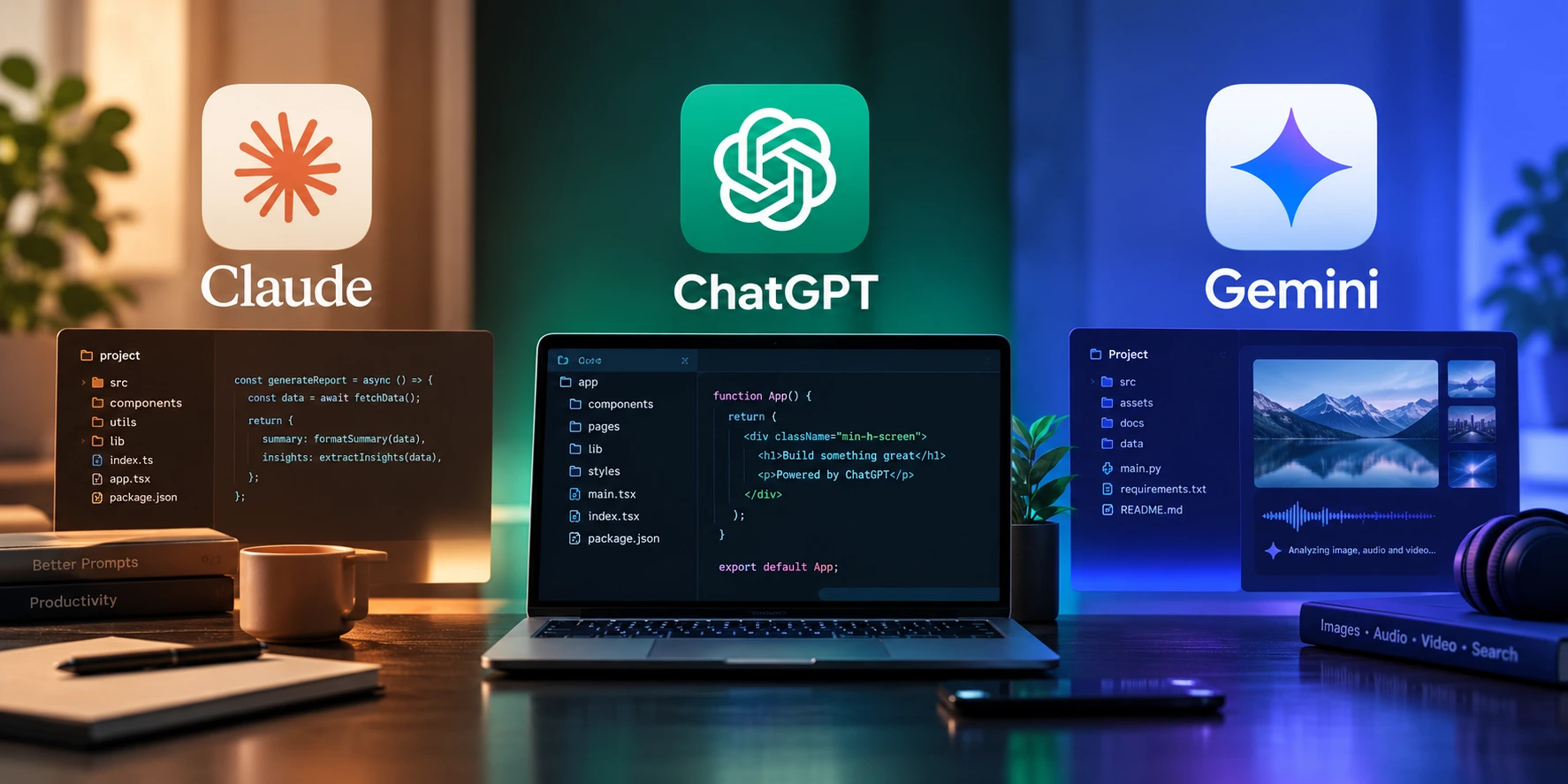
Anthropic’s Claude Code and Google’s Jules are both part of the paid-tier story here.
If you code casually, ChatGPT may feel like the easiest place to start because it’s fast, broad, and good at explaining what it’s doing. If you’re doing longer, more structured coding work, Claude starts to pull ahead because it stays focused and handles multi-step edits with less friction. Gemini is the sleeper pick when your project is messy in a visual way, since it can work across screenshots, layouts, and other file types more naturally than people expect.
Research, citations, and the live web
Gemini and ChatGPT are the stronger picks when the work depends on current sources.
Gemini uses Google Search and powers AI Overviews, while ChatGPT offers browsing plus Deep Research for long cited reports; Claude is careful and can search, but it tends to be more conservative.
That makes Gemini the obvious Google-native choice and ChatGPT the more polished standalone research tool.
Here’s the thing: “research” can mean very different things. If you need broad web grounding and quick access to current search results, Gemini fits naturally. If you want something that feels more like a guided report-builder, ChatGPT has the edge. Claude can still help, but it often behaves like the careful person in the room who double-checks everything before speaking, which is useful, just not always the fastest route.
Images, audio, and video
Gemini is the broadest multimodal assistant because it handles text, images, audio, and long video in a single context window.
ChatGPT still wins on native image-generation polish and has Advanced Voice mode, while Claude reads documents, charts, tables, and PDFs well but does not generate images.
Gemini’s Nano Banana image model is part of why it feels more complete across media types.
This is one of those areas where the gap feels obvious once you actually use the tools. If you’re working with a photo, an audio clip, a spreadsheet screenshot, and a video transcript all in one workflow, Gemini is just built for that kind of mess. ChatGPT is excellent when the visual part of the task is about creating something polished. Claude is more of a reader and reasoner than a media studio, and that’s not a flaw so much as a design choice.
What the pricing and free tiers look like in mid-2026
Price is where the comparison gets a lot less abstract, because the gaps are real and visible.
All three have usable free tiers and paid plans that start around $20 per month, but Gemini is the cheapest at the entry level with AI Plus at $4.99, while ChatGPT Plus is $20 and Claude Pro is $20 or $17 annually.
The higher tiers climb quickly too: ChatGPT Pro is $200, Gemini AI Ultra is $99.99, and Claude Max goes to $100 and $200.
The consumer pricing ladder, side by side
| Plan | ChatGPT | Gemini | Claude |
|---|---|---|---|
| Free | $0, GPT-5.5 with limits | $0, Gemini 3.5 Flash plus daily Pro | $0, Sonnet with limits |
| Entry paid | Go | AI Plus, $4.99/mo | Pro, $20/mo ($17 annual) |
| Mid paid | Plus, $20/mo | AI Pro, $19.99/mo | Max 5x, $100/mo |
| Top consumer | Pro, $200/mo | AI Ultra, $99.99/mo | Max 20x, $200/mo |
Free tiers are useful but capped: ChatGPT gives limited GPT-5.5 access before a lighter model, Gemini gives Flash plus a daily Pro allowance, and Claude runs on Sonnet with five-hourly limits.
That is why Gemini looks strongest on value, especially if you also care about Google storage and Workspace bundling.
For a lot of people, this is where the decision gets made. Not on raw performance alone, but on whether the tool feels generous enough to use without constantly watching the meter. Gemini’s low-cost entry point is hard to ignore. ChatGPT’s mid-tier is more familiar and widely useful. Claude’s pricing makes sense if writing or coding quality is where you get your return.
Which AI is best for each job?
Once you break the market into tasks, the shortlist gets much easier to read.
ChatGPT is the best all-rounder, Claude is best for writing and serious coding, Gemini is best for value and multimodal work, and GPT-5.5 has the edge when the question is genuinely hard reasoning or maths.
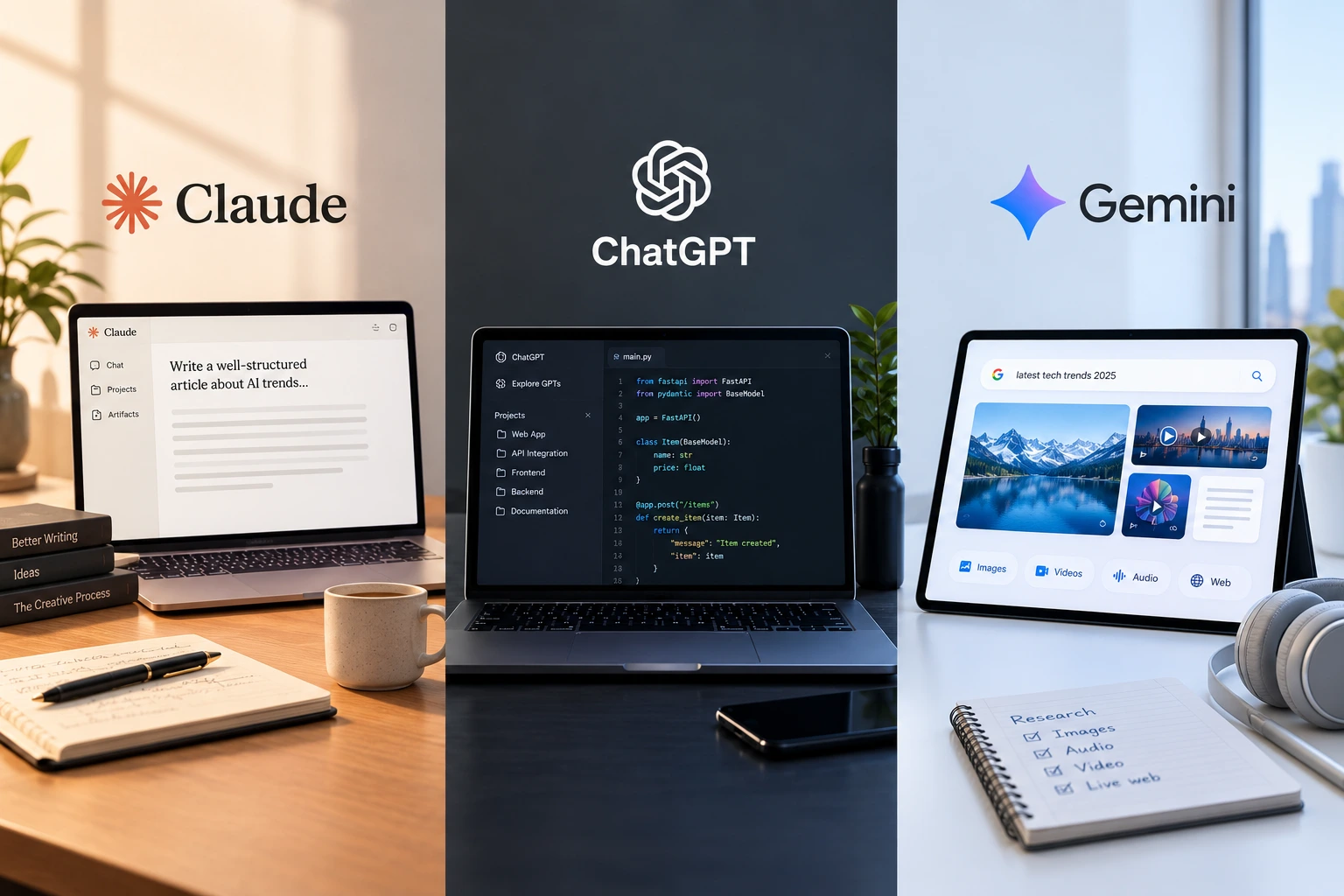
For research with sources, Gemini and ChatGPT are the two that matter most; for day-to-day flexibility, ChatGPT stays the safest default.
- Best all-rounder: ChatGPT
- Best for writing: Claude
- Best for coding: Claude Opus 4.8 or GPT-5.5
- Best for research with sources: Gemini for live web grounding, ChatGPT for polished cited reports
- Best for maths and hard reasoning: GPT-5.5 at the frontier
- Best for video, audio, and multimodal: Gemini
- Best value: Gemini, especially the free tier and $4.99 AI Plus plan
If you want the shortest possible answer, that list is it. But the more useful takeaway is that no one tool dominates every use case. A lot of experienced users end up using two of them, sometimes even all three, because the overlap is big enough to be convenient but the differences are still real enough to matter. That’s normal, not indecisive.
FAQ
These questions come from the second-order doubts readers usually have after they know the broad winner.
Q: Which AI model is best in 2026?
There is no single best model overall. ChatGPT is the strongest default, Claude is better for writing and agentic coding, and Gemini gives the best value and multimodal range.
Q: Is Claude AI free, and are ChatGPT and Gemini free too?
Yes. All three have free tiers, though the caps are real and heavy users will outgrow them quickly.
Q: What is the difference between Claude vs ChatGPT and Gemini vs ChatGPT?
Claude vs ChatGPT is mainly about writing quality and coding depth versus versatility. Gemini vs ChatGPT is more about value, web grounding, and Google ecosystem integration.
Q: What is Claude Opus 4.8 best at?
Claude Opus 4.8 is strongest for long agentic coding and careful writing, which is why developers and editors keep putting it near the top of their lists.
Conclusion
The clean answer is that ChatGPT, Gemini, and Claude are all excellent in 2026, but they are excellent in different ways.
If you want one dependable default, choose ChatGPT; if you want value and multimodal breadth, choose Gemini; if you care most about writing and serious coding, choose Claude.
So the real question is not which model wins forever. It’s which one fits the work you actually do today. And once you frame it that way, the choice gets a lot easier.