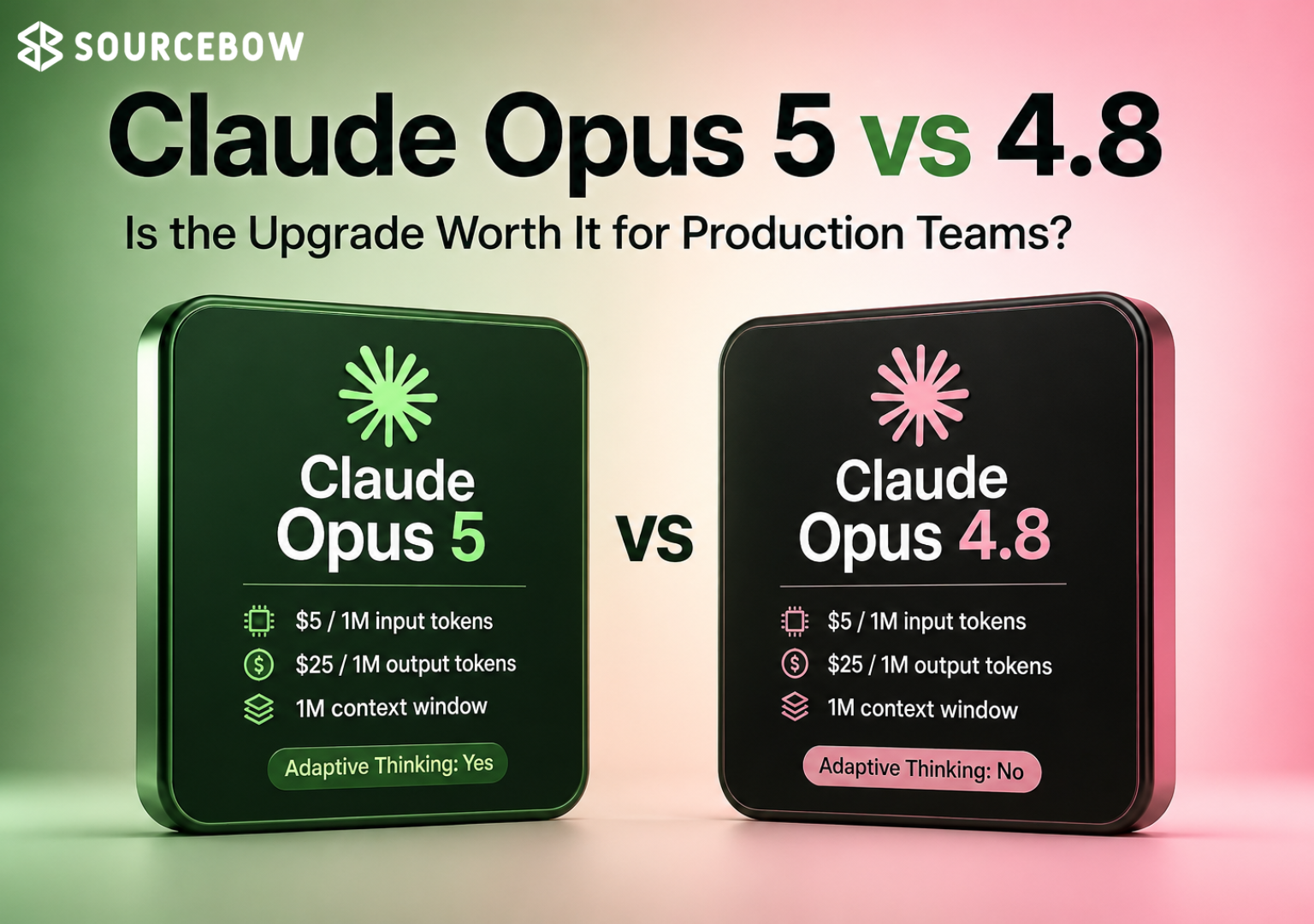
Same $5/$25 pricing, 1M context, and a model that’s stronger on reasoning and agents — so the real question isn’t cost, it’s whether the migration work actually earns its keep.
If you’re already running Claude Opus in production, this is probably the part that matters most. You don’t usually want a new model just because it’s newer. You want it because it helps the team ship cleaner code, handle messier tasks, and waste less time on weird edge cases. That’s the tension here with Claude Opus 5 vs Opus 4.8.
Quick Highlights
- Same pricing, same 1M context window
- Opus 5 is stronger on reasoning and agents
- Best gains show up in hard coding workflows
- Safe migration usually means testing first, not rushing
Introduction
Claude Opus 5 keeps the same $5 per million input tokens and $25 per million output tokens pricing, plus the same 1M-token context window. That’s important, because it removes the usual excuse for staying put. You’re not paying more just to try the newer model.
So the Claude Opus 5 vs opus 4.8 is less about cost and more about whether the new model is worth the switch in real workflows. And honestly, that’s the right way to think about it. If your system is already stable, a new model has to prove it can do something meaningful — not just look better on a benchmark slide.
What makes this comparison interesting is how narrow it is. This isn’t one of those upgrades where everything changes at once. The shape of the product is basically the same. But under the hood, the behavior is better in ways that can matter a lot once your use case gets serious.
What actually changed between Opus 4.8 and Opus 5
Opus 5 is better on three things that matter in practice: reasoning depth, agent reliability, and adaptive thinking. That last one is a big deal. It means the model can scale its reasoning effort up or down depending on the task, while Opus 4.8 does not have adaptive thinking at all.
Here’s the thing: that doesn’t always sound dramatic until you run a messy workload through it. Then it becomes obvious. Some tasks need a quick answer. Others need the model to slow down, hold more context in mind, and avoid cutting corners. Opus 5 is built to be more flexible there.
The price stays the same at $5 input / $25 output per million tokens, and the 1M-token context window stays unchanged. So the upgrade is less about getting a new category of model and more about getting more capability at the same token rate. That’s a subtle difference, but for production teams, it’s often the only kind that matters.
Difference Between Claude Opus 5 vs Opus 4.8
The comparison is simple enough to show directly, because the meaningful differences are narrow and concrete. The table below is really the whole story at a glance, at least for the parts people care about before they start testing in production.
| Dimension | Claude Opus 5 | Claude Opus 4.8 |
|---|---|---|
| Input price per million tokens | $5 | $5 |
| Output price per million tokens | $25 | $25 |
| Context window | 1M tokens | 1M tokens |
| Adaptive thinking | Yes | No |
| Model ID | claude-opus-5 | claude-opus-4-8 |
| Where it runs | Anthropic API, Claude Code, Enterprise | Anthropic API, Claude Code, Enterprise |
That’s why a lot of teams won’t feel the upgrade in a dramatic way on day one. The surface area of change is small. But if your workload depends on the model staying disciplined over long, complicated steps, that one difference in thinking behavior can matter more than a dozen minor tweaks.
When Opus 5 is the better choice for coding and agent workflows
Opus 4.8 is still fine for routine coding, but Opus 5 pulls ahead when the work gets messy, multi-step, or long-running. That’s the type of work where good-enough starts to fall apart. A model can look strong on a simple coding prompt and still struggle when you ask it to juggle several files, dependencies, or constraints at once.
That shows up in multi-file refactors, tricky debugging, and long agentic coding sessions — the kind of work where the model has to keep track of a lot of state without drifting. If you’ve ever watched an agent confidently wander off after doing three correct steps, you already know why this matters.
For everyday bug fixes and simple code generation, the gap is small. For hard engineering work, it is not. And that’s the core of the decision. If your production use case is mostly straightforward, Opus 4.8 may still feel perfectly adequate. But if your team is pushing more ambitious workflows, Opus 5 gives you more headroom.
Where the coding upgrade is noticeable
Opus 4.8 is already strong enough for most general-purpose coding, which is why teams using Claude Code often have no complaints. It handles common tasks well and can be very productive for day-to-day work. But once the task becomes more layered, Opus 5 starts to feel less brittle.
- Strong general-purpose coding in Opus 4.8
- Better performance in multi-file refactors with Opus 5
- Improved tricky debugging on hard tasks
- Deeper reasoning in long agentic coding sessions
- Similar results for simple code generation and basic bug fixes
That list is really the pattern to watch. Opus 5 doesn’t exist to make simple things slightly simpler. It exists to make difficult things more dependable. And in production, dependability is often the whole game.
Where agents stop being a nice demo and start becoming expensive
Opus 5 matters most when an unattended agent has to stay coherent over 20 or more steps. This is where a lot of teams start to feel the pain of small model mistakes. One wrong assumption early on can echo through the rest of the workflow.
Opus 4.8 handles shorter loops well, but it is more likely to lose track of earlier context or accumulate errors in extended workflows. Because the token cost is the same, the real win is fewer failures, not lower spend. That’s a useful way to think about it: you’re buying consistency, not savings.
- Opus 5: better coherence on 20+ step agent workflows
- Opus 4.8: reliable on shorter, well-defined agent loops
- Unattended agents benefit most from the upgrade
- Same token cost on both models
If your agent mostly does one narrow task and returns, you might not see much difference. But if it has to inspect, decide, revise, and continue across a long chain of actions, Opus 5 is the safer bet. That’s where the extra reasoning support starts paying for itself in fewer retries and less babysitting.
When Opus 4.8 still makes sense
There are still sane reasons to stay on Opus 4.8, especially if the current setup is already stable. Not every production system needs the newest thing. Sometimes the best move is the boring one, because boring systems are the ones that keep working on Monday morning.
Teams with production pipelines that are working well, prompts tuned tightly to Opus 4.8 behavior, or low-complexity workloads may not need the extra migration risk yet. If your system is delivering reliable outputs and no one is complaining, there’s nothing wrong with letting it keep doing its job.
The upgrade is attractive, but it is not automatic if your system is already behaving the way you need it to. In other words, better on paper doesn’t always mean better in your environment.
The situations that argue for staying put
Some teams care more about avoiding output drift than about chasing a better model on paper. That’s not hesitation. It’s just a realistic priority when production outputs have to stay consistent.
- Stable production pipelines with no quality complaints
- Tightly optimized prompts that depend on specific Opus 4.8 behaviors
- Teams without bandwidth for migration testing right now
- Low-complexity workloads where the reasoning upgrade adds little value
If that sounds like your setup, it’s okay to wait. Migration only becomes urgent when the current model starts to create friction, or when the new one clearly solves a problem you already feel.
How to upgrade safely without breaking production
The safest path is a staged migration, not a hard switch. That’s true for a lot of model changes, but it matters especially here because the models are close enough that teams can get overconfident. Close is not the same as identical.
Swap the model ID from claude-opus-4-8 to claude-opus-5, then test before sending production traffic. Run both models against the same prompts, compare tone and formatting, and clear prompt caches because cached prompts are model-specific. That last part is easy to forget, and it can create confusing results if you don’t handle it early.
A shadow deployment, edge-case testing, and gradual rollout reduce the odds of finding out too late that the new model behaves differently. This is the unglamorous part of upgrade planning, but it’s also the part that saves teams from avoidable headaches.
The rollout sequence that avoids surprises
A controlled switch costs a bit more during testing, but it prevents a bad production surprise. That trade-off is usually worth it. You want to discover quirks while you can still do something about them.
- Shadow deploy: send requests to both models and compare outputs
- Test edge cases first: unusual inputs, long conversations, complex instructions
- Roll out gradually: 10% of traffic, then 50%, then 100%
- Monitor for quality issues, error rates, and user feedback at each stage
- Expect the staged rollout to take two to three weeks
- Rebuild prompt caches after migration
That sequence is pretty practical. It doesn’t ask for perfection, just discipline. And if you’re supporting a production team, that’s usually enough. You’re not trying to make the migration elegant. You’re trying to make it safe.
FAQ
These are the smaller doubts people usually have once they already understand the price, the model swap, and the rollout risk.
Q: Is Claude Opus 5 more expensive than Opus 4.8?
No. Both models cost $5 per million input tokens and $25 per million output tokens, so there is no pricing penalty for switching.
Q: Do I need to change my API code to use Opus 5?
Usually just the model ID. The request and response formats are compatible, so the main swap is claude-opus-4-8 to claude-opus-5.
Q: Will my prompts work the same on Opus 5?
Not always. Outputs can shift, especially on edge cases, long conversations, and complex instructions, which is why prompt testing matters.
Q: Is Claude Opus 4.8 being deprecated?
The raw material does not say that it is. It is described as stable and still useful, especially for production pipelines that already work well.
Conclusion
For most teams, Opus 5 is the stronger model at the same price, and that makes the upgrade a good bet. The biggest gains show up where production teams actually feel pain: multi-step coding, unreliable agent behavior, and workflows that need deeper reasoning without getting sloppy.
But if your Opus 4.8 setup is stable, well-tested, and not especially complex, there is no urgency — migrate on purpose, test the hard cases, and keep 4.8 around until the switch is boring. That’s probably the healthiest way to think about it. Don’t upgrade because the label changed. Upgrade because the new behavior earns its place.
So if you’re weighing Claude Opus 5 vs 4.8 right now, the answer is pretty simple: take Opus 5 if you want more capability at the same price, and stay with 4.8 if stability matters more than novelty. Either way, make the decision based on real workflows, not just model headlines.