Google Updates MedGemma 1.5: Now It Can Read CT Scans, MRI Images, and Lab Reports
Artificial intelligence in healthcare has been moving forward in small, careful steps for years. Every new system promises speed, accuracy, or efficiency, but very few feel ready to handle the complexity of real medical data. That is why Google’s latest update to MedGemma 1.5 is getting attention.
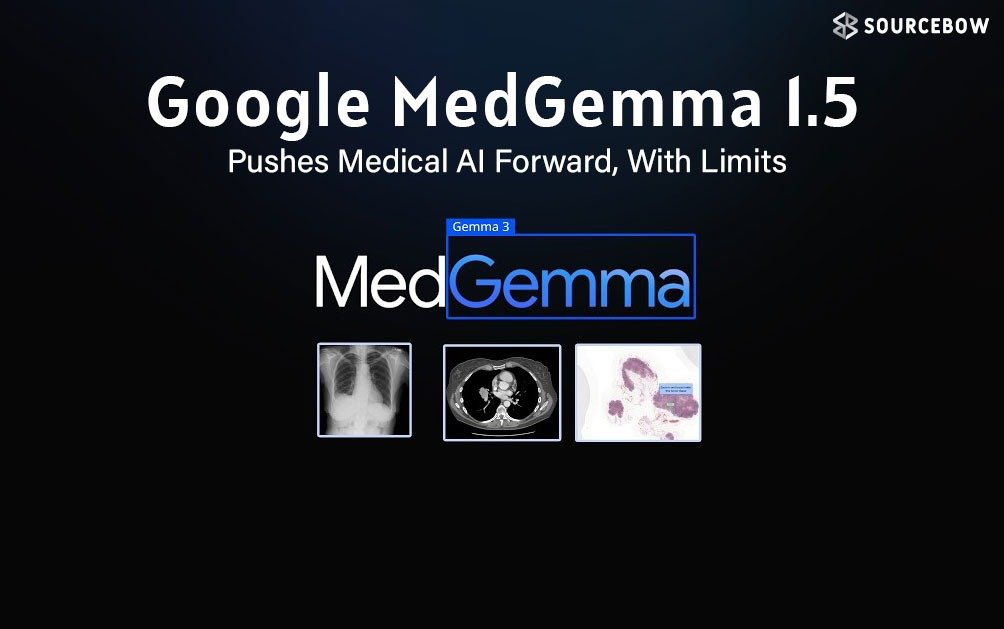
Google has officially upgraded MedGemma to version 1.5, expanding what the model can understand and analyze. Earlier versions focused mainly on medical text and limited imaging tasks. MedGemma 1.5 goes much further. It can now read and reason over CT scans, MRI images, and structured lab reports, all within a single AI system.
This update is not about flashy demos or replacing doctors. It is about building a foundation model that understands medical information the way clinicians see it in real life. Medical decisions rarely rely on one source of data. Doctors look at images, lab values, patient history, and written notes together. MedGemma 1.5 is designed to do the same.
Let’s break down what MedGemma 1.5 is, what exactly has changed, how it works, and why this update matters for the future of healthcare AI.
What Is MedGemma?
MedGemma is part of Google’s Gemma family of open and open-weight AI models. While many healthcare AI systems are closed and proprietary, MedGemma is designed to be more accessible to researchers, developers, and healthcare organizations.
The goal behind MedGemma is simple in theory but difficult in practice. Create a general-purpose medical AI model that understands clinical language, medical images, and structured data, while being safe enough for research and controlled clinical use.
Earlier versions of MedGemma focused mostly on medical text. That included clinical notes, discharge summaries, research papers, and basic medical question answering. Some image understanding was present, but it was limited.
MedGemma 1.5 marks a clear shift. This is no longer just a medical language model. It is becoming a true multimodal medical AI.
What’s New in MedGemma 1.5?
The most prominent shift in MedGemma 1.5 is its tolerance level for medical data types that it can process at one time.
Here are the top three upgrades:
CT Scan Comprehension in MedGemma 1.5
Computed Tomography Scans, or CT Scans, have numerous applications in emergency care, oncology, cardiology, and neurology. These tests provide a clear image of the inner workings of the body and are commonly required for tumor identification, blood clots, infections, and damage to vital body organs.
MedGemma 1.5 has the capability to analyze the CT scan and interpret the important visual elements present in the image. This includes abnormality recognition, knowledge of the body structure, and interpretation of findings in the context of the case, provided it’s available.
It is essential to clarify. The tool does not have the capability to diagnosis patients independently. It is able to help with activities such as summary reports, areas of interest, or aiding radiologists in their image reviews.
MRI Image Interpretation with MedGemma 1.5
MRI scans are even more complex than CT scans. They show soft tissue in high detail and are used for brain imaging, spinal issues, joint problems, and many neurological conditions.
MedGemma 1.5 has been trained to understand MRI images across common medical use cases. This includes recognizing tissue differences, spatial relationships, and changes that may be clinically relevant.
Handling MRI data is a major technical challenge. These images are high resolution, multi-dimensional, and vary widely depending on the scan protocol. The fact that MedGemma 1.5 can reason over MRI images shows how far medical AI has progressed.
Why Multimodal Medical AI Matters
Healthcare data is fragmented by nature. A single patient encounter might generate:
- Radiology images
- Lab test results
- Doctor’s notes
- Medication history
- Discharge summaries
How MedGemma 1.5 Is Trained
Google has not released every technical detail, but the general approach is clear.
MedGemma 1.5 is trained on a mix of:
- De-identified medical images
- Annotated radiology datasets
- Medical text from trusted sources
- Structured clinical data
Safety and privacy are a key part of this. Medical AI must have strict controls to prevent the exposure of patient data during its training process. Google is very clear on MedGemma’s intended use: “MedGemma is intended for research and development use only and not for clinical diagnosis without supervision.”
It is further evaluated in medical benchmarks that judge its reasoning, accuracy, and consistency capabilities in addition to its prediction skills.
What MedGemma 1.5 Is Not
With all the excitement, it is important to be realistic.
- MedGemma 1.5 is not a replacement for doctors.
- It does not provide medical advice directly to patients.
- It is not approved as a standalone diagnostic system.
Instead, it is a foundational model. Think of it as a powerful engine that developers, researchers, and healthcare organizations can build on.
How This Compares to Other Medical AI Models
Google is not alone in building healthcare-focused AI. Other major players like OpenAI, Anthropic, and Microsoft are also developing medical models.
What sets MedGemma apart is its open and research-friendly approach combined with deep multimodal capabilities.
Applications in The Real World Using MedGemma 1.5
Emergency Care
Time is of the essence when a patient is in an emergency room. A patient with chest pain is seen. A CT scan is done. Lab tests are ordered. Entries are made with speed.
MedGemma 1.5 might assist with summarizing imaging information, relating this information back to laboratory data, and providing a clear visual summary for doctors to interpret.
Radiology Workflows
Radiologists dedicate numerous hours to analyzing images and preparing reports. AI assistant tools would be able to assist them in preparing structured reports and flag areas of concerns.
Medical Education
Students and trainees can use models like MedGemma to explore how imaging, lab values, and clinical context fit together. This could improve learning and understanding without risking patient safety.
Research and Data Analysis
Medical research often involves analyzing large datasets of images and lab results. MedGemma can help researchers explore patterns and generate insights faster.
Ethical and Safety Considerations Around MedGemma 1.5
Medical AI comes with serious responsibilities. Errors can have real consequences. Bias in training data can lead to unequal outcomes. Overreliance on AI can reduce human judgment.
Google positions MedGemma as a tool that must be used carefully, with human oversight and strong governance. Transparency, evaluation, and continuous monitoring are essential.
What This Update Signals for the Future of Medical AI
MedGemma 1.5 is not just a version update. It is a signal of where medical AI is heading.
Final Thoughts on MedGemma 1.5
The update to MedGemma 1.5 represents a meaningful step forward in healthcare AI. By learning to understand CT scans, MRI images, and lab reports together, the model moves closer to how medicine actually works.
However, at the moment, MedGemma 1.5 is one of the most obvious applications of medical artificial intelligence transitioning from theory to applicability in the real world.