Introduction
The core issue is simple: most large language models start from a blank slate, and that makes AI agent memory the thing that turns a capable tool into something that can remember a user, a task, or an organization.
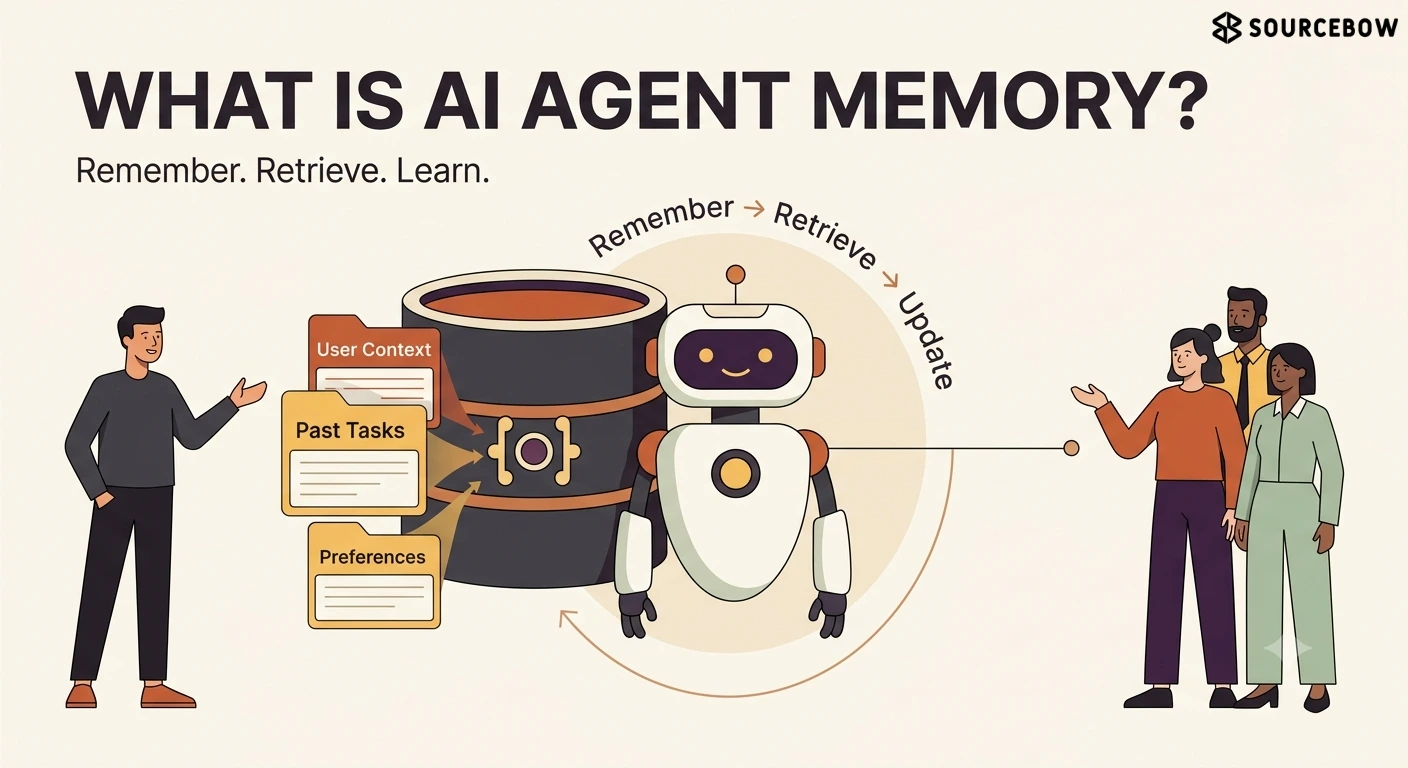
What is AI agent memory, and why does it matter for modern AI systems? It is the architectural layer that allows an agent to retain, retrieve, and update information beyond the current interaction. This article takes the argument past model quality and into architecture — because lasting value comes from what the agent can retain, retrieve, and update, not just how fluent it sounds.
Quick Highlights
- Memory helps agents stay useful across sessions.
- Enterprise workflows need continuity, not just fluency.
- Good memory systems must extract, store, update, and retrieve well.
- Governance matters as much as recall.
Why stateless AI agents fail in real enterprise workflows
Agents that forget every interaction can handle one-off prompts, but they break down when work stretches across days, teams, or months.
The raw failure mode is context discontinuity: no record of who the user is, what happened yesterday, or what changed in the middle of a procurement process, bank relationship, or internal support thread.
That is why a stateless agent can feel fine in pilot testing and still stall in production.

Single-turn prompts hide the problem
Summarizing a document, drafting an email, or answering a factual question does not require continuity, so the memory gap stays invisible.
The trouble starts once the same agent has to remember preferences, prior promises, or outcomes from earlier sessions.
Enterprise work exposes the real cost
The article points to relationships and workflows that unfold over time: a bank customer over years, an employee over months, or a procurement process over dozens of steps.
In those settings, forgetting is not a small defect — it is a structural failure.
What AI agent memory actually stores and how the four memory types differ

Agent memory is the layer that lets an AI system encode, store, retrieve, and update information beyond the current prompt.
The model itself is not the whole story; memory is what tells it what it knows at any given moment.
Semantic memory, episodic memory, procedural memory, and working memory
- Semantic memory: facts the agent has learned and kept, such as who the user is, their role, terminology inside the organization, and preferences over time.
- Episodic memory: what actually happened before — past interactions, sequence, outcomes, what was tried, what worked, and what was promised.
- Procedural memory: the behaviors, rules, protocols, escalation logic, compliance constraints, and organizational policies that shape how the agent acts.
- Working memory: the current context window, where relevant facts from semantic memory, episodic history, and procedural rules are assembled right before response time.
Short-term memory and long-term memory are not the same thing
Short-term memory for AI agents is what the system knows inside the current session.
Long-term memory for AI agents is the persistent store that survives between sessions and has to be retrieved on demand.
How the agent memory pipeline works from extraction to retrieval
The memory system only helps if the pipeline behind it is disciplined.
Four stages matter here: extraction, storage, consolidation, and retrieval — and the weak link in any one of them can drag the whole system down.

Extraction decides what is worth keeping
Not every fact from a conversation deserves to survive.
Good systems keep relevant facts, preferences, decisions, and outcomes while dropping noise; poor ones end up with bloated memory stores or empty ones that missed the real signal.
Storage usually means vector databases, and sometimes graph databases
Vector databases store information by semantic meaning rather than exact keywords, which helps the agent retrieve relevant memories even when wording changes.
For more complex relationships, graph databases can store both facts and the connections between them.
Consolidation keeps old memories from becoming wrong memories
Preferences change, facts age out, and policies get replaced.
Without consolidation, new information collides with stale records instead of updating them, and the memory system becomes a liability as it grows.
Retrieval has to be precise enough to help and light enough to stay fast
Pull too much into context and the agent gets noisy; pull too little and it stays under-informed.
The best retrieval systems surface what is relevant quickly enough not to slow response latency.
| Pipeline stage | What it does | Failure mode |
|---|---|---|
| Extraction | Separates useful facts, preferences, decisions, and outcomes from noise | Bloated or impoverished memory stores |
| Storage | Uses vector databases or graph databases to persist memory | Weak retrieval or poor relationship handling |
| Consolidation | Resolves contradictions, updates records, and discards redundancy | Outdated and conflicting memories |
| Retrieval | Brings relevant memory into the active context window | Too much noise or too little context |
Why persistent memory gets hard once you scale it across users, policies, and agents
The design is obvious in theory and messy in practice.
That is where the staleness problem, the noise problem, the governance problem, and the multi-agent problem start to matter more than the idea itself.
Staleness, noise, governance, and multi-agent scoping
- Staleness: a user’s role, budget, preferences, and circumstances change, so memory needs lifecycle management, timestamps, contradictory-update checks, and invalidation.
- Noise: memory stores that grow without consolidation surface irrelevant results, so deduplication and merging at write time become essential.
- Governance: GDPR, CCPA, and other privacy laws require access, correction, and deletion rights, plus metadata like source, timestamp, confidence, and lifecycle status.
- Multi-agent scoping: different agents need different read/write boundaries, so a customer-facing agent may see account history while staying away from unrelated HR data.
How agent memory differs from RAG, and why enterprises usually need both
RAG and memory solve different problems, even though people often lump them together.

RAG is read-only and gives every user the same static knowledge base at inference time; agent memory reads and writes, changes with interaction, and stays personal to a user, team, or organization.
RAG gives shared knowledge; memory gives evolving context
RAG is the encyclopedia.
Persistent AI agent memory is the record that changes as the agent learns from use.
The strongest enterprise setups use both
RAG handles broad organizational and domain knowledge.
Agent memory handles user-specific and interaction-specific context, which is why treating RAG as a full substitute leaves half the problem unsolved.
Two memory types work in tandem
- Session Meta Memory: a default, system-managed store that captures session identifiers, user references, application context, and timestamps with no configuration needed.
- Custom Memory Stores: persistent stores that developers can read from and write to using code tools or workflow nodes.
- JSON Schema: the format control that keeps stored data valid, structured, and queryable at scale.
Three access types define what memory can be shared
| Access type | Scope | Best use case |
|---|---|---|
| User-specific | Persists across all sessions for one user | Personalization over time |
| Application-wide | Available to every user across the app | Shared policies or announcements |
| Session-level | Exists only for one interaction | Intermediate steps in multi-turn workflows |
Retention policies and multi-agent coordination add the enterprise layer
Retention policies can automatically expire data at configurable intervals, which helps with performance and compliance.
Across multi-agent workflows, the same structure can act as a coordination backbone, passing structured context between agents without forcing users to repeat themselves.
That is also why the platform is positioned as governance-ready: schema-enforced structure, granular access types, and configurable retention policies all show up in the same architecture.
Why persistent AI agent memory creates a compounding advantage
The real value is not one better interaction.
It is the fact that every interaction adds to the agent’s understanding of the user, the workflow, and the organization, so the system improves with use instead of resetting.
The 26 percent response-quality gain is the hard number worth noticing
Mem0 reported that integrating persistent memory into LLM applications produces a 26 percent improvement in response quality.
That matters because it shows the gain can come from architecture, not just from a better model.
Memory becomes hard to copy once it has months or years of real usage behind it
As the memory store accumulates domain terminology, workflow patterns, and organizational preferences, it turns into a form of AI capital.
That kind of advantage compounds rather than resets.
Where AI agent memory is heading next
Agent memory is moving from advanced capability to baseline expectation.
The major cloud providers have already announced or deployed managed memory services, and purpose-built frameworks are emerging for teams that want more control.
FAQ
These are the questions that usually come up once someone understands the basics but still wants the practical boundary lines.
Q: What is agent memory in AI?
It is the ability of an AI agent to retain, recall, and build on information across interactions and sessions instead of starting fresh each time.
Q: What is the difference between short-term and long-term memory in AI agents?
Short-term memory lives in the current session; long-term memory is stored persistently in external systems like vector databases or knowledge graphs and is retrieved when needed.
Q: How is agent memory different from RAG?
RAG is read-only and works from a shared corpus, while agent memory reads and writes, changes with use, and stays specific to a user or organization.
Q: Why does agent memory matter for enterprises?
It prevents repeated context loss, supports continuity in multi-step work, and can improve response quality by 26 percent while compounding organizational knowledge over time.
Conclusion
For enterprise AI, the point of AI agent memory is not novelty; it is continuity, learning, and control that survive beyond one conversation.
If the architecture can retain context, manage retrieval, and handle governance cleanly, the agent stops acting like a polished one-off responder and starts becoming useful in a way that compounds.