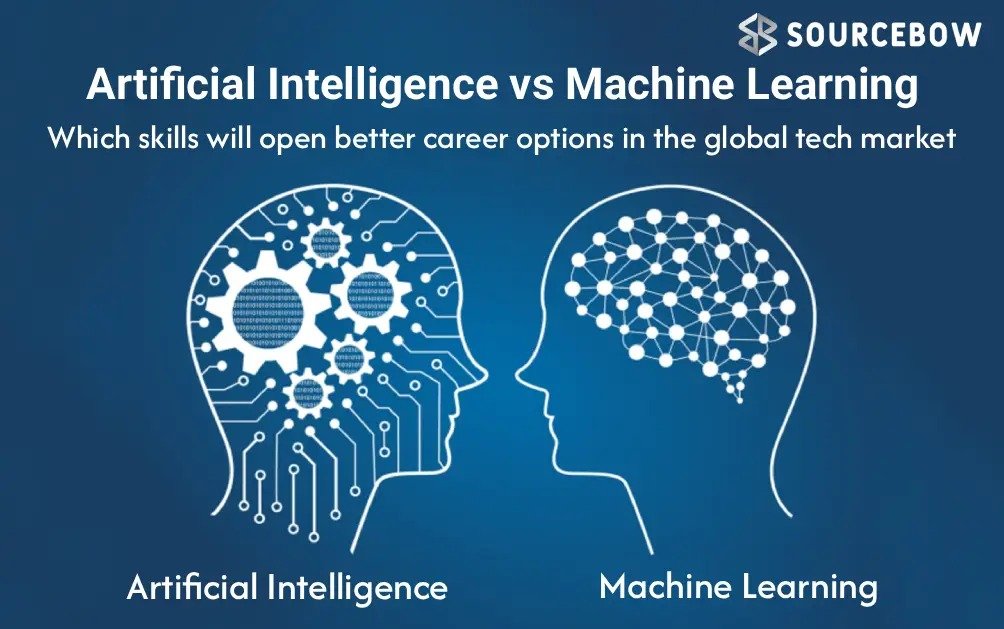
Everyone seems to be rushing toward AI right now, but that’s exactly why the real question matters: where do you actually fit? The AI vs Machine Learning career choice looks simple from the outside, yet once you compare the day-to-day work, the skill stack, and the long-term growth, the two paths start to feel very different. One is broader and more systems-focused. The other is more technical, more math-heavy, and often more specialized.
And here’s the thing: a lot of people choose based on hype, not fit. That usually leads to frustration later. So instead of treating AI and ML like the same career with different labels, let’s break down what they really mean, where the jobs are, what the work looks like, and how you can tell which one makes more sense for your personality and goals in 2026.
Quick highlights
- AI is broader; ML is more specialized.
- ML usually leans harder into math and data work.
- AI roles can open more system-level career paths.
- Both fields are growing fast across major global markets.
- Your best fit depends on how you like to solve problems.
What is the difference between AI and Machine Learning?
In simple terms, artificial intelligence definition starts with the idea of making machines act intelligently, while machine learning is the method many of those systems use to improve from data. A handy way to remember it is this: AI = goal, ML = method. AI is the larger umbrella. ML sits underneath it. That’s why things like NLP, robotics, and computer vision are usually discussed as part of AI, while ML often powers recommendation engines, fraud models, and prediction systems.
IBM and Gartner both describe AI as a broader field that includes systems designed to perform tasks that normally need human intelligence. ML, meanwhile, focuses on algorithms that learn patterns from data rather than relying on every rule being manually programmed. In 2026, that distinction matters even more because companies aren’t just asking for “AI people” anymore. They want people who can choose the right layer of intelligence for the problem.
Where is AI and Machine Learning used in real life?
This is where the topic gets less abstract and a lot more useful. You’re already living around both technologies every day, even if you don’t notice it. Voice assistants answering questions, recommendation engines suggesting what to watch next, and fraud detection systems flagging suspicious payments all run on some version of these ideas.
Here’s a quick way to map it:
- Healthcare diagnostics often uses AI applications industries like imaging support and patient triage.
- Finance depends heavily on predictive analytics and fraud detection.
- Education uses personalized learning systems and automated feedback tools.
- Logistics relies on route optimization and demand forecasting.
And if you’re wondering where jobs come in, think of it like this: a hospital using AI for image analysis may need an AI engineer, while a bank building a fraud model may hire an ML engineer or data scientist. That role mapping is important because it shows how machine learning examples turn into real careers, not just cool demos.
The generative AI wave has only added fuel here. More companies are adopting tools that automate writing, summarization, search, and internal knowledge support, which means the future of AI jobs is expanding into areas that used to be handled very differently.
What skills are required for an AI vs Machine Learning career?
This part is where a lot of people make the wrong assumption. They think the only difference is “AI sounds broader, ML sounds more technical.” In practice, the skill sets overlap, but the emphasis changes a lot.
AI career opportunities often reward system thinking. You need to understand how different technologies fit together, how a solution should be deployed, and how to connect business goals with intelligent features. That can include working with NLP, robotics, computer vision, and even product design at times.
Machine learning skills required are usually more focused: Python, statistics, data analysis, model evaluation, feature engineering, and a decent grip on ML algorithms basics. If you’ve ever struggled with math-heavy problem solving, that doesn’t mean ML is off the table, but it does mean you should be honest about the learning curve.
In a very rough sense, the difficulty curve looks like this:
- AI: broader thinking, architecture, integration, applied logic.
- ML: deeper math, experimentation, tuning, and data modeling.
That doesn’t mean one is “easy.” It means they challenge you differently. LinkedIn skills trends and hiring data have shown that employers increasingly want people who combine technical ability with applied judgment, especially in 2026 hiring trends where AI certifications and hands-on projects matter just as much as theory.
What does a day in the life of AI vs ML professionals look like?
Job titles can sound glamorous from the outside, but daily work is usually a mix of problem-solving, debugging, and explaining ideas to other people. For an AI engineer, the day may involve system integration, checking how different tools talk to each other, and making sure the product actually works in the real world. For an ML engineer, the day is often more experimental: cleaning data, testing models, comparing results, and trying to improve accuracy without making the system messy.
That reality check matters. A lot of beginners imagine AI jobs as endless creativity and futuristic tools. In practice, there’s a lot of structure, a lot of iteration, and yes, a fair bit of frustration too. ML roles can feel especially intense because a tiny change in data or parameters can shift outcomes in ways that take time to understand.
Still, that’s also what makes both paths rewarding. AI engineer vs ML engineer isn’t really about “better” versus “worse.” It’s about whether you like building the bigger system or working closer to the model itself. If you enjoy seeing how pieces connect, AI may feel more natural. If you like precise tuning and measurable performance, ML may feel more satisfying.
AI vs Machine Learning career: salary, demand, and growth in 2026
Now we get to the part most people secretly care about first: money and job demand. And fair enough. Career choices should be practical, not just exciting on paper.
Across the US, UK, Germany, India, and Singapore, hiring for AI and ML continues to grow, especially in healthcare, finance, education, and logistics. The broader trend is simple: companies want more automation, more prediction, and more intelligent systems that can save time or reduce risk. That’s why AI jobs demand 2026 is expected to stay strong, especially for candidates who can work across product, data, and engineering teams.
Salary ranges vary a lot by region, experience, and company size, so treat any number as directional rather than permanent truth. Still, the pattern is fairly consistent: ML roles often start a bit stronger when the job is highly technical, while AI roles can grow quickly into broader product or leadership tracks. That’s where the global mobility advantage comes in. Both paths can travel well across markets if your portfolio is strong.
| Factor | AI Career | ML Career |
|---|---|---|
| Scope | Broad | Specialized |
| Skills | Multi-domain | Data-focused |
| Roles | AI Engineer | ML Engineer |
| Difficulty | Moderate | High, math-heavy |
| Flexibility | High | Medium |
If you look at Glassdoor-style salary benchmarks, the exact figures move around, but the message is steady: both fields pay well, and growth is strongest for people who can show impact, not just certificates.
AI engineer vs ML engineer: which role is better?
Better is a tricky word here. A better role for one person can be a bad fit for another. That’s why the more useful question is: do you want breadth or depth?
An AI engineer vs ML engineer comparison usually comes down to this tradeoff. AI engineers often work across systems, deployment, automation, and product features. ML engineers spend more time building and refining models, testing performance, and dealing with data quality issues. One role can feel like orchestration. The other feels like precision work.
In many companies, the line isn’t perfectly clean anymore. Hybrid roles are growing, especially in teams that work with AutoML, LLMs, and other modern tools. But if you’re choosing a starting direction, here’s a simple way to think about it: AI gives you more room to move laterally into product, architecture, or leadership. ML gives you stronger depth in data-driven technical work.
So, if you want a career that stays close to models, metrics, and experimentation, ML may suit you. If you want a path that touches systems, products, and multiple problem types, AI can feel more natural.
How do you choose between AI and Machine Learning as a career?
This is the part most blogs skip, which is honestly the most useful part. Choosing between them isn’t about which one sounds smarter. It’s about what kind of work you enjoy when no one is watching.
Start with three questions:
- Do you like systems or data? If systems, AI may fit better. If data, ML may fit better.
- How do you handle math? If you enjoy statistics and modeling, ML becomes easier to stick with.
- What kind of growth do you want? If you want broad career movement, AI can be more flexible. If you want deep specialization, ML can be more rewarding.
That’s the heart of the decision framework. A student who enjoys building products and thinking across domains may lean toward AI career roadmap options. Someone who likes experiments, predictive analytics, and measurable performance may feel more at home in a machine learning career path.
And yes, you can switch later. Many professionals move from AI into ML or the other way around after learning data science vs AI fundamentals and building practical projects. The good news is that both paths overlap enough to keep your options open.
A simple reality check before you choose
Let’s be blunt for a moment. A lot of people choose based on buzzwords, then wonder why the work doesn’t feel exciting after six months. That’s avoidable.
If you like broad problem-solving, business context, and building systems that do many things, AI career opportunities probably make more sense. If you like mathematical clarity, model tuning, and digging into why predictions work, then the machine learning career path may be the better bet.
Both are future-proof in different ways. Both can lead to strong salaries. Both can work globally. But they reward different personalities.
That’s why the smartest choice in 2026 isn’t always the trendiest one. It’s the one that matches how you actually think.
Wrapping it up without the hype
If you strip away the buzz, the choice gets clearer. AI is the broader, more flexible path. ML is the deeper, more technical one. Both have real demand, both have room to grow, and both can lead to global careers if you build the right foundation.
So before you jump into courses or certifications, pause for a second and ask yourself: do you want to build systems, or do you want to master models? That one question can save you a lot of time.
And if you’re still not sure, that’s okay too. Start small, test both paths, and see which one actually feels like work you’d want to keep doing.