Introduction
Retrieval augmented generation changes the part that usually breaks first: the model’s stale knowledge. Instead of relying only on what was frozen into training, it pulls in real-time information when it needs it. That sounds simple, but it’s a pretty big shift in how AI answers questions.
And honestly, that’s why people keep talking about it. Traditional generative models can drift into outdated answers, hallucinations, and those annoying expensive fine-tuning cycles that never quite end. So, when you hear people ask What is Retrieval-Augmented Generation (RAG)? and Why Does It Matter?, the short answer is that it gives AI a way to stay useful after the training data gets old.
Quick Highlights
- RAG helps AI answer with fresher information.
- It can reduce hallucinations by grounding answers.
- It’s often cheaper than constant retraining.
- Citations and traceability are a big plus.
Now, the interesting part is that RAG doesn’t try to make the model smarter in the old-school sense. It makes the model better informed at the moment of answering. That’s a very different idea, and once you see it, a lot of the AI conversation starts to make more sense.
Why traditional generative AI starts to fail on current information
Generative models like GPT-4 can sound confident while still being wrong, mostly because they’re built on static datasets. The problem is not intelligence so much as freshness. They’re like a very well-read person who last checked the news a long time ago. Smart? Yes. Current? Not always.
That gap creates four pressure points that show up over and over again. You get outdated knowledge because the training data is frozen at a certain point in time. You get hallucinations when verification is missing. You get expensive fine-tuning if you keep trying to patch the model with new training rounds. And you get weak domain-specific performance unless the model is heavily adapted for one narrow job.
- Outdated knowledge from static training data
- Hallucinations when verification is missing
- Expensive fine-tuning that depends on retraining and new datasets
- Limited domain-specific knowledge unless the model is specialized
That’s really the heart of the problem. A model can be fluent, even impressive, and still miss the mark if the answer depends on something recent, local, or highly specific. Think policy updates, product changes, medical guidance, or legal rules. A stale model can still talk beautifully while being completely out of date.
Look, this is also why people get frustrated with AI sometimes. They ask for something practical, and the answer is polished but shaky. Traditional generative AI is strong at pattern completion. But when the task needs current facts, it can wobble. That’s where retrieval augmented generation starts to matter in a very real way.
How RAG actually works, from query to answer
RAG is not one trick; it is a sequence. A user asks something, the system decides whether it needs outside knowledge, and then it goes looking. Instead of answering from memory alone, it reaches into a source of documents, retrieves relevant pieces, and then uses those pieces to shape the final response.
The raw workflow includes an Embedding Model, a Vector Database, re-ranking with BM25 or Cross-Encoders, an Integration Layer, prompt engineering, citations, and a response that can carry memory into follow-up turns. It sounds like a lot, but in practice it’s just a smarter path from question to answer.
Retrieval, re-ranking, and the prompt layer
The query is turned into a vector, matched against a Vector Database, and then cleaned up through re-ranking so the most relevant sources rise to the top. That is where BM25 and Cross-Encoders enter. They help the system avoid grabbing the vaguely related stuff and instead focus on the documents that actually matter.
After that, the retrieved material is formatted through prompt engineering for RAG and injected into the LLM’s context before the answer is generated. In simple terms, the model gets a stack of notes right before it starts writing. It’s still generating language, but now it’s doing so with actual source material in front of it.
This is why RAG feels different from a normal chatbot. It isn’t just guessing from patterns in training. It’s checking the shelves first. That makes the answer more grounded, and often more defensible if someone asks, “Where did that come from?”
Why memory matters in multi-turn chats
RAG systems can also store interactions through multi-turn memory for chatbots, which helps the model keep continuity instead of treating every follow-up like a fresh question. That matters more than people expect. Without memory, a chatbot can feel weirdly forgetful, like it’s nodding politely and then immediately losing the thread.
With memory, follow-up questions make more sense. The system can keep track of what you were discussing, what source it used, and what context still matters. It’s not perfect human memory, of course, but it’s good enough to make conversations feel less fragmented and a lot more practical.
- User query input determines whether external knowledge is needed
- Embedding Model converts the query into a vector
- Vector Database returns similar documents
- BM25 or Cross-Encoders handle re-ranking
- Integration Layer structures the retrieved data
- Prompt engineering for RAG injects context into the LLM
- Citations are attached before delivery
- Memory supports multi-turn conversations
That chain is the reason RAG feels so useful in real products. Each step helps narrow the gap between what the user asked and what the system should responsibly answer. The final result is not just a fluent response. It’s a response that has a better chance of being right.
Where RAG is already useful in enterprise systems
The strongest use cases are the ones where accuracy depends on freshness and traceability. RAG in enterprise AI is especially useful when documents, regulations, or product details change faster than a model can be retrained. And in a lot of organizations, that’s basically every week, sometimes every day.
The article names seven areas, and they’re all very practical: enterprise knowledge management, customer support automation, healthcare and clinical decision support, legal document analysis and compliance, financial and market intelligence, e-learning and personalized education, and research assistance. Those aren’t abstract examples. They’re the places where people actually need answers they can trust.
- Enterprise knowledge management
- Customer support automation
- Healthcare and clinical decision support
- Legal document analysis and compliance
- Financial and market intelligence
- E-learning and personalized education
- Research assistance
Enterprise knowledge management is probably the easiest place to understand the value. Instead of hunting through scattered docs and stale wikis, employees can ask a question and get a sourced answer back. Customer support works similarly. A support agent or chatbot can pull from product manuals, policies, or internal notes instead of improvising.
Research assistance is another interesting one. If you’ve ever tried to keep up with papers, reports, and changing recommendations, you already know how fast information overload hits. RAG can’t replace judgment, but it can reduce the time spent searching. That’s a real win.
Clinical, legal, and financial use cases need more than fluent answers
Clinical decision support RAG can surface real-time clinical guidelines, research papers, and patient records. Legal document analysis RAG can pull case law, contracts, and compliance regulations. Financial teams use it for reports, market trends, and economic forecasts. These are not casual use cases. A wrong answer can have actual consequences.
That’s why citations and current source retrieval matter more than elegant wording. In these fields, sounding smart is not enough. The system has to show its work, or at least point clearly to the source it used. That traceability is a huge part of the value.
It also makes review easier. A lawyer, clinician, analyst, or editor can inspect the source material and decide whether the answer holds up. That’s a much better workflow than trusting a model’s memory and hoping for the best.
RAG vs. fine-tuning: when each one makes more sense
The real decision is not which one sounds more advanced. It is whether the use case needs model behavior to change internally or simply needs current information at answer time. That’s the part people often blur together. But they solve different problems.
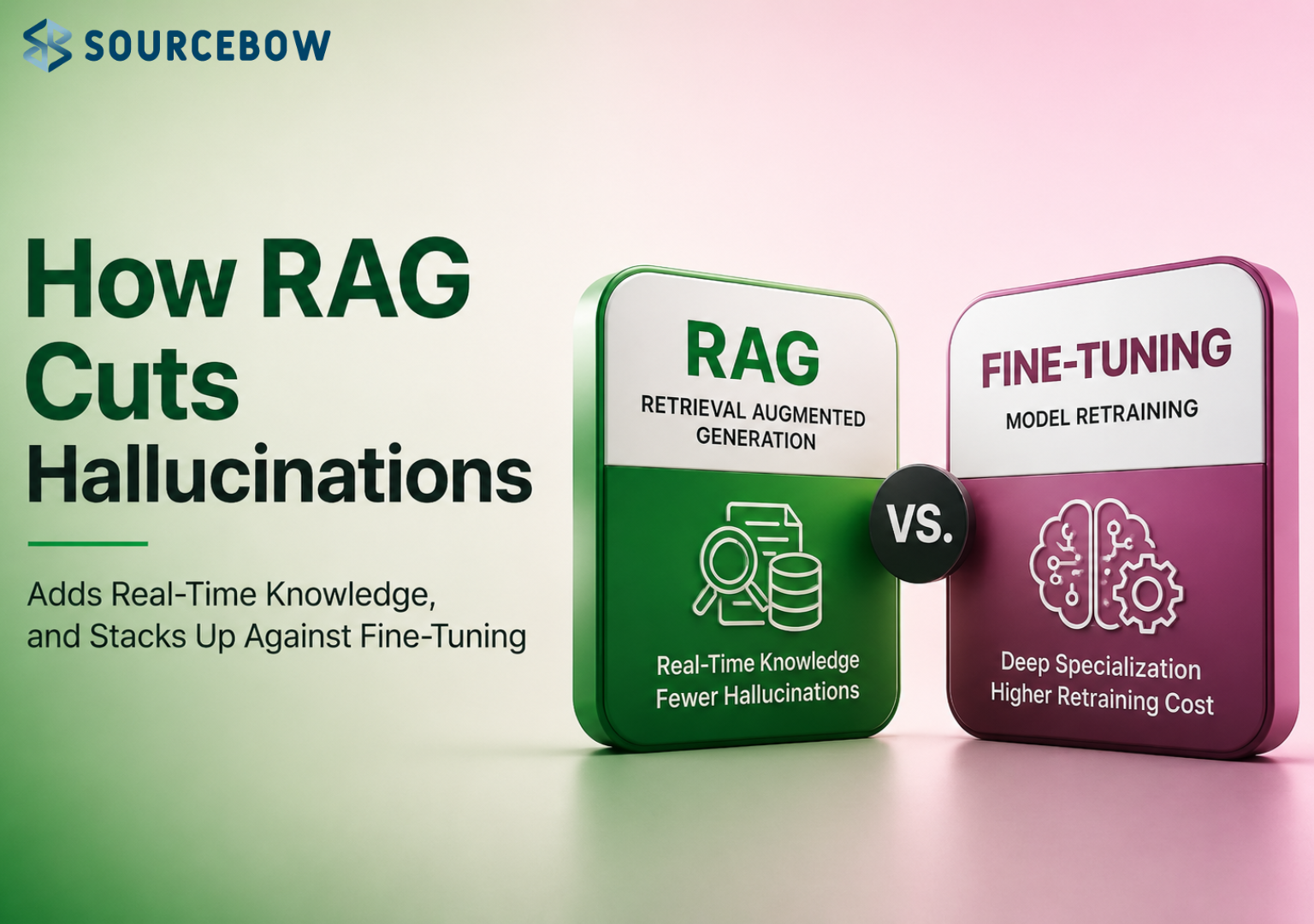
Fine-tuning changes the model’s parameters on a domain-specific dataset. RAG leaves the model alone and retrieves external knowledge on demand. So one changes the brain a bit, while the other gives the brain a better notebook right before it answers. Both can be useful. They just solve different headaches.
| Category | Fine-Tuning | RAG |
|---|---|---|
| Knowledge handling | Embedded into the model through training | Fetched in real time from external sources |
| Freshness | Static unless retrained | Always up-to-date with the latest knowledge |
| Cost | Expensive & resource-intensive, requiring GPUs and labeled data | Lower training costs and infrastructure requirements |
| Accuracy profile | Highly accurate for structured, well-defined applications | More explainable & traceable responses with citations |
| Main drawback | Risk of overfitting and frequent retraining | Slower inference and dependence on source quality |
That table really tells the story. Fine-tuning is a strong move when you want the model to learn a very specific style, behavior, or task. It’s especially useful when the domain is stable and you can justify the training cost. But if the main problem is that the facts keep changing, RAG is often the more practical choice.
- Fine-tuning works well when you need high accuracy on a structured, domain-specific dataset
- Fine-tuning is better when you can afford computational and retraining costs
- Fine-tuning makes more sense when the use case does not require frequent updates
- RAG fits better when the model needs real-time, dynamic knowledge
- RAG helps reduce retraining costs
- RAG is the cleaner choice when explainable responses with citations matter
In other words, don’t pick the tool based on buzz. Pick it based on the shape of the problem. If the model needs to behave differently all the time, fine-tuning might be worth it. If it mostly needs to stay current, RAG is usually the simpler, cleaner answer.
What the hybrid approach is trying to solve
The hybrid approach exists because neither method is perfect on its own. Fine-tuning can give domain depth, while RAG keeps the system current. That’s a very natural combination if you think about it. One adds behavior, the other adds freshness.
Used together, they aim to make AI both knowledgeable and adaptable instead of forcing one method to carry both jobs. That matters in bigger systems, where users want outputs that feel specialized but still reflect the latest information. A hybrid setup can be a little more complex, sure, but complexity is sometimes the price of getting both speed and reliability.
Here’s the thing: many real-world products don’t live neatly in one camp. They need a model that understands the domain, follows the right tone, and still checks external sources before answering. Hybrid systems are trying to meet that reality instead of pretending one solution can do everything.
FAQ
These are the smaller doubts readers usually have after they understand the basic split between retrieval and training.
Q: Is RAG better than fine-tuning?
Not always. RAG is better when freshness, citations, and lower retraining cost matter more than changing the model itself.
Q: Why does RAG reduce hallucinations?
Because the model can ground its answer in retrieved sources instead of relying only on memory from training data.
Q: What slows RAG down?
The retrieval step adds latency, and the system is only as good as the external knowledge source behind it.
Q: Can RAG handle multi-turn conversations?
Yes, if the system includes memory. That lets it keep context across follow-ups instead of answering each turn in isolation.
Conclusion
Retrieval augmented generation is the better fit when you need current information, fewer hallucinations, and a cleaner way to explain where answers come from. It doesn’t magically solve every AI problem, but it does solve a very real one: how to make a model useful when the world keeps changing after training ends.
If the job is knowledge that changes, RAG is usually the first place to look; if the job is deep specialization, fine-tuning may still belong in the mix. That’s really the practical takeaway. Don’t ask which method is more impressive. Ask which one matches the problem in front of you.