Introduction
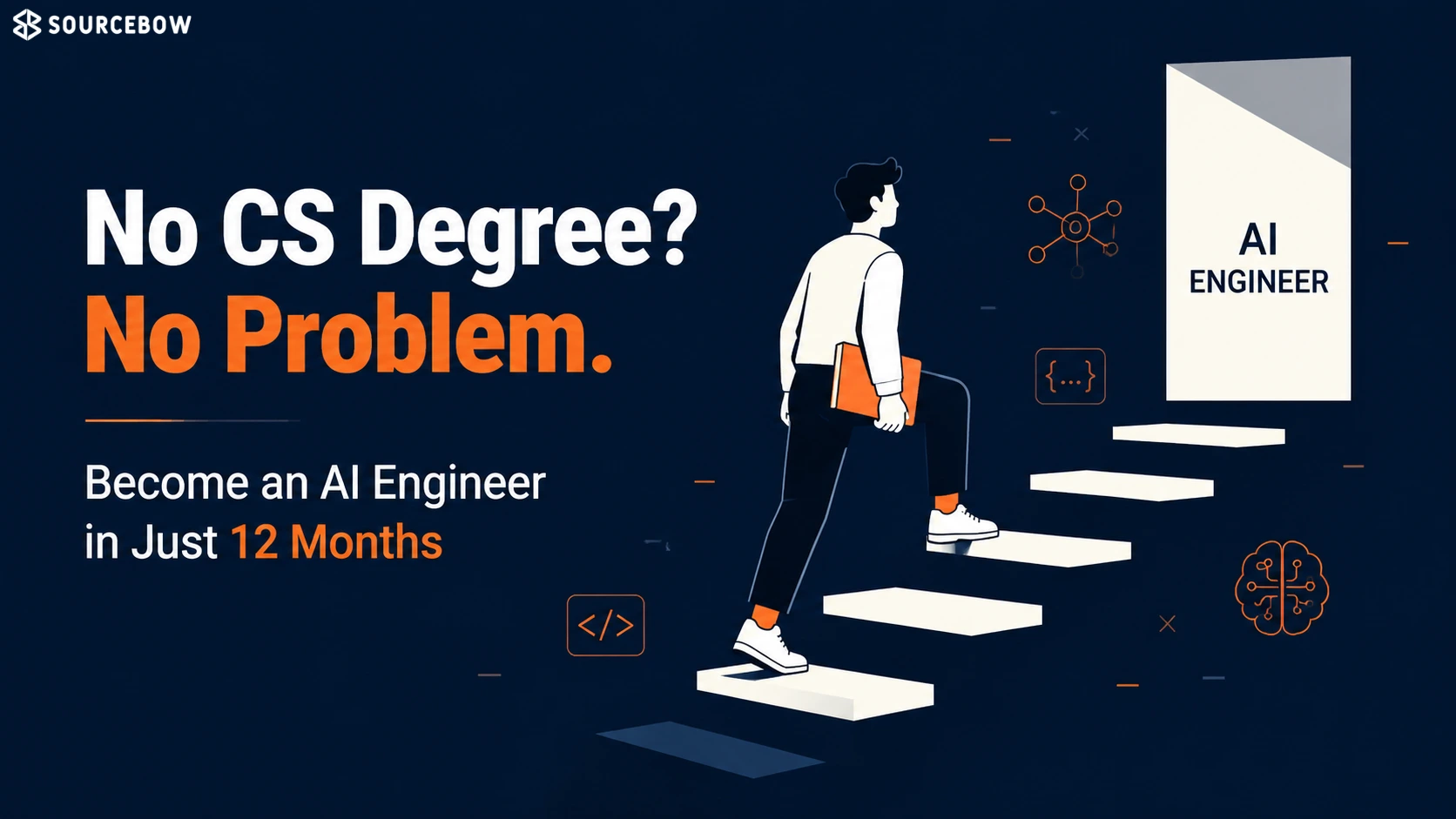
The promise is blunt: you can learn how to become an AI engineer without a CS degree and still build the kind of portfolio hiring managers actually trust.
The catch is that this only works if you stop preparing and start shipping, because the market rewards projects that work in production, not credentials that look good on paper.
Quick Highlights
Now, that doesn’t mean the path is easy. It just means it’s clearer than most people think. A lot of beginners get stuck in a weird loop where they keep learning about AI without ever building with it. But the people who actually get hired usually do the opposite. They learn enough to build, then they build enough to prove it. That’s the whole game.
And here’s the thing: this is not about becoming a research scientist. It’s about becoming the person who can take existing models and turn them into useful products. That’s a very different job, and honestly, it’s a much more approachable one for someone starting from zero.
What an AI engineer without a CS degree actually does, and why that matters more than a diploma
An AI engineer is not the person inventing new models from scratch; it is the person wiring existing models into useful products.
The raw distinction is simple but important: machine learning researchers train models, while AI engineers build support bots, internal search, and agents that handle multi-step work without human babysitting.
That shift in definition changes the whole path, because the role sits on software engineering, language-model behavior, and product thinking — not a PhD gate.
So if you’ve been wondering whether you’re “smart enough” or “technical enough,” it helps to zoom out. The job is less about advanced math on a whiteboard and more about making systems work in the real world. A strong AI engineer can take a model, connect it to data, shape the prompts, test the output, and make the whole thing reliable enough that a team can depend on it. That’s practical engineering, not magic.
That’s also why a portfolio matters so much. Employers want to know whether you can build something useful, not whether you once sat through a lecture series. A polished diploma may open doors in some fields, but in this one, it’s often the shipped work that makes someone stop and pay attention.
Why shipped work beats credentials for most open roles
The article keeps coming back to the same hiring reality: a portfolio of shipped projects carries more weight than a degree in most of these jobs.
It even says hiring managers have watched self-taught engineers run circles around PhD holders, because shipping is a different skill than studying.
That might sound a little blunt, but it matches how this field behaves. A project that actually works, even if it’s small, proves you understand the messy parts: APIs break, outputs drift, data gets weird, and users do unexpected things. That’s the stuff job interviews often try to uncover later anyway. So when you’ve already dealt with it yourself, you’re walking in with real stories instead of polished theory.
The first 3 months: learn Python well enough to build real things
The first phase is intentionally unglamorous: Python, Git, and the habit of writing code every day.
You are not aiming for “I watched a tutorial” comfort; you are aiming for “I can build from a blank file without looking up basic syntax.”
That means variables, data types, control flow, functions, files, APIs, error handling, and reading other people’s code, plus GitHub from day one.
Look, this part isn’t exciting. It’s the equivalent of learning how to chop vegetables before trying to cook a restaurant meal. But if you skip it, everything later feels shaky. Python is the language you’ll use to stitch almost everything together, and Git is how you’ll stop losing work and start showing progress publicly. If you can write small scripts without panicking, you’re already moving in the right direction.
One useful mindset shift here is to stop thinking in terms of “learning Python” as a finish line. Instead, think in terms of building comfort. Can you read a file, clean some text, make a request to an API, and handle errors without freezing? If yes, you’re getting close to the kind of basic fluency that makes the later AI work much less intimidating.
Five starter projects that prove you can actually code
The outline here is deliberately concrete because the raw content is concrete: five tiny programs, all pushed publicly to GitHub.
- A calculator
- A file organizer
- A script that calls a public API
- A simple data cleaner
- A command-line note taker
These aren’t meant to impress anyone on their own. They’re proof that you can finish things. And finishing matters. A lot. A beginner who has five tiny but complete projects usually looks more hireable than someone who has one ambitious half-built app sitting in a private folder somewhere.
The math concern gets a clean answer too: basic statistics is useful, but linear algebra and calculus are not the first hurdle for building with LLMs.
That should take some pressure off. You do not need to become a math specialist before you start. For this path, the first real win is being able to write clean code, use GitHub well, and create a few small tools that show you understand how software behaves.
Months 3–5: work through the LLM API, not the chat box
This is where the job starts to feel real, because the consumer chat interface is not the product-building surface — the API is.
You learn to send messages from your own Python script, handle streaming responses, manage conversation history, control output format, and deal with rate limits and errors.
The article also draws a line between a decent prompt and a repeatable one, which matters because “usually right” is a bug in production.
Here’s the thing: a chat window is a demo. An API is a system. When you build through the API, you start seeing all the little things that matter in real applications — how the model behaves across multiple turns, how to structure requests, how to format the output so your app can actually use it, and what to do when the model gives you something vague, delayed, or just plain wrong.
This stage is where many beginners finally realize that prompt writing is only part of the skill. The bigger skill is designing a reliable interaction. Can you make the model output JSON? Can you preserve context across messages? Can you recover gracefully when a request fails? Those are the kinds of details that turn “I played with AI” into “I built something useful.”
Tool use is the doorway to agents
The specific step here is function calling: giving the model a function it can call, then making it call it correctly.
Once that clicks, the article says, agents stop feeling abstract because they are basically models with tools and a loop.
- Get an API key and make your first call in your first hour
- Build a command-line tool that turns pasted text into something useful
- Build a chatbot with memory
- Implement tool use with one callable function
This part is where things start feeling a little futuristic, but not in a scary way. Tool use is just the model asking your program to do something it cannot do directly. Maybe it needs to search a file, look up a record, calculate something, or fetch data. Once it can call a function, the model becomes more than a text generator. It becomes part of an actual workflow.
And that’s a big leap. Because once you understand tool use, the idea of an agent stops sounding like marketing jargon. It starts looking like a structured loop: think, call a tool, inspect the result, decide the next move. Not magical. Just useful.
Months 5–9: build the two projects employers actually recognize, RAG and agents
This is the part with the clearest hiring signal, because the article treats these as the systems most real AI products are already using.
RAG comes first: retrieval-augmented generation pulls the right information from your own data so the model can answer accurately about things it was never trained on.
Then agents: goal-driven systems that break work into steps, use tools, and keep going until the task is done — or fail for messy reasons you have to design around.
Now we’re in the zone where your portfolio starts looking like real industry work. A lot of companies don’t need a model trained from scratch. They need systems that can answer questions from internal documents, help employees find the right information fast, or carry out repeatable tasks using tools and rules. That’s why RAG and agents show up so often. They’re not just trendy. They’re practical.
If you build these well, you’re also learning the awkward parts that employers care about: how to reduce hallucinations, how to make search better, how to keep tool-based systems from wandering off, and how to explain the limits of what your app can do. That last part matters more than people think. Honest AI systems are often more trustworthy than flashy ones.
RAG systems need embeddings, vector databases, and retrieval that actually works
The article gets specific about the pipeline: chunk documents, turn them into embeddings, store them in a vector database, retrieve the best matches, then feed those into the model.
It names the data sources too: company documents, product manuals, knowledge bases, PDFs, a wiki, or even your own notes.
It also insists on retrieval evaluation, because finding nearby chunks is not the same as finding the right ones.
To make that feel less abstract, think of RAG like a librarian with excellent recall but limited patience. The model doesn’t magically know your company handbook or your personal notes. You have to give it a smart way to search. Embeddings help represent meaning, vector databases help store and compare that meaning, and retrieval helps surface the most relevant pieces before the model answers.
This is one of those places where beginner mistakes are totally normal. People often assume that if the documents are in the system, the model will “just know” what to do with them. But retrieval quality changes everything. Bad retrieval means bad answers, even if the model itself is strong. That’s why evaluation starts to matter here, not later.
- Learn embeddings and vector databases conceptually, then in code
- Build a RAG app over a real document set
- Add retrieval evaluation
- Deploy it somewhere a stranger can use it
Agents are harder than demos make them look
The clean definition in the source is simple: an agent takes a goal, breaks it into steps, uses tools, and decides what to do next based on what happened.
The hard part is reliability — agents can loop, call the wrong tool, or get stuck — so failure handling and clear tool design matter as much as the flashy demo.
This phase also adds the second major portfolio project: a multi-agent system where two or more agents collaborate or check each other.
Agents are where a lot of enthusiasm runs into reality. In a demo, everything looks smooth. In practice, the system can get confused, repeat itself, or make a confident mess of the task. That doesn’t mean agents aren’t valuable. It just means they need boundaries. Good tool design, clear instructions, and failure handling aren’t boring extras — they’re the difference between a neat experiment and a system someone could rely on.
And if you build a multi-agent system, you start learning another useful lesson: coordination is a skill. When two or more agents work together, you have to think about roles, handoffs, checks, and what happens when they disagree. That’s a surprisingly good mirror of real software teams, which is probably why employers like seeing it.
- Build a single-agent system with several tools
- Build a small multi-agent system
- Add explicit failure handling for tool failures or empty outputs
- Make this portfolio project number two
Months 9–11: evaluation and deployment are what make the work hireable
The article calls this the boring phase, but it is the one that separates a working demo from something companies will trust in production.
Evaluation means measuring factual accuracy, relevance, and consistency against reference answers, sometimes with another model, sometimes with human review.
Deployment means hosting, monitoring, handling load, watching costs, and catching failures before users do — the cluster often called MLOps.
If you want the honest version, this is where a lot of people slow down. Not because it’s impossible, but because it feels less exciting than building features. Still, companies care about this part a lot. A system that behaves well in your local environment but falls apart once real users arrive is not really finished.
Evaluation gives you evidence. Deployment gives you reach. Together, they make your work feel like something a company could actually adopt. And that’s why this phase matters so much. You’re no longer just proving that you can make an AI app. You’re proving that you can make one that behaves predictably enough to live in the wild.
The third portfolio project is a deployed system with monitoring
The raw content is very explicit here: build an evaluation suite, deploy one project properly, and add monitoring plus basic cost tracking.
That becomes portfolio project number three, and it is the kind of proof that says you can work beyond your own laptop.
- Build an evaluation suite with test cases and scoring
- Deploy one project properly with monitoring and cost tracking
- Document what you measured and how you’d improve it
That last point is worth lingering on. Documentation is underrated. If you can clearly explain what you measured, what failed, and what you’d improve next, you immediately sound more like an engineer and less like someone who just copied a tutorial. That clarity helps in interviews, but it also helps you understand your own work better.
Months 11–12: package the portfolio and apply like someone who already works here
By the end, the article says you should have three real projects: a RAG application with evaluation, a multi-agent system, and a deployed system with monitoring.
Then the work becomes positioning: clear case studies, public breakdowns, and applications aimed at the realistic first step, often an AI-augmented software engineering role.
The salary range given is specific too, with entry commonly around $120K and experience pushing past $200K depending heavily on company and location.
This is where a lot of people get nervous, because applying feels more exposed than learning. But if you’ve actually built the projects, you’re not coming in empty-handed. You’ve got evidence. Now you just need to present it clearly. A good project page should answer simple questions: What did you build? Why did you build it? What problem did it solve? What broke? What did you learn?
That kind of packaging matters because it helps hiring managers see the shape of your thinking. And in this field, thinking clearly about tradeoffs can be just as valuable as knowing a particular framework. You want them to see that you can build, debug, explain, and improve. Those are employable traits.
What to say in interviews when they ask about your projects
The answer is not theory. It is what you shipped, what failed, how you evaluated it, and what you would change next.
The article uses examples like explaining how an agent should handle a tool failure or how you would evaluate a RAG system — exactly the kinds of questions those case studies prepare you for.
- Write a case study for each project
- Publish at least one technical breakdown
- Apply broadly, including AI-augmented software roles
- Talk about what you shipped, not what you memorized
That interview mindset is huge. A lot of candidates try to sound impressive by stuffing their answers with buzzwords. But what usually lands better is calm, concrete explanation. If your RAG system had weak retrieval at first, say that. If your agent loop got stuck, explain how you fixed it. That honesty signals actual experience, and real experience tends to stand out fast.
FAQ
These are the doubts that sit underneath the main path: whether the degree matters, whether AI will replace the skill, and whether the timeline is actually realistic.
Q: Do you need a computer science degree to become an AI engineer?
No. The article argues that for most of these roles, shipped projects matter more than the diploma. The degree gate is described as mostly an illusion.
Q: Why learn AI engineering if AI can already write code?
Because someone still has to design the system, integrate it, evaluate the output, and decide what gets built. The tools raise the value of the engineer who can direct them well.
Q: Is 12 months really enough to get hired?
According to the path here, yes — but only if you build through all six phases and keep shipping. The timeline is real, but passive preparation is not enough.
Q: What should the first project be?
Start with Python and small programs before moving into LLM API work. The first real momentum comes from proving you can build something from a blank file and put it on GitHub.
Those answers may feel straightforward, but they reflect the spirit of the whole path. Don’t wait for permission. Don’t wait to feel fully ready. Build something, learn from what breaks, then build the next thing a little better.
Conclusion
The article’s answer is blunt: if you want to become an AI engineer, build the portfolio first and let the degree question fade into the background.
Open a blank file today, start Phase 1, and keep shipping until you have three projects that prove you can build with AI in the real world.
That’s really the heart of it. Not perfection. Not endless studying. Just a steady sequence of useful things that stack up into proof. And proof, in this field, goes a long way.