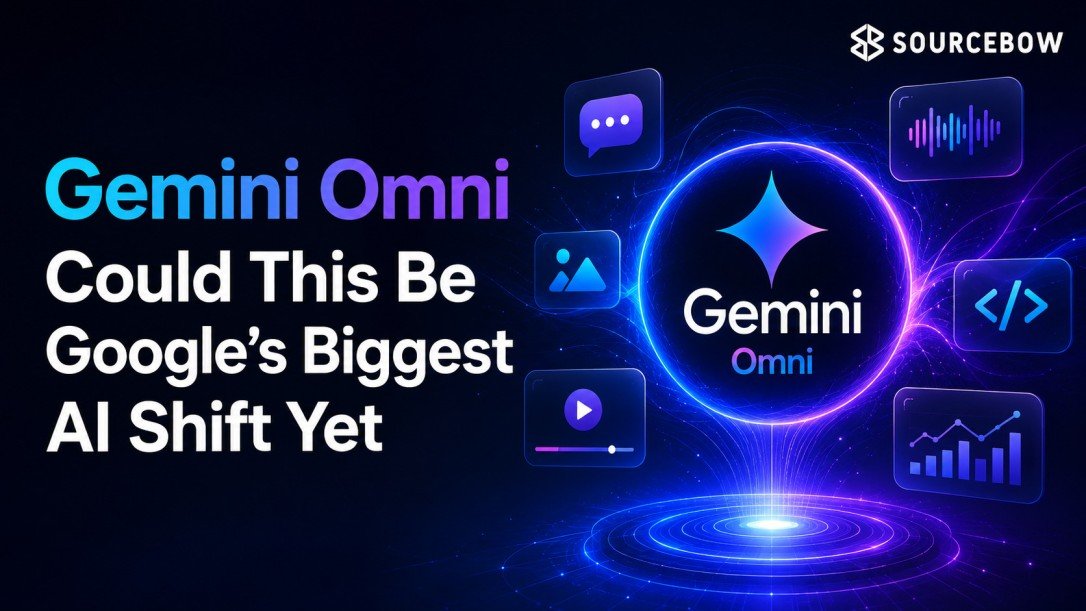
Google didn’t just launch another text-to-video toy. With Gemini Omni, it’s pushing AI video generation toward something much bigger: conversational editing, multimodal prompts, and motion that feels grounded in the real world.
Quick Highlights
If you’ve ever lost an hour nudging a clip frame by frame, the appeal is pretty obvious. The new workflow is built around natural language, contextual memory, and AI-assisted iteration, which could change how creators, marketers, and even enterprise teams think about video production. Google also appears to be tying the system into the Gemini app, Google Flow, and YouTube Shorts, which makes this more than just a flashy demo.
Here’s the thing: the real story isn’t only better generative AI video. It’s the shift from manual editing software to an AI collaborator that understands intent, consistency, and motion. That’s why people are paying attention now.
What Is Gemini Omni and Why Is Google Calling It a “World Model”?
Gemini Omni is Google’s multimodal AI video system built to accept text, images, audio, and video prompts at the same time while generating and editing video with strong contextual continuity. In plain English, it’s not just making clips from prompts. It’s trying to understand what’s happening in a scene, how objects move, and how one change should affect everything else.
That’s where the “world model AI” idea comes in. Google DeepMind has been pushing the broader research direction for years: systems that don’t just recognize patterns, but build an internal sense of how the world works. In video generation, that matters because realism is more than sharp visuals. A cup should fall like a cup, water should move like water, and a person should stay consistent across shots even after several edits.
This is a big deal for AI content creation because the industry has been full of tools that can imitate style but still struggle with physical logic. A lot of text-to-video AI systems are good at spectacle. Fewer are good at coherence. Google seems to want both. And in 2026, that ambition matters because world model AI is becoming one of the
most interesting battlegrounds in generative AI.
For creators and businesses, the practical takeaway is simple: this isn’t positioned as a novelty generator. It’s an AI video generator that tries to understand the scene well enough to keep improving it across multiple turns.
How Does Gemini Omni’s Conversational Video Editing Actually Work?
This is the part that could disrupt a lot of workflows. Instead of opening a traditional timeline and dragging clips around, you describe what you want. You can ask for a new background, a different style, a character inserted into a
scene, or a revised shot order. Then you keep refining it in conversation.
That’s conversational video editing in practice. The model remembers earlier instructions, so it can maintain character consistency, camera continuity, and scene logic across multiple edits. If you say, “Keep the same host, but move the scene outdoors and make it feel more cinematic,” it doesn’t treat that like a brand-new prompt every time. It tries to preserve the important details while changing only what you asked for.
Now, this doesn’t mean professional editors disappear overnight. It does mean the first draft process changes a lot. A rough cut that used to take 40 minutes of manual cleanup might be reduced to a much faster back-and-forth. In creator circles, even a small time reduction can be a huge deal, especially for short-form content where speed matters
more than perfection.
There’s also a mobile-first angle here that people sometimes miss. Hands-free editing on a phone, especially for YouTube Shorts users, is a very different experience from sitting in front of a desktop timeline. For solo creators, that could be enough to switch habits fast.
Think about it like this: old editing software asks you to operate the machine. Gemini Omni tries to act like the assistant that operates with you.
Why Physics-Aware AI Video Generation Matters More Than Better Graphics
A lot of people hear “physics-aware AI” and assume it just means more realism. That’s true, but only part of the story. Google says the system models things like gravity, fluid dynamics, kinetic energy, and motion realism. In practice, that means the AI isn’t only copying the look of motion; it’s trying to understand how motion should behave.
Why does that matter? Because believable video breaks down quickly when physics is wrong. A person walking unnaturally, an object floating, or liquid behaving like jelly instantly reminds the viewer that they’re watching synthetic content. Better graphics alone can’t fix that. Physical reasoning can.
And this is where the AGI conversation starts to get interesting. If a model can learn how scenes evolve, how objects interact, and how changes ripple through a video, it’s getting closer to the kind of simulation thinking researchers care about in robotics, gaming, and autonomous systems. That doesn’t mean it’s AGI. But it does mean the research direction feels bigger than entertainment.
NVIDIA and OpenAI have both pushed simulation-heavy ideas in different ways, and Google’s move fits that larger trend. The future may not be just about generating pretty videos. It may be about generating simulated environments that are useful for training, testing, and creative production. That’s a much wider play.
In other words, the “physics-aware” part is not a gimmick. It’s a clue.
Can Gemini Omni Replace Traditional Video Editing Software?
Short answer: not entirely. But it could absolutely change what most people need from editing software in the first place.
| Workflow area | Timeline-based editing | Gemini Omni style editing |
|---|---|---|
| Learning curve | Steep for beginners | Much easier to start |
| Speed of iteration | Manual and slower | Fast conversational tweaks |
| Continuity | Controlled by the editor | Maintained through memory |
| Precision | Very high | Good, but not always surgical |
| Best for | Complex pro workflows | Creators, marketers, rapid drafts |
That table is really the heart of the disruption. Traditional tools still win on exactness. But AI video editing tools like this win on speed, accessibility, and iteration. For a lot of creators, especially in YouTube Shorts and social media marketing, that’s enough to shift the default workflow.
Adobe Premiere and similar software aren’t going away. What changes is where the first draft happens. If the first 80 percent of editing can be handled conversationally, the remaining 20 percent becomes the specialist layer. That’s a meaningful shift for agencies too, because it could change how teams allocate time and talent.
In practical terms, the biggest win is simple: less friction. The less friction there is, the more people actually publish.
Gemini Omni vs OpenAI Sora vs Runway: Which AI Video Platform Is Best?
There’s no perfect winner here, because each system is aiming at a slightly different job. But if you compare them through a creator workflow lens, Google has one obvious advantage: ecosystem lock-in.
| Feature | Gemini Omni | OpenAI Sora | Runway |
|---|---|---|---|
| Conversational editing | Yes | Limited | Partial |
| Multimodal inputs | Full | Partial | Partial |
| Physics simulation | Advanced | Moderate | Moderate |
| YouTube integration | Native | No | No |
| Watermarking | SynthID | Unknown | Limited |
| Enterprise APIs | Planned | Limited | Available |
If you’re comparing Gemini Omni vs Sora, the important thing isn’t just output quality. It’s distribution. Google can plug directly into Gemini, YouTube, and creator tooling in a way competitors can’t easily match. Runway still has a
strong place for focused creative production, and it’s already useful for teams that need practical AI content creation workflows. But Google’s advantage is broader than the model itself.
And that matters because the market is moving toward consolidation. People don’t want five separate tools for ideation, generation, editing, publishing, and analytics. They want fewer handoffs. Google understands that.
How Is Google Addressing Deepfakes and AI Video Safety?
Safety is the part that’s easy to skim past, but honestly, it’s one of the most important pieces of this rollout. Every AI-generated video platform now has to deal with the same uncomfortable question: how do you encourage creativity without making misinformation easier?
Google’s answer includes SynthID watermarking, which embeds an invisible marker into generated media so it can be identified later. That’s a big trust signal, especially as deepfake concerns keep rising. It also helps that Google is being careful with speech editing. Instead of opening the floodgates right away, the company has held back broader voice manipulation features while testing safety boundaries.
That cautious rollout makes sense. The ability to create digital avatars using a user’s voice and likeness is powerful, but it’s also sensitive. Google seems to be drawing a line between creator-friendly customization and the kind of tools that could be abused.
In a world where AI-generated video can spread fast, verification matters. So does labeling. And yes, regulators are watching this space closely in 2026. The companies that take trust seriously will probably be the ones that get wider adoption in the long run.
Who Can Use Gemini Omni Right Now?
The rollout strategy is very Google: start inside the ecosystem, then expand outward. Access is being tied to premium Gemini tiers such as AI Plus, Pro, and Ultra, while YouTube Shorts AI tools are also part of the early distribution path. Developers and enterprise users are expected to get API access as the platform matures.
That staged release tells you a lot. Google isn’t just launching a demo for the internet to play with. It’s building a product ladder. Casual users get exposure through Shorts and creator tools. Subscribers get more advanced access. Developers and enterprises get the long-term platform layer.
That’s smart business. It also makes the product harder to ignore if you live inside the Google stack already. If your team uses Gemini, publishes to YouTube, or works in Google’s AI ecosystem, the friction to try this is pretty low.
And if you’re in marketing or enterprise AI buying, that rollout structure is probably the real signal. It suggests Google wants this to become infrastructure, not just entertainment.
Is This the Start of AI Native Content Creation?
Maybe not all at once, but yes, it feels like a serious step in that direction. The old model was: humans write, design, edit, and publish with software in between. The newer model is starting to look more like: humans set intent, and AI helps assemble the media with far less manual effort.
That’s a subtle shift, but it’s huge. When tools like Gemini Omni improve, AI content creation stops being a side experiment and starts becoming part of the operating system for creators, agencies, and studios. You can already see similar moves in Adobe, Figma, and Canva, where AI features are moving from novelty to default workflow. Google is
pushing in the same direction, just from a stronger distribution base.
For creators, that means faster output. For marketing teams, that means more variations with less production overhead. For enterprise buyers, it could mean new internal content pipelines that are partially automated from script to publish. That’s not fantasy. It’s the direction the market is heading.
The real question is whether people want a tool that helps them edit or one that starts to replace the editing mindset altogether. Google seems to be betting on the second option.
So where does that leave you? If you care about generative AI video, this is one of those moments worth watching closely. Not because it’s perfect, but because it points to a new default workflow. And once users get used to talking to their editing tools instead of wrestling with them, it’s hard to go back.
If you’re tracking AI creator tools, this is probably the one to keep on your radar. And if you’ve been waiting to see when AI-native editing workflows would actually feel real, well, this is very close.
FAQ
What is Gemini Omni? Gemini Omni is Google’s multimodal AI model family designed for conversational video generation and editing. It accepts text, images, audio, and video inputs while generating realistic motion andcontextual continuity.
How is Gemini Omni different from traditional AI video tools? Unlike standard text-to-video systems, it supports multi-turn conversational editing and keeps scene continuity, character consistency, and motion realism in place.
Can Gemini Omni generate videos using a user’s voice and appearance? Yes, Google says it can create digital versions of users using their likeness and voice, though broader speech-editing features are still limited during safety testing.
What is SynthID in Gemini Omni? SynthID is Google DeepMind’s invisible watermarking system that helps identify AI-generated content and verify that a video was made with Google’s AI tools.
Is Gemini Omni available for free? Google is rolling out limited access through YouTube Shorts and related creator tools, while premium Gemini subscribers get broader access earlier.
Will Gemini Omni replace video editing software? Not completely. It may reduce reliance on timeline-based editing for many creators, but advanced production teams will still need professional software for precision work.
Gemini Omni feels like the editing shift creators didn’t see coming. Google is blending multimodal prompts, conversational editing, physics-aware AI, and YouTube distribution into one system, and that combination could reshape how video gets made in 2026.