Google I/O 2026 doesn’t look like one of those events where Google just drops a few shiny product updates and moves on. This one feels bigger. More connected. A little more ambitious, honestly. If the rumors and early signals hold up, we’re looking at a year where Google’s AI ecosystem, Android roadmap, desktop plans, and wearable push all start pointing in the same direction.
That matters because the biggest story probably isn’t a single announcement. It’s the way Google seems to be turning Gemini into something much closer to an ambient AI layer across phones, laptops, glasses, and even the desktop. Analysts at firms like IDC and Gartner have been pushing a similar idea for a while: the next wave of adoption won’t
come from standalone apps, but from AI built into everyday devices people already use.
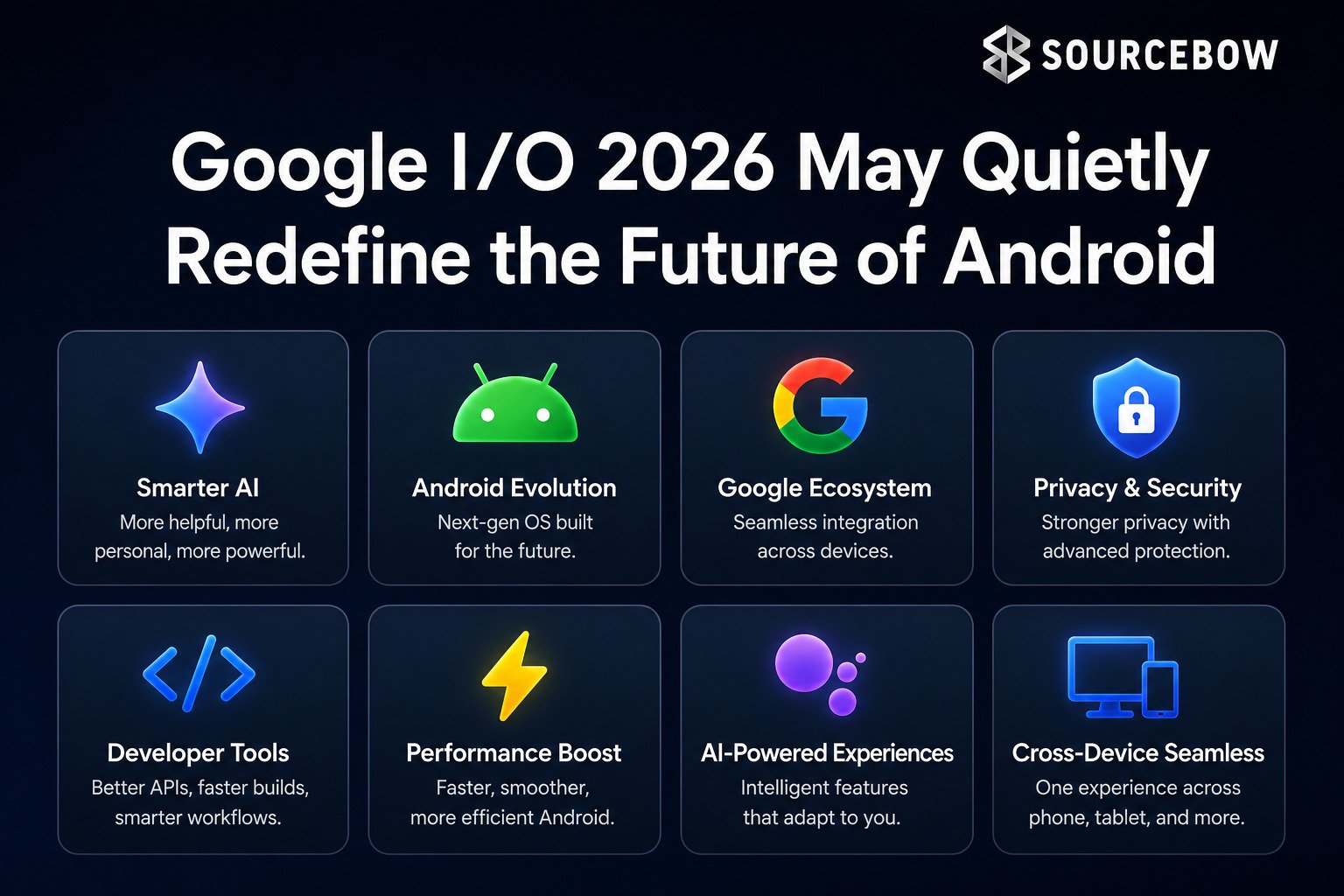
Quick Highlights
Why Google I/O 2026 feels different this time
Every Google developer conference has a main theme, but this year the mood feels more platform-defining than feature-focused. The event starts May 19, and the timing matters. By then, the AI race will be even more intense, with every major tech company trying to make its assistant feel less like a chatbot and more like a real helper that can take action.
That’s where Google’s approach gets interesting. Instead of treating AI as one product, it looks like Google is trying to fold it into the whole ecosystem. Phones, desktops, wearables, smart glasses, and maybe even new laptop hardware could all become part of the same connected experience. If that happens, the announcement cycle becomes less
about “what’s new” and more about “how Google wants people to live inside its software layer.”
And that’s a much bigger deal. In the past, Google I/O was often remembered for individual launches: a new Android version, a fresh Pixel feature, a developer tool. This time, the conversation is leaning toward convergence. The company seems to be building toward a world where your devices don’t feel separate anymore. They just become different surfaces for the same AI assistant.
Gemini is the part everyone will watch first
If there’s one area likely to dominate the stage, it’s Gemini. The expectation is that Google will show off more Gemini AI updates, and not just the usual quality-of-life improvements. The rumored direction is more agentic. In plain English, that means the assistant doesn’t just answer questions; it starts doing things on your behalf.
That could include scheduling, summarizing, drafting, organizing, and handling tasks across apps. There’s also chatter around an autonomous assistant codenamed Remy, which fits the bigger trend of AI agents becoming a breakout category in 2026. Instead of talking at you, the system becomes more like a layer that quietly works in the background.
Another key detail is multimodality. Gemini multimodal AI is expected to handle text, image, audio, video, and code together, which is a big leap from older assistants that mostly lived in a chat box. That matters because real life isn’t one format. You might snap a photo, dictate a note, ask for a summary, and then want it turned into a task or a message. A stronger multimodal assistant can connect those steps without making you do the glue work yourself.
That’s also why this isn’t just about chat. It’s about control. OpenAI and Microsoft Copilot have pushed the category forward in different ways, but Google’s advantage may be distribution. If Gemini shows up naturally across Android, ChromeOS replacements, and wearables, it can become the assistant people meet without thinking about it too much. That’s the shift from app to layer.
Android 17 looks like the first AI-native Android step
Android 17 features are likely to matter more than the typical version number suggests. Google already previewed Android 17 during the Android Show, so this isn’t coming out of nowhere. But what stands out is the direction: Android is starting to look less app-native and more AI-native.
That sounds abstract, but it’s pretty simple. Traditional Android is mostly about launching apps, switching between them, and relying on them individually. An AI-native version would try to understand context first. What are you doing right now? What device are you on? What should happen next? That could change the way Android works on phones, cars, wearables, and tablets.
For users, that might mean more proactive suggestions, smarter personalization, and deeper Gemini integration baked into the system rather than added on top. You could see this in notification handling, voice interaction, cross-device handoff, and maybe even more intelligent routines. The Android ecosystem is huge already, and that scale gives Google room to make AI feel less like a feature and more like the default behavior.
It’s also worth remembering that Android still commands massive global market share. That gives Google a runway most companies would envy. If a small percentage of that installed base starts using AI-first features daily, the impact could be enormous. Not flashy all at once, but steady. And in tech, steady adoption often wins.
Aluminum OS might be the real long game
Here’s the part a lot of people could miss: Aluminum OS may end up being more important than whatever gets the loudest applause on keynote day. The rumored idea is to merge Android and ChromeOS into a more unified desktop platform, and that’s not just a product tweak. It’s a philosophy shift.
If Google pulls this off, it could become the company’s biggest software shift since ChromeOS itself. The goal appears to be a more serious desktop experience with better window management, better peripheral support, and a smoother bridge between mobile and laptop workflows. In other words, a Google desktop platform that doesn’t feel like
a compromise.
That matters because desktop Android has always been the missing piece. Google has strong mobile software, huge cloud reach, and a massive ecosystem, but the desktop story has been fragmented. Aluminum OS could be the effort to close that gap. And with ARM-based PCs gaining momentum, the timing makes sense. More people are open to lighter, battery-efficient machines than they were a few years ago.
To make it easier to picture, here’s a simple comparison of what the big platform pieces could mean:
| Product | Main Focus | AI Integration | Expected Impact |
|---|---|---|---|
| Gemini | Agentic AI | Deep | Very High |
| Android 17 | Ecosystem overhaul | Native | High |
| Aluminum OS | Desktop convergence | Moderate | High |
| Googlebooks | AI laptops | Deep | Medium |
| Android XR | Wearable AI | Deep | High |
That table is the real story in miniature. Google isn’t just shipping products. It’s trying to connect them into one operating model.
Googlebooks could replace the old Chromebook idea
The rumored Googlebooks laptop category is another clue that Google wants a fresh start. If Chromebooks were about simple, affordable web-first computing, Googlebooks looks more like a move toward AI-first productivity. That’s a subtle but important shift.
Chromebooks have done well in education and lightweight work environments, but the market has changed. AI PCs are becoming a bigger category in 2026, and people now expect their devices to do more than just open docs and browse tabs. If Googlebooks launches as a Chromebook successor, the pitch will likely be that the machine is not only cheap and manageable, but also smarter out of the box.
Think of it this way: the old value proposition was “easy and safe.” The new one may be “easy, safe, and useful in a more intelligent way.” With Gemini integration built in, these laptops could help summarize notes, draft emails, organize assignments, and assist with workflows without requiring a separate app for every task.
That would make sense for both education and enterprise buyers. Schools care about simplicity and admin controls. Businesses care about productivity and device management. If Google can keep the low-friction appeal while adding real AI value, Googlebooks could become a serious second act rather than just a rebrand.
Android XR smart glasses might be the sleeper hit
The Android XR smart glasses story is easy to underestimate, but maybe it shouldn’t be. Google previewed the concept last year, and now the expectation is that it could surface again with more developer access and clearer product direction. The really interesting part is the fashion angle.
Collaborations with Gentle Monster and Warby Parker suggest Google understands something important: smart wearables need to look normal before they can become normal. That’s been one of the biggest barriers for wearable AI products. Nobody wants to wear something that feels like lab equipment all day.
By leaning into design partnerships, Google is signaling that XR glasses aren’t just for hardcore tech users. They’re meant to fit into everyday life. That’s smart, because the next wave of wearable AI will probably succeed when it stops looking futuristic and starts looking familiar.
Will they go mainstream immediately? Probably not. XR market growth is real, but adoption usually takes time, especially for hardware that sits on your face. Still, if Google gets the comfort, style, and assistant experience right, these AI glasses could become one of the most interesting long-term bets in the entire lineup.
So what matters most across the whole event?
If you step back, the pattern is pretty clear. The biggest news isn’t likely to be one product stealing the show. It’s the way each product reinforces the next one. Gemini powers Android. Android points toward wearable AI. Wearables connect to XR. Desktop ambitions push Aluminum OS forward. And Googlebooks gives the whole thing a laptop story that feels native to the rest of the ecosystem.
That’s why this feels more like an ecosystem war than a normal launch event. Apple is still the standard for hardware-software coordination. Microsoft keeps pushing productivity AI into work workflows. Google seems to be aiming at both, but from a different angle: ambient AI across as many surfaces as possible.
Here’s the short version. If Google gets this right, the win won’t be one headline. It’ll be habit change. People will start using Google’s AI ecosystem without thinking much about it, and that’s usually when a platform gets dangerous in the best possible way.
And if you’re trying to follow the Google AI announcements 2026 closely, that’s the lens to use. Don’t just ask what launched. Ask what got connected. That’s where the real shift probably is.
Which part feels most likely to change your day-to-day use first: Gemini, Android 17, Aluminum OS, Googlebooks, or the Android XR smart glasses? If you want, follow the live coverage and keep an eye on how the pieces fit together, because that’s where the interesting part is hiding.