If you’ve been juggling multiple model providers and wondering why things suddenly feel messy, an AI router in 2026 is probably the missing layer you haven’t been looking at closely enough. It sits between your app and a bunch of LLMs, makes a choice for each request, and can quietly handle failover, testing, and even voice signals without turning your stack into a patchwork of scripts.
Here’s the interesting part: the real question isn’t whether multi-model setups can work. They can. It’s whether routing makes them cheaper, cleaner, and easier to manage than throwing every request at one expensive model and hoping for the best.
Quick Highlights
- Routes each request to the model that fits best
- Can reduce spend by avoiding overpowered models
- Helps with failover and A/B testing too
- Voice signals can improve routing in speech apps
- Some tools are gateways; others are true routers
Introduction
An AI router cuts costs, adds failover, and routes to 220+ LLMs with CEL rules, A/B testing, and voice-aware signals. That’s a lot packed into one layer, but the core idea is simple enough: instead of sending every request down the same path, the router decides what should happen next.
And that matters more than people first realize. Once you’re working with several models, the problem stops being “which model exists?” and becomes “which model should handle this specific request?” That’s where routing starts to feel less like a nice extra and more like a practical control point.
The real question is not whether multi-model setups work — it’s whether routing makes them cheaper and less chaotic than sending everything to one model. In many teams, that answer is yes, especially once traffic volume grows and the requests themselves start to vary a lot.
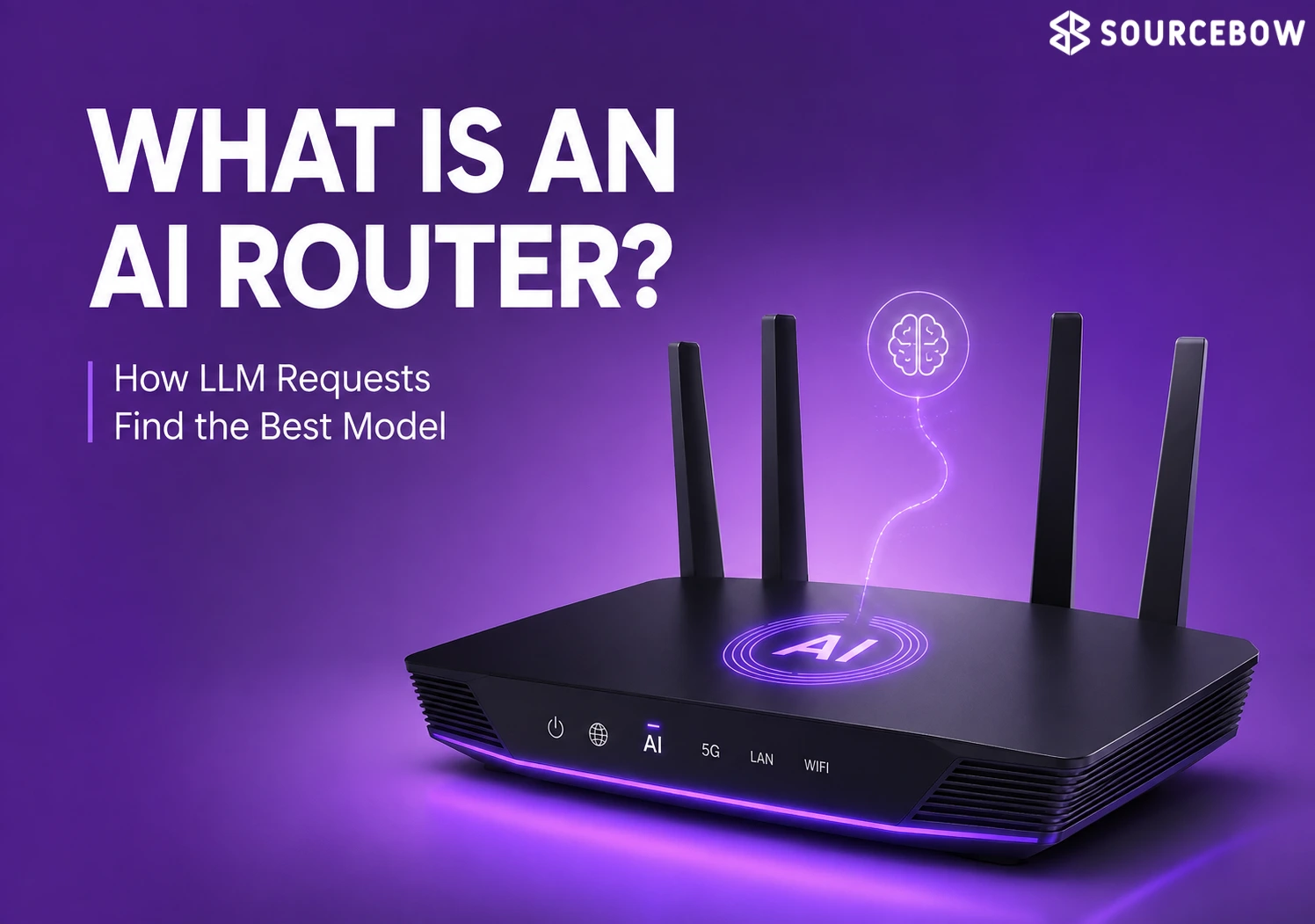
An AI router sits between your application and multiple model providers, then chooses the model based on cost, latency, quality, or business rules. Inworld Router routes through an OpenAI-compatible API endpoint and returns logging on the model used, latency, and attempt chain.
The basic flow is simple: request in, rules checked, model selected, response returned. If the primary fails with a 429, 5xx, or timeout, the router retries with the next model in the fallback chain. That makes it feel a bit like a traffic controller, except the traffic is made of prompts and responses instead of cars.
Look, that’s the part people underestimate. A router isn’t just pointing traffic somewhere else. It’s making a choice under constraints, and those constraints can change from one request to the next.
The routing decision can use metadata, content, and failure handling at the same time
Routing rules can look at user tier, region, content analysis, cost constraints, and latency requirements before choosing a model. That’s the difference between a dumb proxy and something that actually reacts to the request in front of it.
So if a paying customer sends in a long, complex request, the router might choose a stronger model. If a free user asks something simple, it can go cheaper. If the first provider is struggling, the failover path kicks in without making the app feel broken.
Why routing changes the economics of running multiple models
Routing saves money by matching model price to task complexity instead of treating every request like it deserves a frontier model. The raw math matters here: frontier reasoning models cost an order of magnitude more than budget models.
If 60% of production traffic is just greetings, classification, or short answers, sending those to lightweight models can turn into recurring savings at scale. University of Michigan research on the Eagle router found significant cost reduction while keeping task quality intact.
- Simple tasks: greetings, classification, short answers
- Complex tasks: deep reasoning, code generation
- Scale effect: savings compound across production traffic, not one request at a time
That scale effect is the real story. A few cents saved on one request doesn’t feel dramatic. But across thousands or millions of requests, the difference becomes very real, very quickly.
And here’s where many teams get trapped: they assume the “best” model should handle everything because it’s safest. But safe doesn’t always mean efficient. Sometimes it just means expensive.
The production reality in 2026 is usually five or more models
The article’s premise is blunt: teams are routinely running five or more models, so routing is now the layer that decides whether that setup is cost-effective or just messy. In production, the difference shows up in recurring spend, not a one-time benchmark.
That’s why routing has shifted from being a fancy optimization idea to a practical necessity. Once your stack includes several providers, model choice becomes operational, not theoretical.
AI gateway vs. AI router: same surface, very different behavior
People use the terms interchangeably, but the capabilities are not the same. An AI gateway gives unified API access and failover; an AI router adds dynamic selection based on request content, user context, and business rules.
| Capability | AI Gateway | AI Router |
|---|---|---|
| Unified API access | Yes | Yes |
| Failover | Yes | Yes, with attempt chain transparency |
| Routing intelligence | None to minimal | Dynamic: request content, user context, business rules |
| A/B testing | Rarely | Native (with sticky user assignment) |
| Cost optimization | Indirect | Direct: matches model cost to task complexity |
Most modern tools blur the line, but the distinction still matters when you care about more than just access. Inworld Router is both gateway and router; Vercel AI Gateway and OpenRouter are primarily gateways.
That difference sounds small until you’re actually operating at scale. Then it becomes the difference between “we can reach models” and “we can intelligently decide which model should work on what.”
Why voice-aware routing is the most interesting part of the stack
Voice-aware routing extends the decision-making layer into speech applications instead of stopping at text. With Realtime STT and the Realtime API, the router can receive acoustic signals like speaker emotion, age, hesitation, language, and conversational dynamics.
That changes the routing question from “what did the user say?” to “how is this being said?” A frustrated caller can be routed to a more capable model, while a simple question can go to a fast, cost-effective one.
And honestly, that feels like a real step forward. Text-only routing is useful, but voice carries extra context that can matter a lot in live conversations. The pause before a sentence, the strain in someone’s voice, the pace of the interaction — these things are not fluff. They’re signals.
Few routers ship this because most are still pure LLM proxies
The article is explicit that few AI routers have upstream STT context today. Inworld Router is positioned differently because it is tied into Realtime STT, Realtime TTS, and the Realtime API rather than acting like a standalone text proxy.
That’s a big reason it stands out. A lot of tools are built to move prompts around. Fewer are built to understand the whole speech pipeline, and that makes voice-aware routing feel a bit more future-facing than standard model selection.
| Router | Models | Routing Type | A/B Testing | Voice-Aware |
|---|---|---|---|---|
| Inworld Router | 220+ (3P) plus Inworld-optimized open-source (1P) | Conditional (CEL) | Native | Yes |
| OpenRouter | Broadest catalog | Availability-based | No | No |
| Portkey | Largest catalog | Cost, weighted, region | Basic | No |
| Vercel AI Gateway | Major frontier providers | Static fallback | No | No |
| LiteLLM | Self-hosted catalog | Latency, cost, weighted | No | No |
Few routers ship this because most are still pure LLM proxies, so if you’re building voice products, the gap becomes obvious pretty fast. Once speech enters the picture, the router has more context to work with, and that can improve both experience and efficiency.
The model list includes both third-party providers and Inworld-optimized open-source models
The named third-party providers are OpenAI, Anthropic, Google, Mistral, DeepSeek, xAI, Meta, Groq, and DeepInfra. The Inworld-optimized open-source set includes Gemma 4, DeepSeek V3.2/V4, and GLM-5.1/5.2 on first-party infrastructure.
That split is part catalog, part control layer, which is why the article treats routing as infrastructure rather than a thin API convenience.
And that’s probably the cleanest way to think about it. The bigger the model menu gets, the more valuable the routing logic becomes. Otherwise, you’re just collecting options without a good way to use them.
FAQ
These are the smaller doubts readers tend to have after they understand the main routing tradeoffs.
Q: What is an AI router?
A system that dynamically selects which model handles each request based on cost, latency, quality, or business rules. In practice, that can mean routing across providers like OpenRouter, Portkey, LiteLLM, and Inworld Router.
Q: How does an AI router save money?
By sending simple work like greetings, classification, and short Q&A to cheaper models while keeping deep reasoning and code generation on frontier models. The point is to match model price to task complexity instead of overpaying for every request.
Q: Is an AI router the same as an AI gateway?
No. A gateway is mainly unified access and failover; a router adds intelligent model selection. Inworld Router does both, while Vercel AI Gateway and OpenRouter are primarily gateways.
Q: What is voice-aware routing?
It uses acoustic signals from Realtime STT — emotion, hesitation, speaker profile, and conversational dynamics — to influence model choice. That makes the system react to how someone is speaking, not just the text they produced.
Conclusion
An AI router makes the most sense when multi-model deployments are already real and the next problem is cost, failover, and fit. The 2026 version of the category is moving toward conditional routing, voice-aware signals, and native A/B testing, not just a smarter proxy.
If you are deciding between a gateway and a router, start with the job you need the system to do next: unified access, or actual model selection.
That’s the simplest way to look at it. If all you need is a single doorway into a few providers, a gateway may be enough. But if you want the system to make smarter choices on your behalf, an AI router is where the real leverage starts showing up.