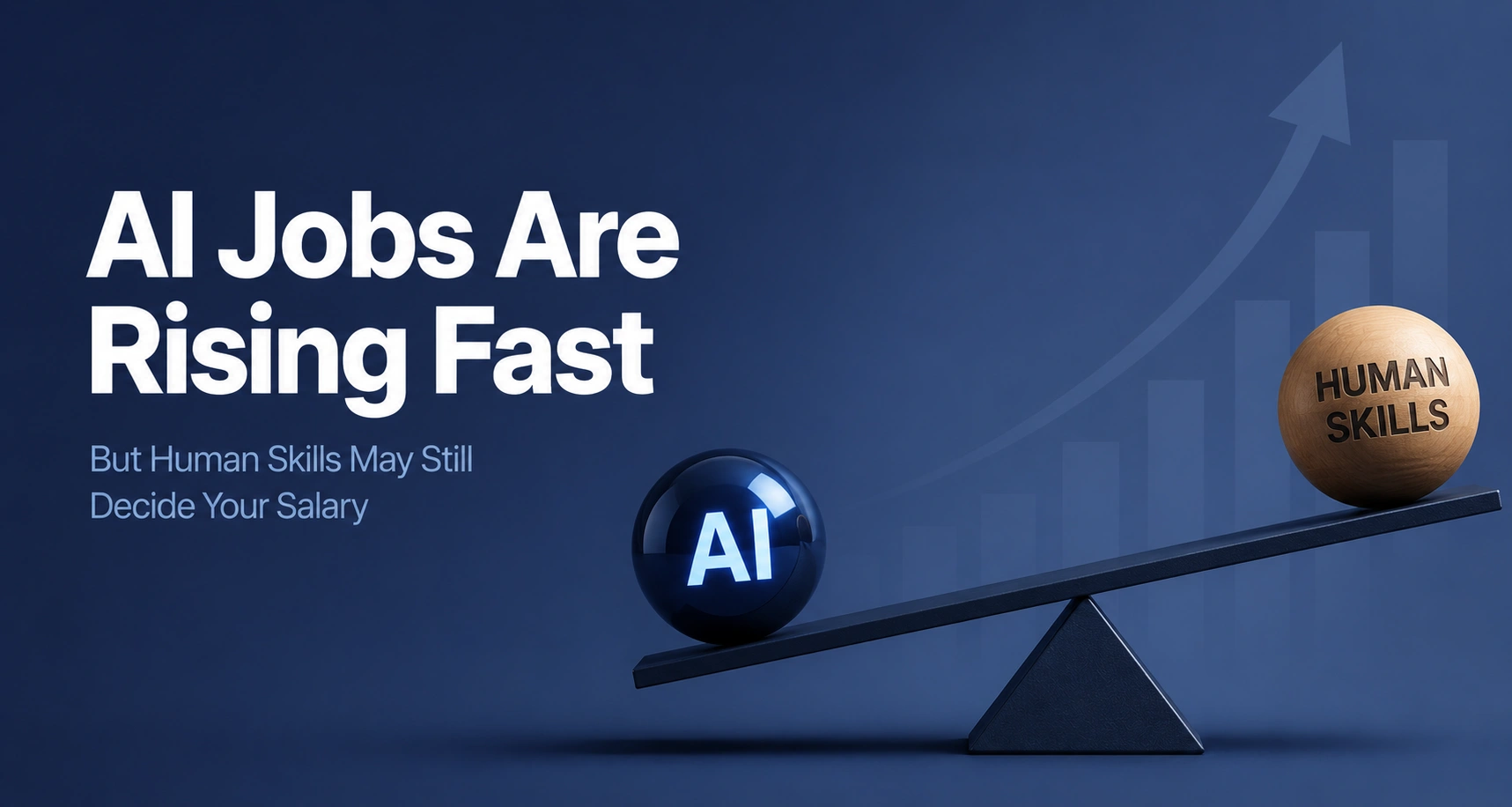
AI Jobs is changing hiring faster than most people expected. But here’s the twist: the skills getting more valuable in 2026 are often the ones that look the least “technical” on paper. Adaptability. Communication. Judgment. The stuff that still matters when the tools get smarter.
If you’ve been wondering whether your degree, job title, or current role will still carry the same weight, you’re not alone. Companies are moving toward skills-based hiring, rethinking internal mobility, and using AI to speed up work without removing people from the picture. That shift changes careers in a very real way.
Quick Highlights
- Human skills are becoming a bigger hiring signal.
- AI Jobs is boosting productivity, not fully replacing teams.
- Skills-based hiring is replacing rigid job titles.
- Reskilling is often faster than external hiring.
- Career growth is becoming more flexible and less linear.
The AI Jobs shift is changing what “qualified” really means
The big change in 2026 isn’t just that more companies are using AI. It’s that they’re evaluating people differently. For years, hiring often leaned heavily on degrees, job titles, and neat career ladders. Now, more employers want to know what you can actually do, how quickly you learn, and whether you can work well with both people and machines.
That doesn’t mean formal credentials are useless. Far from it. But the balance is shifting. A candidate with strong practical skills, a few real projects, and the ability to adapt can often look more useful than someone with a polished resume but no flexibility. That’s especially true in fast-moving teams where responsibilities change every quarter, not every year.
And honestly, that can feel a little unsettling. If you’ve built your career around a title or a single path, this new model may seem messy. But it also opens doors. People who used to be boxed out by traditional hiring filters now have a better shot if they can show clear capability.
Why human skills are becoming more important in the AI era
Here’s the thing: AI is good at patterns, speed, repetition, and data processing. It’s still not great at trust, nuance, persuasion, or knowing how to respond when a situation is emotionally charged or strategically unclear. That’s why human skills are climbing in value so quickly.
Companies that are adopting AI well usually don’t treat it like a magic replacement. They use it to take repetitive work off people’s plates so employees can focus on the parts that need judgment. That puts a spotlight on communication, leadership, and decision-making. If a team can’t align on goals, explain trade-offs, or resolve friction, the technology won’t save them.
Trust-building is another one. In a workplace full of automation, people still need leaders they can rely on. They need colleagues who can make sense of ambiguity and explain what’s changing. AI can summarize information, sure. But it can’t build a culture where people feel safe making hard decisions together.
That’s why human skills in 2026 are less like “soft extras” and more like the actual operating system of modern work.
How AI is enhancing work instead of replacing employees
A lot of the panic around AI comes from the idea that every new tool is really just a replacement waiting to happen. But in many organisations, the opposite is happening. AI is being used to improve speed, reduce friction, and free up time for better work.
Think of it like this: if a team spends hours sorting reports, drafting first versions, or summarising internal information, AI can handle some of that grunt work. That doesn’t erase the team. It changes what the team spends its energy on. Instead of being buried in repetitive tasks, people can focus on strategy, creative thinking, client relationships, and problem-solving.
This is especially visible in roles where judgement matters. A tool can suggest, rank, draft, or predict. But someone still has to decide whether the suggestion actually makes sense in context. That’s the part many businesses are trying to protect.
So the real workplace trend isn’t “AI versus humans.” It’s more like humans using AI to work faster while staying responsible for the outcome. That’s a much more practical way to think about it.
Which human skills are most valuable in 2026?
Employers in 2026 are paying close attention to a specific mix of capabilities. Not just “good communication” in the abstract, but the kind of human skills that help teams move faster and make better decisions under pressure.
- Interpersonal influence for persuading teams, clients, and stakeholders
- Intercultural collaboration for working across regions and backgrounds
- Leadership for guiding people through change
- Operational thinking for understanding how work actually gets done
- Contextual judgment for making smart calls when the data isn’t enough
That list matters because it shows what companies are really buying when they hire. They’re not just buying tasks. They’re buying the ability to navigate complexity. A person who understands the bigger picture, communicates clearly, and can work across departments often creates far more value than someone who can only stay inside one narrow lane.
And yes, AI literacy is part of that mix too. You don’t need to be a machine learning engineer to stay relevant. But you do need to understand how AI tools fit into your workflow, where they help, and where they absolutely need human oversight.
Skills-based hiring is replacing traditional job structures
One of the biggest shifts linked to LinkedIn job market trends is the move toward skills-based hiring. In plain English, that means companies are less interested in locking everyone into fixed job titles and more interested in matching actual capabilities to actual work.
This matters because many modern teams don’t operate like old-school org charts anymore. Work is often project-based, cross-functional, and fast changing. A single person might contribute to marketing, operations, and customer experience in the same month. Rigid titles can get in the way of that.
It also changes how managers think. Instead of asking, “Who owns this role?” they ask, “Who has the right skill for this task right now?” That’s a much more flexible way to run a company, especially when AI tools are accelerating the pace of change.
For job seekers, this is good news if you can show proof of ability. Portfolios, project work, case studies, and practical experience often speak louder than a clean title on paper.
Why job titles matter less in modern organisations
Job titles still exist, of course. But in many workplaces, they’re becoming less important than the actual tasks you can handle. A “manager” might not manage people. A “specialist” might lead strategy. A “coordinator” might own part of a major initiative. Titles are starting to feel more like rough containers than fixed identities.
That shift can be freeing, but it can also be confusing. The upside is that people can contribute beyond their official lane. The downside is that career paths can feel less obvious. You may need to advocate for yourself more, show your impact more clearly, and keep a better record of the value you create.
That’s not a bad thing, but it is a different kind of career game.
Are degrees still important for career growth?
Yes, but not in the old automatic way. Degrees still offer credibility, structure, and foundational knowledge. For many fields, they also act as an initial filter. That part hasn’t disappeared.
What’s changed is the weight they carry after that first step. Employers are increasingly looking for practical skills, project experience, and learning agility. In other words, can you apply what you know? Can you pick up new tools quickly? Can you adapt when the work changes?
If you have a degree, it can still help you. If you don’t, it doesn’t automatically close the door the way it once did. The stronger your evidence of skill, the less your career depends on a single credential.
Why real-time skills visibility is becoming critical
Companies want to know what their people can do right now, not just what they were hired for two years ago. That’s what real-time skills visibility is about. It’s the ability to see employee capabilities clearly enough to deploy teams quickly as business needs shift.
This matters because work changes faster than traditional HR systems usually do. A company might suddenly need people who can handle AI-enabled workflows, customer communication, or process redesign. If leaders don’t know where those skills already exist, they waste time and money.
So organisations are investing in better ways to map skills internally. That helps them move talent around faster, avoid unnecessary hiring, and make smarter decisions when priorities change.
Internal mobility is becoming a bigger part of career growth
Career growth used to look pretty linear: get hired, get promoted, move up, repeat. That model still exists in some places, but it’s no longer the only one. In many companies, internal mobility is becoming a more realistic path.
That means moving sideways, trying new functions, taking on broader responsibilities, or reskilling into a different role altogether. It may not sound as neat as a promotion ladder, but it’s often more useful in an AI-shaped workplace.
Why? Because the old definition of “advancing” doesn’t always fit how work operates now. Sometimes the smartest move is not up, but across. A cross-functional move can teach you more, make you more valuable, and put you closer to the parts of the business that are growing.
Why companies prefer reskilling existing employees
Hiring externally takes time. It’s expensive, uncertain, and often slower than leaders want. That’s why many companies prefer to reskill employees they already know.
It’s usually easier to train someone who already understands the company, the culture, and the internal systems than to bring in a brand-new person and hope they settle quickly. This is especially true in AI-related roles, where the tools and expectations are changing so fast that yesterday’s perfect hire may not be tomorrow’s best fit.
Reskilling also sends a message. It says the company sees people as assets worth developing, not just labor to be swapped out.
How employees can adapt to non-linear career paths
If the career ladder is becoming less rigid, then adaptability becomes your real safety net. The people who do well in this environment usually keep learning, stay curious, and don’t panic when responsibilities shift.
That can look like taking a course on a new tool, asking for exposure to a different team, or volunteering for a project outside your usual comfort zone. It can also mean getting better at collaboration, because cross-functional work is where a lot of growth happens now.
You don’t need to reinvent yourself every six months. But you do need to stay moveable. The more easily you can learn, contribute, and shift gears, the more competitive you become in the AI economy.
Is AI actually cheaper than human workers?
This is where a lot of people get surprised. AI can look cheaper on the surface, especially when companies focus on automation and productivity gains. But once you add in infrastructure, compute, integration, licensing, maintenance, and ongoing oversight, the costs can get a lot bigger.
Large-scale AI adoption is not free. It takes planning, reliable systems, and people who know how to manage it responsibly. In some cases, the expense makes companies think twice about replacing large parts of the workforce. They realise that a balanced model is simply more stable.
That’s one reason human workers still matter so much. It’s not just sentiment. It’s economics. Businesses need flexible people who can adapt without requiring a huge technical stack behind every task.
Why AI costs are influencing hiring decisions
When AI implementation gets expensive, companies become more selective about where they use it. That usually pushes them toward mixed teams rather than full automation. They’ll automate certain repetitive workflows, but keep humans in the loop for judgement, service, quality control, and edge cases.
This is actually a healthy correction. It encourages leaders to think carefully instead of chasing hype. The smartest hiring decisions in 2026 often come from asking: what should AI do, and what should people keep doing?
That question is shaping how teams are built. It’s less about replacing headcount and more about finding the right blend of automation and human flexibility.
Why humans still offer long-term business advantages
Human employees bring something AI still struggles with: adaptation under pressure. People notice context. They adjust when a client changes direction. They understand unspoken tension in a meeting. They can make a sensible call when the data is incomplete.
There’s also a cost advantage in the long run. AI systems can create unpredictable expenses through scaling, maintenance, and operational complexity. Human teams aren’t cheap either, obviously, but they’re often more predictable in a strategic sense.
And then there’s the simple fact that businesses are built on relationships. Trust, leadership, and judgment don’t disappear just because software gets better. If anything, they become more important.
FAQ
Will AI replace most jobs in the next few years?
Current hiring trends suggest AI will augment a lot of work rather than fully replace it. Companies are using AI to improve productivity, but they still rely heavily on human collaboration, judgment, and adaptability. So the near future looks more like reshaping jobs than wiping them out.
What skills are most important for future careers?
Communication, leadership, problem-solving, collaboration, AI literacy, and continuous learning are becoming core employability skills across industries. Those are the skills that help people work well with change, not just survive it.
Are companies hiring based more on skills than degrees?
Yes, many employers are moving toward skills-first hiring models. Practical ability and learning potential are getting more attention, often alongside formal qualifications rather than below them.
How can students prepare for AI-driven workplaces?
Students can improve career readiness by combining technical literacy with soft skills, real-world projects, and the ability to adapt quickly to new tools. The more you can show that you can learn, apply, and collaborate, the better positioned you’ll be.
Conclusion
The future of work in 2026 isn’t really about choosing between people and AI. It’s about figuring out how they work together without losing the human side of business. The companies moving fastest are the ones treating adaptability, skills-based growth, and collaboration as core strategy, not side notes.
For workers, that means the safest career move may not be chasing a perfect title. It may be staying useful, staying curious, and building the kind of skills that travel well across roles and industries. That’s a pretty good long game, honestly.
If you’re planning your next step right now, maybe the better question isn’t “Will AI take this job?” It’s “What parts of my work are still strongest when the tools get smarter?”