Introduction
If you’re trying to sort out AI agents vs AI automation, the real question isn’t which one sounds more impressive. It’s which one fits the work you actually need done, without turning into a headache six weeks later. An experienced AI agent development company can help you identify the right approach based on your business goals, budget, and operational needs.
That’s why it helps to compare costs, failure modes, and use cases before you choose between workflows and agents. The wrong choice usually shows up fast in cost, debugging, and trust, and once that happens, people stop caring what the system was called in the first place.
Quick Highlights
- Automation is best for repeatable, rule-based work.
- Agents are useful when the next step depends on context.
- Costs rise fast when every decision needs a model call.
- Reliable systems usually start with workflows first.
So, before you chase the smartest-sounding option, it’s worth drawing a hard line between repeatable workflows and systems that have to decide as they go. That line matters more than most people think. It shows up in cost, debugging, reliability, and even how much your team trusts the thing after launch.
Choosing between AI agents and AI automation depends on your business goals, workflow complexity, and budget. An experienced AI Agent Development Company can help you understand the differences in development costs, potential failure modes, and practical use cases to identify the right solution for your needs. Whether you want to automate repetitive tasks or build intelligent AI agents that handle complex decisions, choosing the right approach can improve efficiency, reduce operational costs, and support long-term business growth.
What’s the difference between AI agents and AI automation?
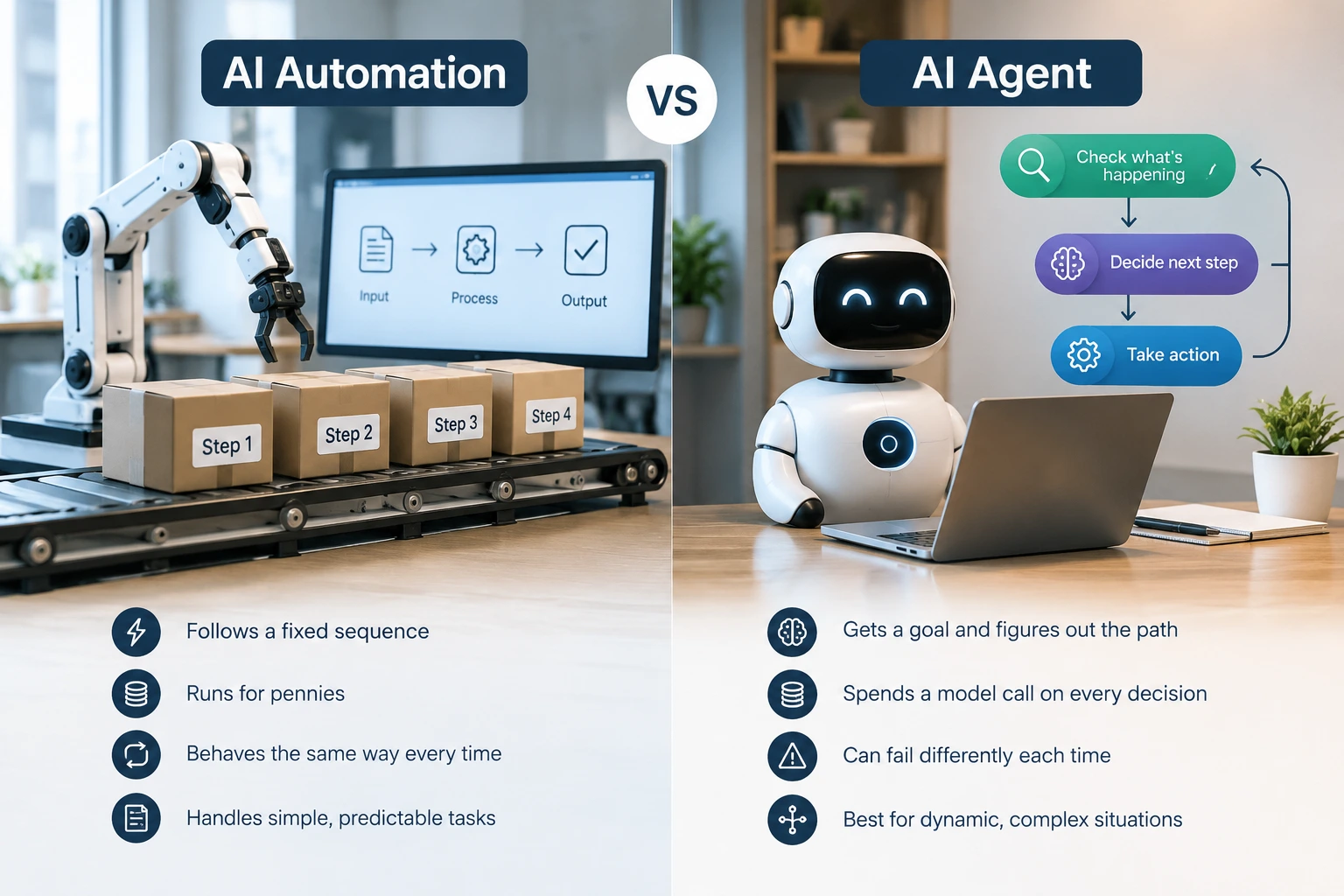
The simplest way to think about it is this: AI automation follows a fixed sequence, while an AI agent gets a goal and figures out the path itself. One is more like a conveyor belt. The other is more like a capable assistant that keeps checking what’s happening and choosing the next move.
That difference sounds small until you price it. Automation runs for pennies and behaves the same way every time, while an agent spends a model call on every decision and can fail differently each time. That variability is the part people underestimate. It sounds flexible, but flexibility has a cost attached.
The fit is different too. Automation handles work you could hand to a new starter with a one-page instruction sheet. Agents are for situations where the next step depends on what just happened. If the process is predictable, you usually don’t need a decision-maker. You need something that follows instructions reliably.
How does AI automation actually work?
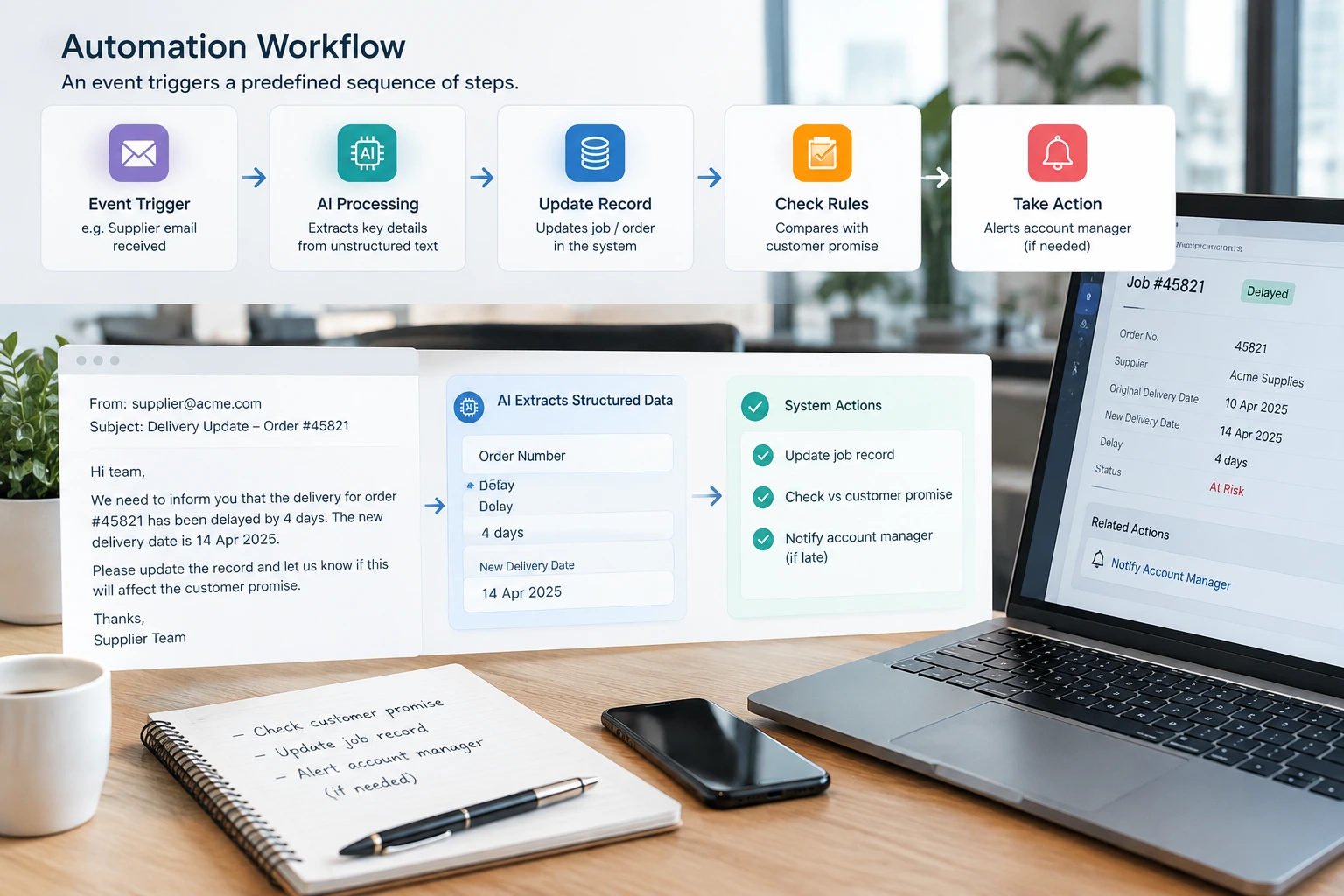
Automation starts with an event and then follows the path someone already set. A form submission. An invoice arriving. A stock level dropping below twelve. Even a Thursday arriving, if the system is built that way. The trigger happens, the workflow wakes up, and the steps run in a fixed order.
Here’s a concrete example. A supplier says a delivery has slipped by four days. The workflow extracts the order number and new date, updates the job record, checks it against the customer promise, and pings the account manager if the job will run late. That’s not magic. It’s just a clean chain of actions, with the messy human text being turned into structured fields.
The important point is that the AI reads messy language and turns it into clean fields, but the rule about whether to alert anyone is still written by a person. That’s the essence of automation: the system helps process the input, but it doesn’t decide the policy unless someone explicitly tells it to.
Why workflow reliability depends on error handling, not the model itself
What keeps a workflow alive is usually error handling and retries, not the AI part. That may sound boring, but boring is good when you want systems to stay up. A workflow that fails loudly gets fixed in an afternoon. One that fails silently can lose records for a fortnight and quietly destroy trust.
And that’s why reliable automation often looks less like “smart AI” and more like disciplined plumbing. If the input is malformed, the system should catch it. If an API times out, it should try again. If the output doesn’t match expectations, it should stop and ask for help instead of pretending everything is fine.
- Predictability matters because the same input gives the same output, so errors are easy to spot.
- Low cost matters because a thousand supplier emails monthly can cost about the same as a lunch.
Where automation stops making sense
Automation starts to break down when the input is too messy to reduce to one rule. Think of a message like: “We’ve had to split your order, two items going out Tuesday, the rest whenever the sensor housings land, probably mid-month.” That’s not one clean date. That’s a bundle of uncertainty.
There’s no single date to extract, no clean rule for partial shipments, and once the branching gets out of hand the workflow becomes too risky to keep changing. At that point, you’re not really running a neat workflow anymore. You’re trying to patch judgment into a system that was built to follow instructions, and that usually gets ugly fast.
How does an AI agent actually work?
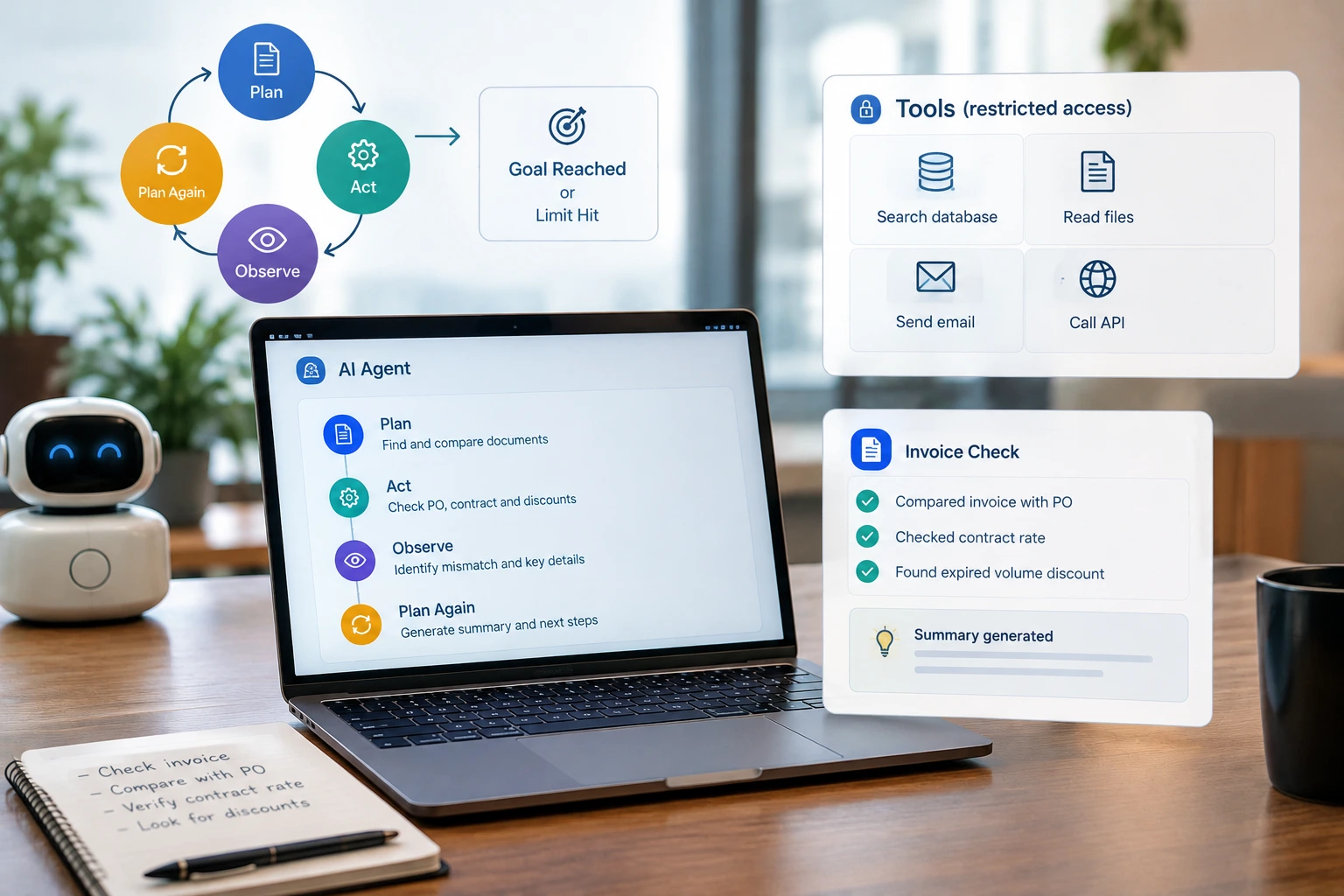
An agent runs a loop: it plans, acts, observes, then plans again until it reaches the goal or hits a limit. That loop is the whole trick. Instead of
executing a fixed path, it keeps adjusting based on what it finds.
Its tools are ordinary functions — search this database, read that file, send an email, call this API — and that tool list is one of the main safety controls in the build. In other words, the agent doesn’t get to wander anywhere it wants. It can only use the tools it’s been given. That’s an
important guardrail, especially once the system starts touching real business data.
The finance example makes it plain. If an invoice doesn’t match the purchase order, the agent compares the documents, checks the contract rate, finds an expired volume discount, and writes up what it found. That’s useful because the task isn’t just repeating a known path. It’s interpreting clues and deciding what matters next.
Why agents are more expensive, harder to test, and slower to trust
Every loop costs a model call, so a five-step resolution needs at least five calls with full context. That adds up quickly. What looks like a smart
shortcut can become the expensive part of the stack before anyone notices.
You also can’t predict the route, which means the same question may be solved two different ways. And once the route changes, testing gets messier. With automation, you can verify a straight line. With an agent, you’re often checking whether it found a good enough path among several possible ones.
The failure math gets ugly fast too. Success rates can drop to 77% for five steps and near 60% for ten. That doesn’t mean agents are bad. It means they’re much easier to admire in a demo than they are to trust under pressure.
- Every loop costs a model call.
- You can’t reliably predict the route.
- Errors multiply across steps.
What does the market data show?
The market says automation is still the bigger, more mature business, even if agent interest is growing faster. That’s a useful reality check, because hype tends to make the newer thing sound like it has already won. It usually hasn’t.
Robotic process automation reached roughly $35.27 billion in 2026 and is forecast to hit $247 billion by 2035, while the AI agent market is about $12.06 billion in 2026 and heading toward $53.2 billion by 2030. So yes, agent growth is real. But automation is still the category with more established production usage and more predictable deployment patterns.
That growth story is real, but production adoption is still thin, and the vendor landscape is noisier than the pitch decks suggest. Plenty of products say “agent” now because it sounds modern. That doesn’t automatically mean they behave like an actual agent in the way most teams would need.
| Metric | Automation | Agents |
|---|---|---|
| Market size in 2026 | $35.27 billion | $12.06 billion |
| Forecast | $247 billion by 2035 | $53.2 billion by 2030 |
| Growth signal | Mature, long-deployed category | About 4x faster growth |
- 45% annual growth rate of the AI agents market through 2030.
- 10% of organizations are scaling AI agents in any single business function.
- 40%+ of agentic AI projects are expected to be canceled by 2027.
- 130 vendors are genuinely offering agentic AI, out of thousands claiming it.
McKinsey’s global survey adds the adoption detail: around 23% have scaled agents somewhere in the business, 39% are still piloting, and only 39% can point to measurable EBIT impact. That’s a pretty good reminder that interest and outcomes are not the same thing. A lot of teams are experimenting. Far fewer are actually seeing financial proof.
Gartner’s research also names the problem directly as “agent washing,” which is why the useful demo question is what happens when the first step comes back with nothing useful. If the system can’t recover from a dead end, then it’s not really helping you make decisions. It’s just performing decision-making on the surface.
What happens when automation alone isn’t enough?
Automation handles the work somebody anticipated, but every process leaves behind a tail of exceptions that gets more visible as the routine stuff disappears. Once the easy volume is automated, what’s left is usually the stuff that’s hard to categorize.
That’s where programs stall. The dashboards look healthy, but the remaining work is all the hard kind, and more branches won’t solve something nobody can enumerate. You can keep adding if-this-then-that logic for a while, but eventually you hit the point where the exceptions are the whole story.
An agent matters when it can take a request nobody scripted, pull from several systems, and either solve it or hand a person a proper summary instead of a raw ticket. That’s the practical value. Not that it thinks like a human. Just that it can sort through a messy situation enough to move it forward.
Why agents sit above workflows instead of replacing them
The strongest version of this is layered, not competitive: automation carries the predictable volume, and the agent handles arrival and judgment. That’s usually the cleanest design. It keeps the expensive parts limited to the situations that actually need them.
That means the agent can read a messy inbound request, work out what’s being asked, and trigger the right workflow with the right data. In practice, this is where the two ideas start to blend. The agent does the interpretation, and the workflow does the reliable execution.
This is where AI workflow automation services and custom AI agent development services start to overlap in a practical way. One isn’t automatically better than the other. They just solve different layers of the same operational problem.
How do the two work together?
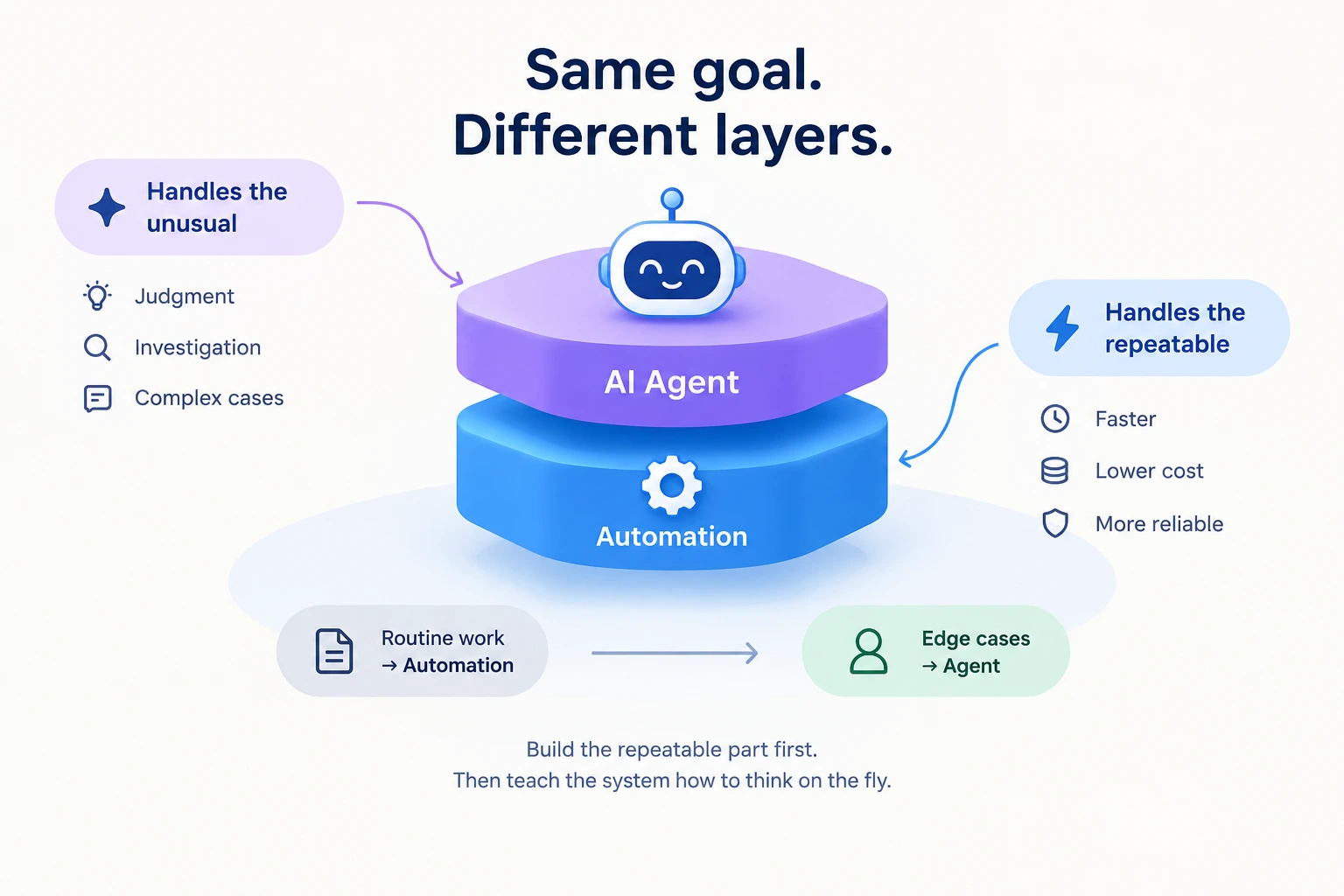
The two are not alternatives. They are layers of the same system, each doing what the other can’t. That’s the part people often miss when they frame the decision as a head-to-head competition. The better question is: which layer should carry which kind of work?
Automation makes the stack affordable because routine work should not burn model calls, while the agent makes the stack usable because unusual work still needs judgment. If you use the agent for everything, costs rise and reliability gets fuzzy. If you use automation for everything, weird cases pile up and humans get dragged back in anyway.
The sensible default is automation first, because it ships in weeks, costs less to prove, and exposes the edge cases you later need the agent to handle. In other words, build the repeatable part before you try to teach the system how to think on the fly.
- Could a new starter follow a one-page document and get it right nearly every
time? - Are you describing a process or a job?
There are exceptions, of course. Research, investigation, and triage across several systems may justify going straight to an agent on day one. If the whole value of the system depends on interpretation and not repetition, then automation alone may not be enough.
The practical line is simple: choose the layer that matches the work, then let AI business consulting map where that line should sit. That’s
usually a better path than forcing everything into one bucket just because the market is talking loudly about agents.
FAQ
These questions come from the doubts people still have after they understand the definitions but before they trust the recommendation. And honestly, that’s normal. The concept is easy. The implementation is where people get cautious.
Q: When should I choose an AI agent instead of automation?
Choose an agent when the next step depends on whatever the last step revealed, or when the request is too messy to pre-map into a fixed workflow. If the process changes based on context, an agent is usually the better fit.
Q: What is the biggest risk with agentic AI projects?
The biggest risk is assuming flexibility is free. It usually shows up as higher build cost, variable running cost, slower responses, and harder
debugging. In other words, the system may look elegant upfront and become expensive later.
Q: What is agent washing?
It’s when vendors relabel existing software as agentic AI without adding true decision-making behavior. Gartner says only about 130 vendors genuinely offer agentic capability, so the label alone isn’t much of a signal anymore.
Q: Do I need both automation and agents?
Usually, yes. Automation should handle the repeatable work, and agents should sit above it to make judgment calls and route unusual cases. That layered setup is often the most stable and cost-effective option.
Conclusion
If you’re choosing between automation and agents, the point isn’t to crown a winner. It’s to build the cheaper, safer layer first and reserve agent logic for the work that truly needs judgment. That simple shift in thinking can save a lot of time, money, and false confidence.
Start with the process that can be mapped cleanly, then add the agent where exceptions, judgment, and messy inputs make the workflow too brittle to trust. That’s the real difference between a system that looks smart and one that actually holds up in daily use.