Introduction
OpenAI’s new ChatGPT Lockdown Mode is one of those features that sounds small until you think about what it’s reacting to. It’s not really about making ChatGPT nicer to use. It’s about making it harder to trick. And that alone tells you the product is growing up in a pretty serious way.
That’s the awkward part, honestly. The more useful ChatGPT becomes, the more it starts touching sensitive work, private files, internal research, and all the messy places where one bad instruction can cause real damage. So this isn’t just a security tweak. It’s a sign of where the whole thing is headed.
Key Points:
ChatGPT Lockdown Mode: What it actually changes
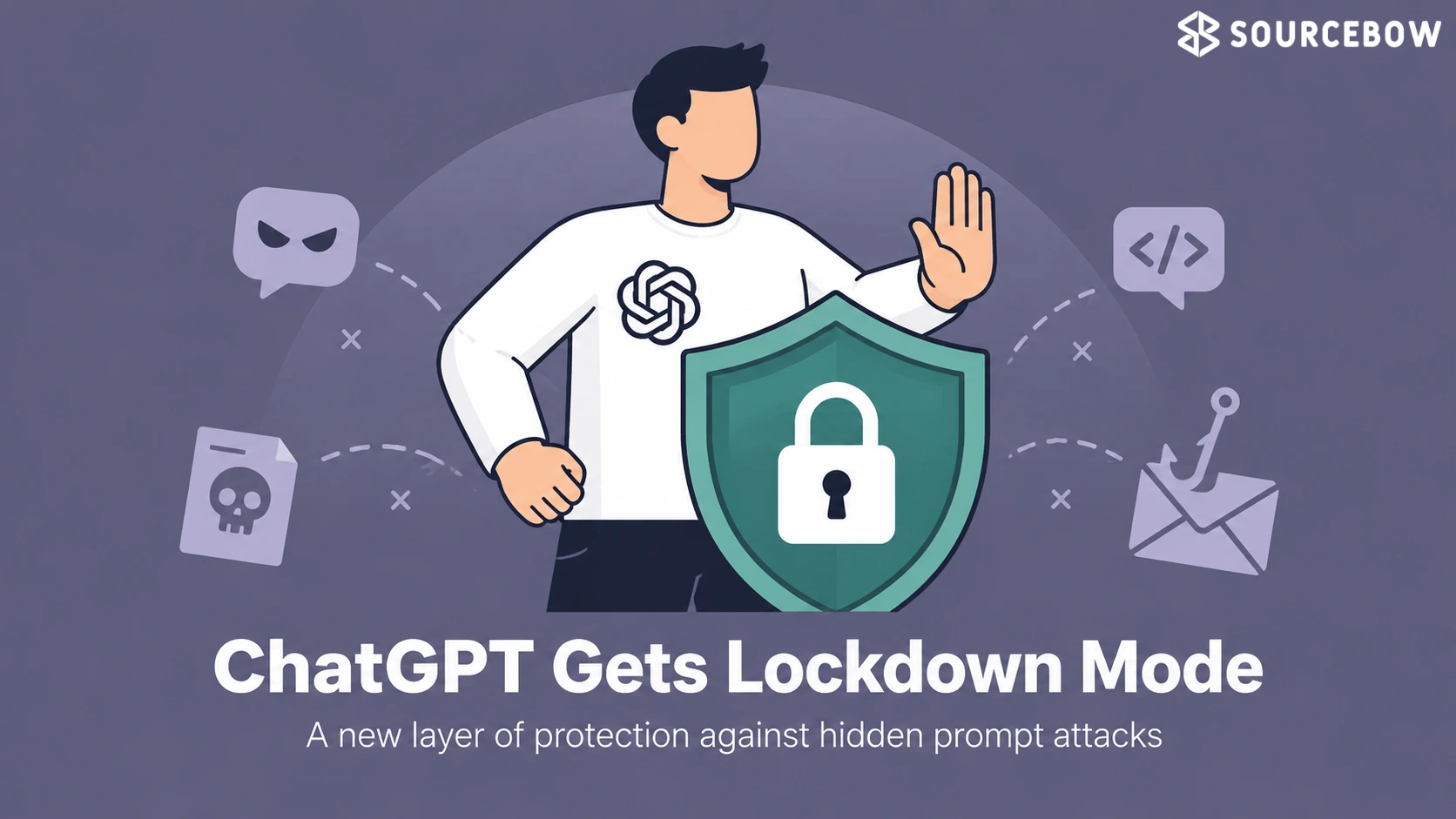
At the simplest level, Lockdown Mode is about shrinking the attack surface. In plain English, that means it shuts off some of the parts of ChatGPT that reach outward into the web, because that’s where hidden instructions can sneak in and do the most damage.
Here’s what gets turned off:
- Live web browsing is disabled
- Web image retrieval is blocked
- Deep Research and Agent Mode are turned off
That might sound restrictive, and yeah, it is. But that’s the point. If you’re handling sensitive material, convenience isn’t the main goal anymore. Reducing exposure is. A model that can browse, fetch, summarize, and act across lots of sources is powerful, but it also has more chances to run into something manipulative.
One detail that matters here: ChatGPT can still generate images even in Lockdown Mode. So this isn’t a full shutdown of creative tools. It’s more targeted than that. The feature is trying to block risky inbound content, not strip away every advanced capability.
Why prompt injection is getting more serious
This is really the issue behind the whole feature. Prompt injection is when malicious instructions are hidden inside content that looks normal on the surface. It could be on a webpage, inside a document, or tucked away in something the model is asked to analyze. The text may look harmless to a person, but the model can still pick up the hidden instructions and follow them.
And that’s what makes it so annoying. It’s not some dramatic hacker movie scenario. It can be as subtle as a line of text that tells the model to ignore its actual task, reveal data, or change behavior. So the danger isn’t just that AI is “wrong.” It’s that AI can be steered by content it should never have trusted in the first place.
There’s also a bigger issue: these attacks are hard to solve completely because the model has to read information to understand it. That means the system is always in a weird position. It needs access in order to help you, but access is exactly what creates the vulnerability. That’s why OpenAI’s response is less about claiming a perfect fix and more about reducing the amount of dangerous stuff the model can touch.
That tradeoff feels familiar if you’ve used AI tools for work. The more you rely on them for research or summarizing, the more you want them to be smart and connected. But the more connected they are, the more they inherit the risks of the open web. That tension is basically the whole story here.
Who Lockdown Mode is really for
This isn’t a feature for people who want ChatGPT to answer dinner ideas a little more safely. It’s for users and teams handling information they can’t afford to casually expose. Think legal work, security-sensitive analysis, private business documents, internal strategy, or anything else where a stray instruction could create a real problem.
That’s why Lockdown Mode feels less like a consumer upgrade and more like a guardrail for serious environments. If you’re just chatting about travel plans, you probably won’t notice the difference. But if you’re asking AI to sort through confidential content or external sources you don’t fully control, then the risk profile changes fast.
And there’s another layer to that. In lots of organizations, the people using tools like ChatGPT aren’t security specialists. They’re analysts, researchers, managers, and operators trying to get work done. So a feature like this matters because it gives those teams a safer default without asking everyone to understand the full technical threat model. That’s not nothing.
Still, it’s worth being clear-eyed. Lockdown Mode lowers risk, but it doesn’t magically make a system invulnerable. It’s more like locking the side doors before someone wanders into a room that should’ve stayed closed. Helpful? Absolutely. Perfect? Not even close.
The “super app” ambition hanging over all of this
Now, here’s where things get interesting. OpenAI doesn’t seem to want ChatGPT to stay a simple chat box. The broader direction looks a lot more ambitious: more tasks, more tools, more connections, more ways for the app to sit in the middle of daily work and life.
That’s the classic super app move. Not just asking questions, but doing things. Pulling in data. Acting on files. Connecting to services. Helping you move through workflows instead of just responding to prompts. And once a product starts heading there, security stops being a side issue and starts becoming part of the architecture.
You can already feel the logic behind it. A basic chatbot can get away with being a little loose because the stakes are low. But a tool that manages sensitive context, runs research, or interacts with connected systems has to earn a lot more trust. That means features like Lockdown Mode aren’t random. They’re a sign that the product is trying to grow up without becoming reckless.
There’s a mild irony in that, of course. The very ambition that makes ChatGPT more useful also makes it more vulnerable. The more places it reaches, the more places something bad can hide. So the push toward a super app and the push toward tighter security are really two sides of the same coin. One expands the product. The other tries to keep that expansion from turning into a mess.
FAQ
These are the obvious questions people ask once they realize the feature reduces risk without pretending to remove it entirely.
Q: Does Lockdown Mode stop prompt injection completely?
No. It lowers exposure, but hidden instructions can still slip through cached pages or uploaded files. So it’s protection, not a perfect shield.
Q: Can ChatGPT generate images in Lockdown Mode?
Yes. Image generation stays available even though image retrieval from the web is blocked, which keeps some creative use cases intact.
Q: Who can use Lockdown Mode right now?
It’s rolling out to self-service ChatGPT Business customers and eligible personal account holders. So it’s available, but not universally for everyone at once.
Q: Why is OpenAI doing this now?
Because the more capable ChatGPT becomes, the more dangerous its connections to outside content start to look. The timing really makes sense when you see how much more the product is trying to do.
Conclusion
Lockdown Mode feels like an admission that better AI tools also create better attack surfaces. That’s not a failure so much as a reality check. If ChatGPT is going to keep expanding into research, workflows, and connected tasks, then security can’t stay in the background anymore.
The bigger story here isn’t just one new setting. It’s the direction of the product. OpenAI is clearly pushing ChatGPT toward something broader and more useful, maybe even something that starts to look like a true super app. But the minute a tool becomes that central, it also becomes more sensitive, more exposed, and more worth protecting.
So, yes, Lockdown Mode matters. But what it really tells us is that ChatGPT is becoming the kind of product where trust has to be designed in, not assumed.