AI has spent the last few years getting smarter in pieces. One model handles vision, another handles speech, a third tries to reason through the mess, and then an orchestration layer glues everything together and hopes context survives the trip. That’s the fragmentation problem. And with NVIDIA Nemotron-3 Nano Omni, NVIDIA is making a pretty clear bet that the next wave of intelligent systems won’t feel stitched together at all.
Launched on April 28, 2026, Nano Omni arrives at a moment when companies are no longer impressed by AI that can simply accept multiple inputs. They want systems that can actually understand what they’re seeing and hearing in real time, without turning every task into a slow pipeline of separate steps. That matters a lot more than it sounds, especially if you’ve ever watched a model lose the thread halfway through a workflow.
Quick Highlights
- Unified perception cuts out multi-step AI handoffs.
- Audio, video, image, and reasoning work together natively.
- NVIDIA is pushing beyond chips into full-stack AI infrastructure.
- The bigger shift is from multimodal inputs to contextual understanding.
What Is NVIDIA Nemotron-3 Nano Omni?
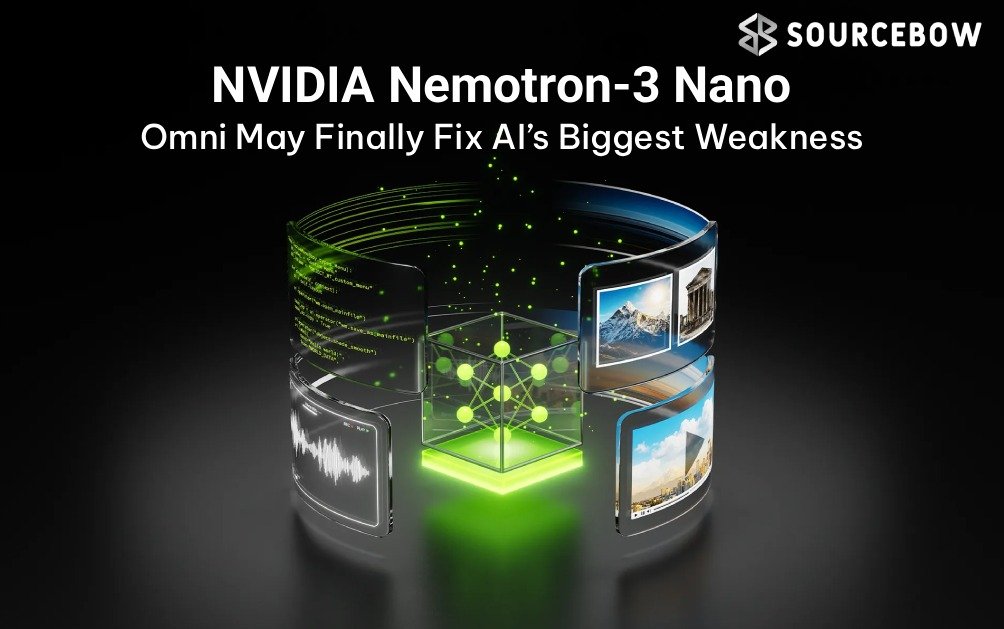
NVIDIA Nemotron-3 Nano Omni is a next-generation AI system designed to process video, audio, images, and reasoning together in one unified loop. Instead of passing information between separate models, it treats perception and interpretation as a single flow, which helps it respond faster and preserve context better.
That’s the real idea here: not just multimodal input, but unified intelligence. In other words, the system isn’t merely receiving different types of data. It’s trying to understand what they mean together, at the same time. That’s why people keep calling this a step toward perception-based AI rather than just another multimodal AI model.
If older systems felt like a relay race, Nano Omni is closer to one athlete doing the whole job. NVIDIA says the model reduces the multi-step processing that usually slows down AI workflows, and that’s important because each extra handoff can add latency, cost, and context loss. In benchmark-style workflow comparisons, that kind of simplification often matters as much as raw model size.
How Did NVIDIA Evolve From GPU Giant to AI Infrastructure Leader?
It’s easy to forget that NVIDIA didn’t start as an AI company at all. The company built its reputation on gaming GPUs, then expanded into CUDA and parallel computing, and eventually became the hardware backbone for modern machine learning. Once deep learning exploded, NVIDIA already had the infrastructure layer that everyone else needed.
That’s where Jensen Huang’s leadership really matters. Under his direction, NVIDIA didn’t just sell chips. It built an ecosystem. Hardware, software, developer tools, deployment support, and now increasingly its own model strategy all work together. That’s a big reason the company now feels less like a chip vendor and more like a full-stack AI infrastructure giant.
And in 2026, that ecosystem control matters more than ever. The AI infrastructure race is no longer only about who has the fastest accelerator. It’s also about who can ship models, optimize inference, support enterprise deployment, and keep developers locked into a smooth workflow. NVIDIA’s position across the stack gives it a serious advantage
here, even as competition heats up.
Think about it this way: if one company can supply the hardware, the inference stack, and the model architecture, it can shape how the market builds AI, not just how it runs it. That’s a much bigger play than selling silicon.
Why Traditional Multimodal AI Systems Still Feel Fragmented
Traditional multimodal systems sound impressive on paper. They can handle video, speech, images, and text. But under the hood, they often rely on separate pipelines: one model transcribes audio, another detects objects in frames, another reasons over the output, and a coordinator tries to keep everything aligned. That’s where the friction starts.
Every extra step creates room for delay and error. A transcript can miss tone. A vision model can catch the object but miss the intent. A reasoning layer can make a decision based on stale or incomplete data. The result is something businesses know all too well: an AI system that technically works, but still feels clunky in practice.
Here’s the thing — companies rarely measure this as a workflow tax, but they should. The tax shows up as slower response times, higher inference costs, more orchestration complexity, and more opportunities for context to slip away. In low-latency environments, that becomes a real problem fast.
Picture a support team analyzing a customer call with attached screenshots and screen recordings. If the audio, video, and reasoning steps all happen separately, the system can still be useful. But it won’t feel truly aware. It’ll feel assembled. And that difference is exactly what NVIDIA is trying to erase.
How Does NVIDIA Nemotron-3 Nano Omni Actually Work?
The simplest way to understand the model is to think of it as a continuous perception loop. It takes in visual and audio signals, interprets them together, and updates its understanding in real time instead of waiting for one stage to finish before starting the next.
So instead of saying, “First I’ll listen, then I’ll look, then I’ll reason,” the system behaves more like a human observer in a fast-moving conversation. It catches tone, motion, imagery, and context as part of the same moment. That’s what makes this feel like an AI perception model rather than a stitched-together stack.
This matters for real-time AI processing because real-world situations don’t wait politely for a clean pipeline. Meetings happen quickly. Support calls are messy. Factory floors, clinics, livestreams, and command centers all produce overlapping signals. The closer an AI system gets to native multimodal AI, the more useful it becomes in those environments.
It also lines up with a broader trend in 2026: always-on systems that are expected to watch, listen, and interpret continuously, not just answer questions on demand. That shift is subtle, but huge. It’s the difference between a chatbot and an intelligent sensing layer.
What Makes Native Perception AI Better Than Traditional AI Pipelines?
| Traditional AI Stack | Native Perception AI |
|---|---|
| Separate models for each input | Unified reasoning across signals |
| Slower workflows | Real-time context handling |
| Higher latency | Faster responses |
| Context can get lost | Intent is preserved |
The big difference isn’t just speed, though that’s part of it. Native perception AI is better at reading the whole situation. It can connect a pause in speech with a facial expression, a chart on screen with a spoken instruction, or a moment of hesitation with the actual task being requested. That’s the kind of contextual AI businesses have been
chasing for a while.
This is also where emotional and situational interpretation gets interesting. A system that understands a frustrated customer’s tone while also seeing the interface they’re using is simply more capable than one that treats audio and video as isolated inputs. In practice, that can mean fewer misreads and less back-and-forth.
For enterprises, the value is obvious: fewer tools, fewer handoffs, and fewer brittle integrations. That’s the promise behind the shift from fragmented AI to intelligent AI systems that feel closer to one coherent brain than a bunch of separate assistants.
How Could Nano Omni Change Everyday Professional Workflows?
Now we get to the part most articles skip. The business impact.
For customer support, a unified system could review a call, inspect screenshots, and interpret the customer’s tone without making agents jump between separate tools. That means faster routing, better summaries, and less manual cleanup.
In healthcare administration, it could help parse bedside audio, visual forms, and workflow notes together. Not as a replacement for professionals, obviously, but as a way to reduce repetitive admin work and catch context that gets lost in paperwork.
For analysts, visual and audio AI could make meetings and screen recordings far easier to digest. Imagine searching a project review by what was said, what was shown, and what the speaker likely meant in the moment. That’s a real workflow upgrade, not just a shiny demo.
Creators and content teams could use the same principle for video understanding, rough editing, metadata generation, and asset tagging. And in enterprise operations, AI workflow automation becomes less about plugging one more SaaS tool into another and more about reducing the number of systems people need to babysit.
That’s why enterprise AI automation is becoming such a serious buying criterion. Teams don’t just want smart outputs. They want less friction.
Is NVIDIA Building the Foundation for Autonomous AI Agents?
This is where Nemotron-3 starts to feel like a bigger strategy, not just a product release. NVIDIA introduced agentic reasoning AI with Nemotron-3 in late 2025, and Nano Omni extends that idea into the sensory layer. That combination is powerful because agents need more than planning. They need perception.
An AI agent that can reason but can’t observe well will always be limited. It might plan a task, but it won’t fully understand the live environment it’s operating in. Once perception and decision-making converge, though, you get something closer to autonomous execution systems — software that doesn’t just answer, but acts with context.
That’s a big reason investors are paying attention to next generation AI models like this. The market is moving beyond chat interfaces toward systems that can monitor, interpret, and respond continuously. In that world, the best models won’t just be clever. They’ll be operationally reliable.
And that reliability is what enterprises will ultimately buy. Not just intelligence, but trust under pressure.
NVIDIA Nemotron-3 Nano Omni vs Traditional Multimodal AI
| Feature | Traditional AI Stack | Nano Omni |
|---|---|---|
| Audio Processing | Separate system | Native |
| Vision Analysis | External model | Integrated |
| Reasoning | Delayed pipeline | Continuous |
| Context Awareness | Partial | Unified |
| Workflow Speed | Slower | Real-time |
| Enterprise Scalability | Complex | Simplified |
If you zoom out a little, the pattern becomes clear. The industry is moving from copilots that assist with text to perception assistants that understand the world around them. That’s a much bigger leap than people sometimes realize.
So, What Should Professionals and Builders Pay Attention To?
If you’re building AI products, the lesson is pretty simple: users don’t care how many models are inside your stack.
They care whether the experience feels smart, fast, and aware of context. Every extra layer between input and interpretation creates more chance for failure.
If you’re in enterprise leadership, this launch is a reminder that the buying criteria for AI is changing. Accuracy still matters, but so do latency, integration cost, and whether the system can operate across audio, video, and image-heavy workflows without becoming a maintenance headache.
And if you’re just following the market, NVIDIA’s direction tells you something important about where the whole category is headed. The future of AI isn’t just bigger models. It’s tighter systems. More unified intelligence. Less stitching, more sensing.
That’s why this release feels more strategic than flashy. It’s not just another product announcement. It’s NVIDIA trying to define the next layer of intelligent AI systems, from the silicon up.
FAQ
What is NVIDIA Nemotron-3 Nano Omni?
It’s a next-generation AI model from NVIDIA that combines reasoning, vision, audio, and contextual understanding into one unified system.
Why is Nano Omni different from traditional AI?
Traditional systems often rely on separate models for speech, vision, and reasoning. Nano Omni processes those signals together in a continuous perception loop, which can reduce latency and context loss.
What does native multimodal AI mean?
It means the model can handle video, audio, and images at the same time instead of stitching together separate tools after the fact.
How can businesses use Nano Omni?
Use cases include customer support automation, meeting analysis, workflow assistance, video understanding, and enterprise AI operations.
What is agentic reasoning in AI?
It’s the ability for AI systems to plan, evaluate, and carry out multi-step tasks with limited human input.
Why does real-time AI perception matter?
Because it improves speed, reduces context loss, and helps AI better understand tone, timing, intent, and visual cues in live situations.
When you put it all together, Nano Omni signals a shift from fragmented AI toward unified perception systems. NVIDIA is clearly expanding beyond chips into full AI infrastructure leadership. And real-time multimodal reasoning may end up reshaping enterprise automation faster than a lot of people expect in 2026.
If that future feels closer than you thought, it probably is. Subscribe for more weekly AI infrastructure insights, or check out our related coverage on enterprise AI workflow automation and how agentic AI is reshaping automation. And if your team is planning an AI integration roadmap, now’s a good time to ask a simple question: are you still stitching tools together, or are you ready for something that actually sees the full picture?
Suggested reads: Best Enterprise AI Tools in 2026, How Agentic AI Is Reshaping Automation, Multimodal AI Explained.