Introduction
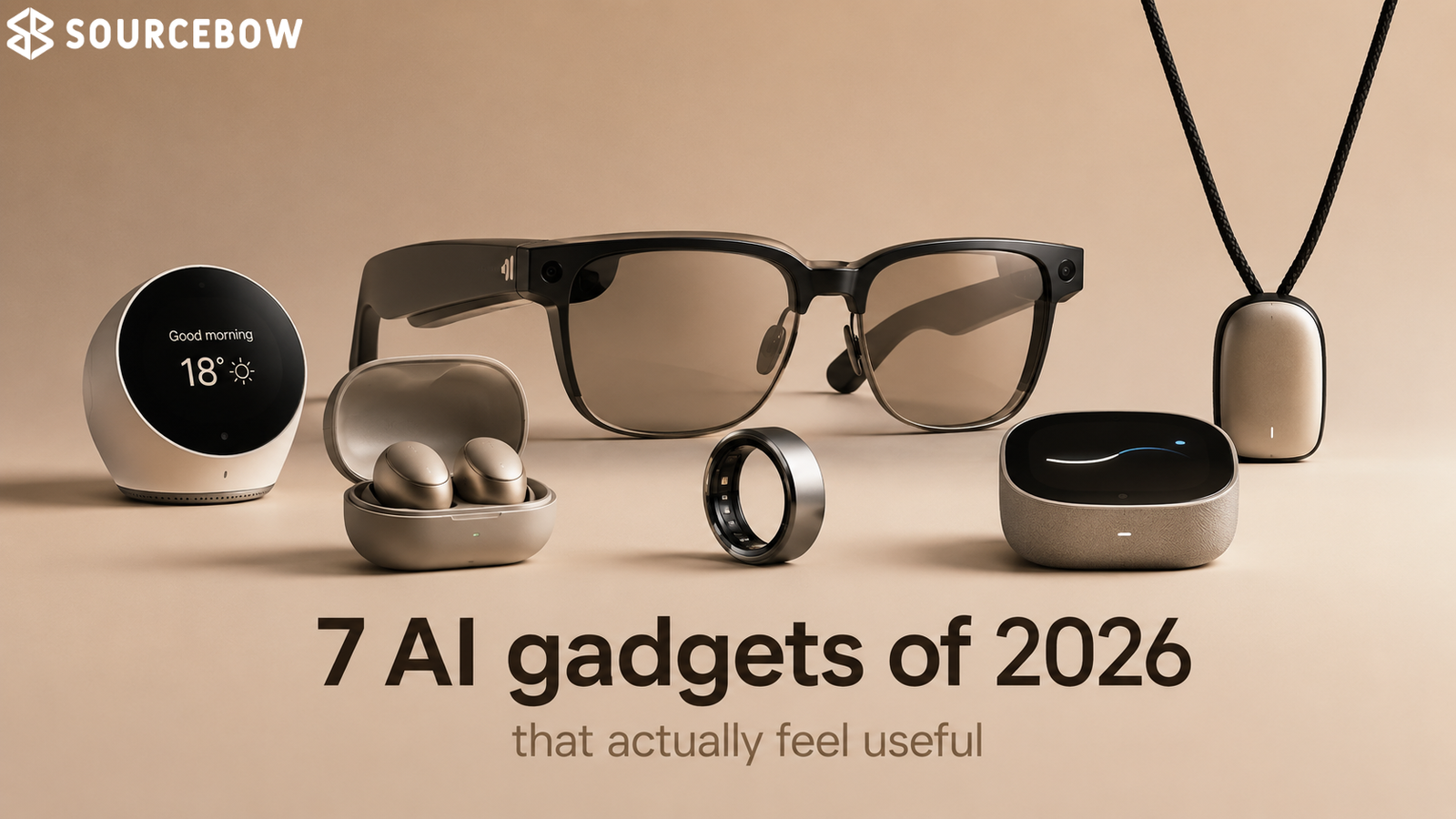
The interesting thing about 2026 is not that AI gadgets got louder, but that a few of them got quieter and more useful. That’s the part worth paying attention to. Because for a while, a lot of AI hardware felt like it was built to impress people for thirty seconds and then sit in a drawer. Now, some of it is finally doing the more boring, more valuable job of making everyday stuff easier.
And honestly, that shift matters more than flashy demos. If a device can help you get through a commute, keep an eye on your health, or save you from tapping through five screens just to do one small task, it starts to feel less like a gadget and more like part of the routine.
Quick Highlights
The health stuff is where AI starts to make sense
There’s a reason wearables keep showing up in these conversations. Health is one of those areas where AI doesn’t need to be dramatic to be helpful. It just needs to notice patterns, catch changes, and translate a wall of numbers into something you can actually use.
That’s where devices like the Fitbit Sense 3 and Samsung Galaxy Ring start to feel surprisingly grounded. They turn raw wellness data into something closer to a nudge than a dashboard. So instead of staring at charts and wondering what any of it means, you get a simple suggestion, a warning, or a small reminder that fits into the day.
The Fitbit Sense 3 leans into the kind of health tracking most people understand right away: heart rate, stress, sleep, recovery, all the usual suspects. But the useful part is not the data itself. It’s the way AI can connect the dots. If your sleep was bad, your stress is high, and your movement has been low for three days, that’s not just trivia. That’s a pattern. And patterns are what make a device feel smart instead of noisy.
The Samsung Galaxy Ring goes in a different direction. It’s more discreet, more passive, and a little less needy. You don’t have to stare at it or fiddle with it much. It just sits there, doing the background work. That’s appealing if you’ve ever wanted the benefits of tracking without the feeling that your wrist or phone is constantly asking for attention.
Now, none of this magically fixes your sleep or your stress. That would be a little too convenient. But it does help with awareness, and awareness is usually the first step that actually sticks. You don’t need a wellness dashboard shouting at you all day. You need something calm enough to be useful.
When a gadget disappears into normal life
This is probably the most interesting category of all. The best AI gadgets in 2026 aren’t the ones that force you into a weird new habit. They’re the ones that fade into the background and still manage to do something helpful. That’s why the Ray-Ban Meta Smart Glasses and Humane AI Pin 2 stand out. They both try to reduce screen dependence, which is a bigger deal than it sounds at first.
Most of us already live inside a screen-based ritual. Tap, swipe, unlock, reply, scroll, repeat. It’s so normal that we barely notice how much effort it takes. These devices are trying to interrupt that loop in a practical way. Not by replacing your phone completely, but by making some tasks simpler and less clumsy.
Ray-Ban Meta Smart Glasses
The Ray-Ban Meta Smart Glasses feel compelling because they don’t look like a tech costume, which sounds minor until you remember how many smart devices are awkward to wear in public. These glasses do a better job of blending in, and that matters a lot. If a device feels weird, you stop reaching for it.
The useful features are the ones you can picture needing in real life: real-time translation, navigation, and contextual help. Imagine being in a new city and getting directions without pulling out your phone every ten seconds. Or hearing something in another language and getting a quick translation without turning it into a whole event. That’s the kind of assistance people actually keep using.
What makes the glasses interesting isn’t that they do something magical. It’s that they reduce friction. Small moments of friction are what wear people down. A tool that removes those tiny interruptions can feel more useful than a fancy device with ten extra features nobody asked for.
Humane AI Pin 2
The Humane AI Pin 2 takes a more practical stab at the screenless idea. The first versions of this category had a lot of ambition, but ambition alone doesn’t help much if the device gets in the way. A better version needs to understand that people want quick utility, not a performance.
That’s why voice, summaries, and fast interactions matter here. You ask something, get an answer, move on. In theory, that can be great for short tasks: checking a detail, summarizing a message, or handling something without opening yet another app. In practice, of course, execution matters a lot. But the concept itself is easier to understand now than it was a couple of years ago.
If the AI Pin 2 can stay simple and responsive, it could become one of those devices that earns its keep quietly. Not because it dazzles you, but because it saves a few seconds here and there. And weirdly enough, that adds up.
Rabbit R2, creator tools, and the slightly messy middle ground
This is the part of AI hardware where things get more experimental. Not all of it is polished, and not all of it should be. But there’s still real value in the messy middle ground, especially when a device can handle tasks people find annoying or time-consuming. The Rabbit R2, Insta360 Flow 2 Pro, and AI home robots all live somewhere in that space.
These aren’t always the devices you recommend first to someone who just wants the safest choice. But they’re the ones that hint at where AI hardware may be heading next. Sometimes that’s through automation. Sometimes it’s through better content creation. Sometimes it’s just through doing one job well enough to be genuinely welcome.
Rabbit R2
The appeal of Rabbit R2 is pretty easy to explain. It’s best when the task is small, annoying, and easier to hand off than to do manually. That could mean a little action that would normally require app hopping, menu digging, or a bunch of taps you don’t feel like doing.
That doesn’t sound revolutionary, and maybe that’s the point. The most useful automation often isn’t the grand kind. It’s the kind that quietly takes one irritating chore off your plate. If the Rabbit R2 can do that well, it earns attention even if it never becomes the most glamorous gadget in the room.
There’s still some uncertainty here, of course. New hardware often promises a lot before it proves itself. But the direction makes sense. People don’t want to manage every tiny digital task by hand forever. They want the device to understand the ask and just handle it.
Insta360 Flow 2 Pro
The Insta360 Flow 2 Pro feels less like a gadget and more like a missing assistant for solo creators. And if you’ve ever tried to film yourself, you probably already understand why that matters. Content creation sounds simple until you’re the camera operator, the talent, the editor, and the person making sure the shot doesn’t wobble.
This is where AI-assisted stabilization, tracking, and setup can make a real difference. Not in a flashy, “look what the machine can do” way, but in a practical, “wow, this is much less annoying now” way. That’s a big shift for people making videos alone or in small teams.
What makes it stand out is that it supports the workflow instead of trying to be the whole workflow. That distinction matters. A useful tool should disappear when you’re focused on the work. It shouldn’t become the work.
AI Home Robots
AI home robots are still rough in places, and it’s worth saying that plainly. The category has always had more imagination than reality attached to it. But the practical use cases are finally starting to sound believable, which is a notable change.
Think less about a movie-style robot butler and more about a helper that can do a few routine things reliably. Maybe it watches over a room, helps with reminders, handles light organization, or takes on simple chores that don’t require human judgment. That’s a much more realistic path, and honestly, a more useful one too.
The reason this category keeps hanging around is simple: people want help with repetitive household tasks. They want something that reduces mental load. If AI home robots can become dependable in even a narrow set of situations, they’ll have a place. Not because they’re perfect, but because homes are full of boring jobs that nobody enjoys doing.
FAQ
A few quick questions about which of these devices actually seems worth paying attention to.
Q: Which AI gadget feels most practical for everyday use?
The smart glasses probably come closest because they solve small problems without asking much back. That’s the real test for everyday tech. If it’s easy to wear, easy to reach for, and doesn’t interrupt your flow, you’re much more likely to keep using it. The Ray-Ban Meta Smart Glasses fit that idea well because they add help without making the whole experience feel awkward.
Q: Are AI rings just a smartwatch replacement?
Not exactly; they feel more passive, more discreet, and a little less needy. A ring usually isn’t trying to be your screen, your notification hub, and your tiny command center all at once. That’s part of its appeal. The Samsung Galaxy Ring is more about background sensing and quiet guidance than constant interaction, which makes it feel different from a smartwatch even when there’s some overlap.
Q: What’s the biggest shift in 2026 AI gadgets?
They’re finally doing fewer things in a more believable way. That may sound modest, but it’s actually the important part. The best devices are no longer trying to impress you with how much they can theoretically do. They’re trying to be useful in the moments that matter, even if those moments are small.
Conclusion
The real story here is not futuristic hardware, but ordinary routines getting slightly less annoying. That is probably why these gadgets stand out: they feel useful before they feel impressive. And that’s a much better place for AI to be.
If 2024 and 2025 were about showing off what AI could potentially do, 2026 feels more like a reality check in the best way. The gadgets that matter now are the ones that fit into life without asking for a big explanation. They help with health, communication, setup, or repetitive tasks. They don’t need to be dazzling. They just need to work well enough that you notice life getting a little easier.
So if you’re looking at AI gadgets this year, pay less attention to the hype and more attention to the boring stuff. Boring, in this case, is a compliment. It means the device has finally found a place in the day.