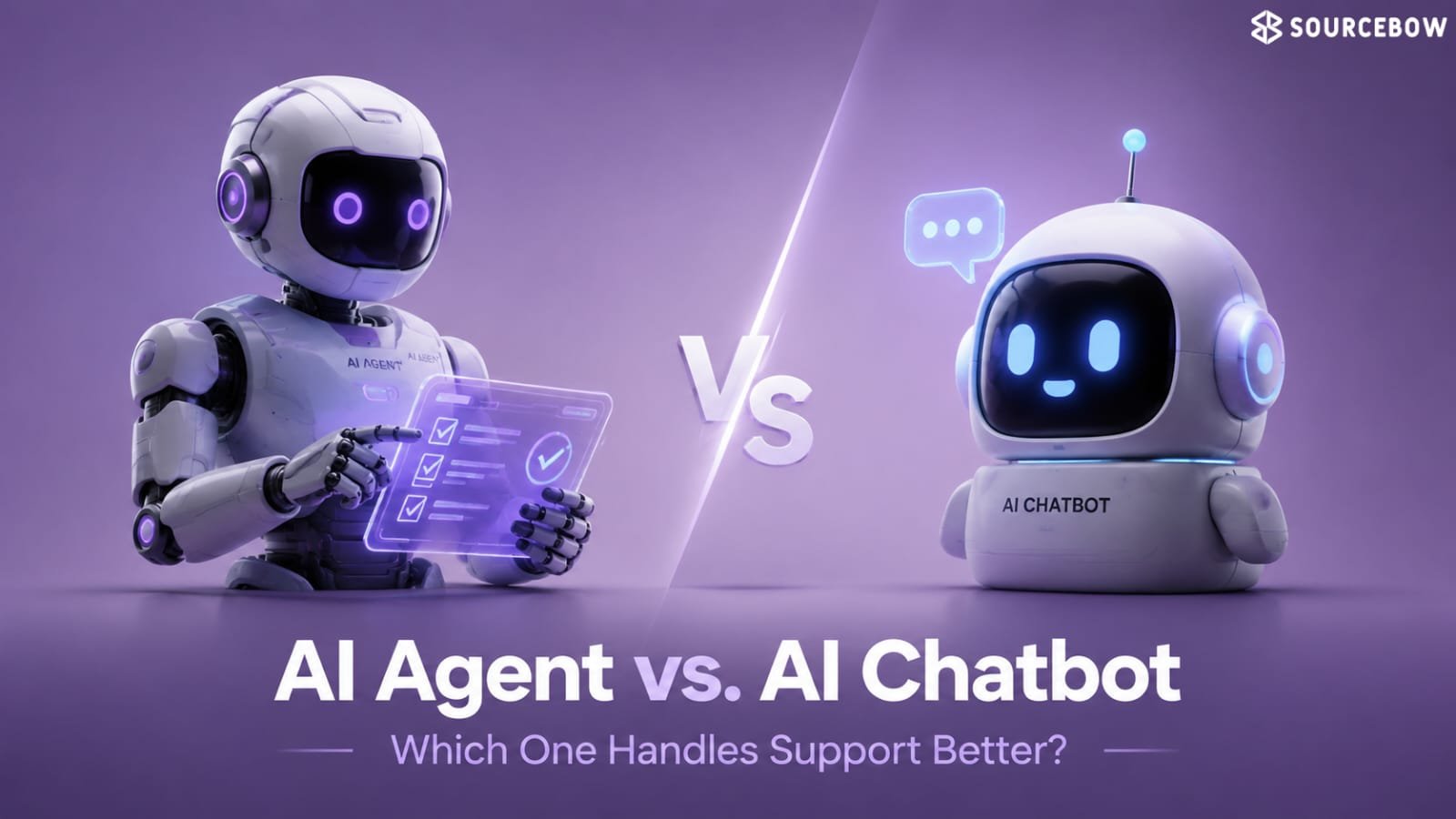
When people talk about AI agent vs chatbot differences, it’s easy to get stuck on the surface stuff. Both can answer questions. Both can live inside support workflows. Both sound smart enough at first glance. But here’s the thing: once a customer needs more than a quick reply, the difference starts to matter a lot.
Support teams aren’t really choosing between two trendy tools. They’re choosing between a system that responds and a system that can reason, act, and keep moving until the issue is actually solved. And that gap shows up everywhere — in CX, workflow execution, QA, and the day-to-day reality of handling support at scale.
Quick Highlights
- Chatbots are best for quick, predictable questions.
- AI agents can take action across systems, not just reply.
- Complex support flows need context, memory, and decision-making.
- Many teams get the best results using both together.
Introduction
Learn how AI agent vs chatbot differences affect CX, QA, and workflow execution — because the real issue is not whether they can answer a question, but whether they can actually finish the job.
Support teams are deciding between a tool that responds and a system that reasons, and that gap matters more as expectations rise for faster, more accurate help. Customers don’t really care what the technology is called. They care whether the problem gets fixed without a long back-and-forth. That’s why this comparison matters in a very practical way.
What an AI agent actually does when a request needs action
An AI agent is more than a conversation layer: it plans, reasons, and takes action toward a goal instead of stopping at the answer.
It uses LLMs, business policies, customer context, memory, and connected systems like knowledge bases, CRM platforms, and order tools to decide the next best step. In simple terms, it’s not just reading a question and responding. It’s trying to complete the task, almost like a support teammate who can click through systems without getting tired or distracted.
That’s why it can handle multi-step work such as checking backend data, updating a delivery address, and confirming the resolution without handing the customer off. And that’s a big deal, because every handoff adds time, friction, and the risk that the customer has to repeat themselves.
Where autonomous resolution shows up in real support work
AI agent use cases tend to cluster around problems that do not end in one reply. Billing disputes, flight rebooking, 24/7 support, and workflow orchestration all need a system that can keep moving.
- Advanced autonomous resolution for multi-step issues like billing disputes or rebooking a flight without human intervention
- 24/7 support for customers in different time zones
- Workflow orchestration to prioritise, escalate, route, and coordinate requests based on intent, urgency, and business context
- Papier’s Zendesk AI setup in the U.S. expansion, where the AI agent handles a large volume of after-hours requests, reduces ticket backlogs, and improves response times
That last example is a good reminder that this isn’t just theory. Once a support operation has to deal with large volumes and messy timing, autonomous resolution stops being a nice bonus and starts looking like a real operational advantage.
Why chatbots feel faster but stop sooner
An AI chatbot is built for scripted assistance: it follows pre-defined rules, recognises keywords, and answers with limited pre-built responses.
That makes it useful for repetitive work, but it also means the system is bounded by what was explicitly programmed into it. So yes, it can feel quick and tidy. It gives the impression of efficiency because it gets straight to an answer. But that speed only goes so far.
It can be quick on common requests, yet it usually struggles once the question falls outside the expected path. If the customer asks in a different way, adds a wrinkle, or needs a decision that wasn’t planned for, the chatbot often runs out of road pretty fast.
The tasks chatbots handle best without pretending to do more
AI chatbot use cases are the predictable ones — the requests support teams see over and over again.
- Customer and employee FAQs, including store hours, working hours, return policies, sick policies, and account settings
- Scheduling for appointments or meeting rooms
- Basic troubleshooting with step-by-step guidance
- Check order status using real-time backend updates for shipping details or delivery timelines
- Domino’s “Dom,” which lets customers place an order and track it in real time
- Chatbot templates for teams mapping common questions, responses, and escalation paths
In other words, chatbots do well when the path is already clear. They’re like a helpful front desk sign: useful, fast, and easy to follow. But they’re not the thing you want handling a complicated exception or a customer situation that keeps changing.
How AI agents and chatbots differ once a conversation gets messy
The biggest difference is autonomy: chatbots converse, while AI agents reason through a goal, make decisions, and act across connected systems.
That difference changes service interactions, QA, task complexity, knowledge scope, and adaptability — basically everything that matters once a support flow stops being neat. And support flows do get messy. Customers forget details, switch topics halfway through, bring up previous issues, or ask for something that requires policy judgment. That’s where the divide becomes obvious.
Customer service interactions and QA do not behave the same way
AI agents keep context, ask follow-up questions, and adapt when the customer changes direction, which makes the interaction feel less brittle.
They can also monitor resolution quality, policy adherence, escalation risk, and customer sentiment in real time, surfacing issues like unresolved intent or a missed policy step. That means they’re not just helping with the reply — they’re helping assess whether the reply actually solved the problem in a way the business can trust.
Chatbots are more transactional: they can trigger satisfaction surveys or run simple sentiment checks, but they offer far less visibility into conversation quality. So while they can tell you that an interaction happened, they usually can’t tell you much about whether the interaction really worked.
Task complexity, knowledge scope, and adaptability split the two tools apart
| Area | AI agent | AI chatbot |
|---|---|---|
| Task complexity | Handles judgement-heavy, multi-step work across systems | Works best for simple tasks with fixed rules and predictable outcomes |
| Scope of knowledge | Uses knowledge bases, customer profiles, policies, and connected systems to act | Depends on help centre articles or scripted responses |
| Learning and adaptability | Improves through outcome optimisation, resolution success, escalation patterns, feedback, and quality scores | Usually needs manual rule changes, new scripts, or new training data |
This is especially relevant in retail, travel, and financial services, where real-time data and policy-aware decisions are part of the job, not a nice extra. If a customer’s answer depends on current inventory, an itinerary change, a risk check, or account history, a simple script starts to feel limited very quickly.
How support teams decide which one to use
The choice comes down to what kind of experience you want to deliver and how much complexity your team actually needs to automate.
AI agents fit end-to-end resolution and deeper personalisation; chatbots fit routine questions and faster response times. Many teams end up using both. And honestly, that hybrid approach often makes the most sense because not every support problem deserves a full-blown autonomous workflow.
The main decision points are goals, budget, CX, and privacy
- Goals: choose AI agents for end-to-end resolution and deeper personalisation, or chatbots for basic interaction automation
- Budget: AI agents cost more up front but can reduce escalations and save time across complex workflows; chatbots are generally cheaper to implement and maintain
- CX: chatbots deliver fast support for predictable needs, while AI agents give more adaptive and personalised interactions
- Data privacy: AI agents access more data and systems, so privacy protections and responsible AI practices matter more
- A combined model is often the practical answer, with chatbots handling routine questions and agents taking over harder work
That combined model is worth pausing on. A chatbot can greet, triage, and answer the easy stuff. Then an agent can step in when the issue needs context, judgment, or action across systems. It’s less about picking a winner and more about designing a support flow that matches the job.
FAQ
These questions come from the doubts people still have after comparing autonomy, safety, and whether one tool will eventually make the other obsolete.
Q: Are AI agents safe for important business decisions?
Not without human oversight. They can support lower-risk workflows and escalate when review is required, but sensitive or regulated decisions still need guardrails and people in control.
Q: Will AI agents replace chatbots?
No. Chatbots still handle routine questions efficiently, while AI agents support harder issues and help live agents work faster and with better context.
Q: Which are better, chatbots or AI agents?
AI agents are stronger when the support problem is complex and the experience needs to feel adaptive. Chatbots are still the better fit for straightforward, predictable requests.
Q: What is the difference between AI agents and ChatGPT?
ChatGPT is usually used by individuals for communication and content creation, while AI agents are embedded in broader workflows such as CX systems. Both rely on LLMs, but only the agent is built to reason, plan, and act toward a goal.
Conclusion
For support teams, the practical answer is simple: use a chatbot when the job is conversation, and use an AI agent when the job is resolution.
If the work involves workflows, context, and decisions across systems, the agent is the closer fit; if the work is repetitive and predictable, the chatbot still does the sensible thing well. That’s the cleanest way to think about AI agent vs chatbot differences without getting lost in the buzzwords.
So if you’re mapping support automation right now, start with the customer problem, not the tool category. The right choice usually becomes much clearer once you ask a better question: do you just need a reply, or do you need the issue fully handled?