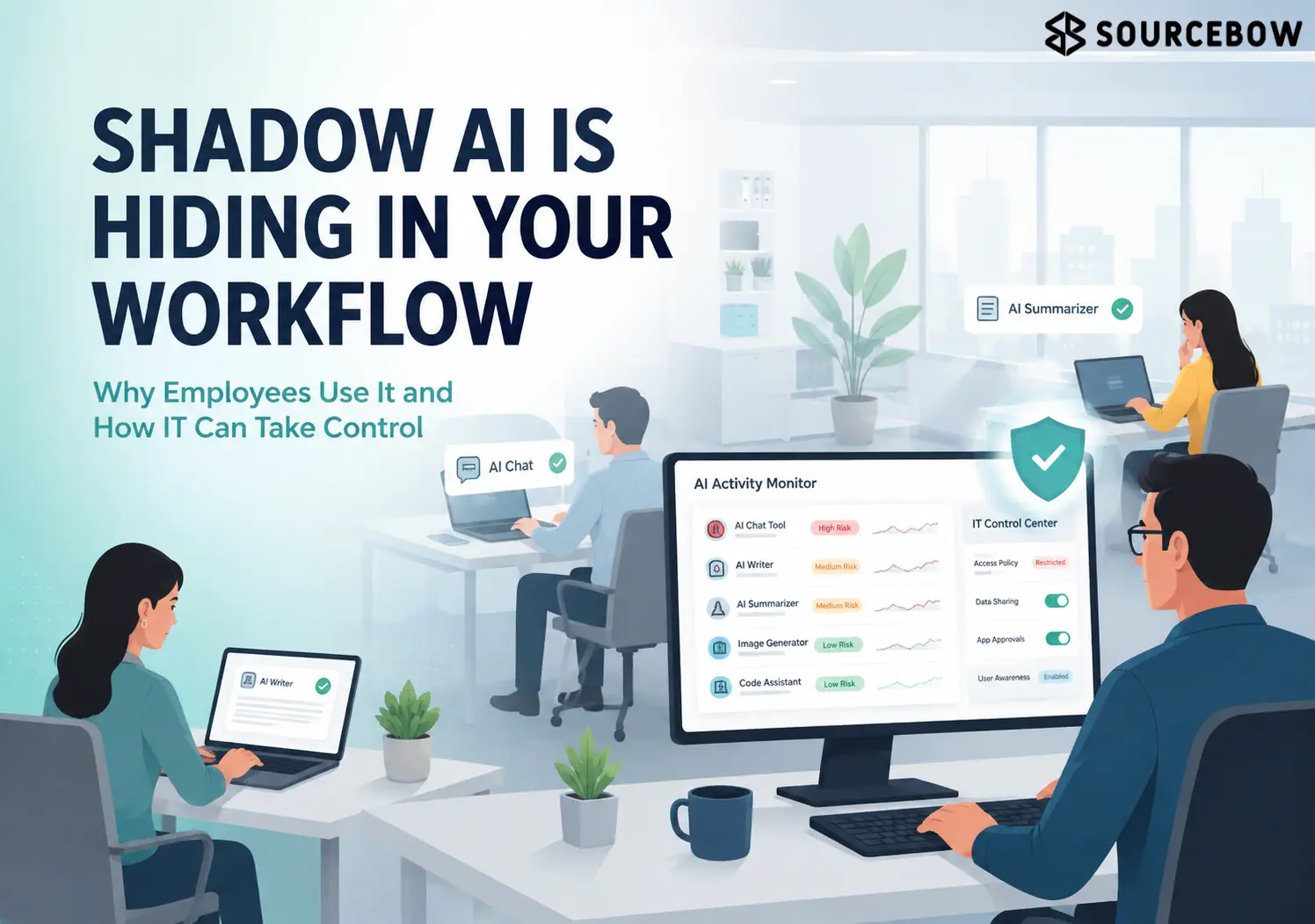
Shadow AI usually doesn’t begin with bad intent. It starts with somebody trying to get work done a little faster, a little cleaner, or a little less painfully than the old process allowed. Someone pastes notes into a chatbot. Someone adds an AI plug-in because it saves an hour. Someone builds a quick workflow with an open-source model and figures they’ll tell IT later. That’s the whole problem in a nutshell: by the time the organization notices, the data may already have moved somewhere it shouldn’t have.
And that’s why Shadow AI has become such a real enterprise issue. It’s not just about a random tool being used off the books. It’s about hidden AI use quietly entering daily work, often inside familiar apps, normal habits, and trusted workflows.
Quick Highlights
- Shadow AI often starts inside everyday work.
- Visibility matters before control can work.
- Not all AI use should be banned.
- Data rules need to be specific, not vague.
- Approved tools can still become risky later.
Introduction
Learn what shadow AI in enterprise means, why it happens, the risks it creates, and 5 steps to control GenAI use before data leaks start.
The tricky part is that the problem doesn’t usually look dramatic at first. It’s not someone breaking into a system or deliberately ignoring security warnings. It’s people using the AI tools that are already sitting in front of them, because those tools feel useful, fast, and honestly kind of inevitable now.
So the question isn’t whether employees will experiment with AI. They already are. The real question is whether the enterprise can see it, guide it, and keep it from turning into a compliance headache or a data exposure event.
What shadow AI actually is, and how it differs from shadow IT
Shadow AI is the use of AI tools, systems, or AI agents without approval, monitoring, or involvement from IT or security teams.
That makes it broader than a single rogue app. It includes tools like ChatGPT and Claude, plus embedded GenAI features, unsanctioned workflows, and agent behavior that never went through governance. In other words, the danger isn’t only the obvious app someone downloaded. It can also be the AI feature that quietly appeared inside software the company already trusts.
Shadow IT and shadow AI are related, but shadow AI carries more data, model, and decision risk.
Why shadow AI is not just another version of shadow IT
Shadow IT is mostly about unsanctioned access to apps or infrastructure; shadow AI is about unsanctioned AI use that can process sensitive data, generate outputs, and influence decisions.
Palo Alto Networks’ Unit 42 says the thirst for AI capability is already creating shadow AI in the same way shadow IT helped push cloud and SaaS adoption. That comparison makes sense. People rarely start with a goal of bypassing governance. They start with convenience, and convenience has a way of outrunning process.
The difference is that AI doesn’t just store or move information. It can transform it, summarize it, rewrite it, and sometimes act on it. That’s where the risk gets bigger fast.
How shadow AI shows up in day-to-day work
The pattern usually starts small and looks helpful. A document gets pasted into a chatbot. A third-party AI plug-in gets added to a workflow. A team builds something with an open-source LLM API without telling IT. None of that feels dramatic in the moment, and that’s exactly why it slips through.
The raw material here is ordinary business activity — ChatGPT for summaries, Hugging Face or OpenRouter for development work, personal accounts inside SaaS apps with embedded AI, and developer tools that never hit procurement or compliance review. You might notice that these are not exotic behaviors. They’re just the shortcuts people reach for when deadlines are tight and the work keeps piling up.
Because these choices are easy, free, or already built into familiar software, they often happen before anyone notices. By then, the organization may have no idea what data was entered, where it was stored, or whether the output was ever reviewed properly.
Examples that look harmless until they aren’t
- A sales ops team uses Copilot Studio to build an AI agent that queries the CRM and sends automated follow-ups, with broad permission to read and write customer records.
- A product manager uses Claude to summarize an internal strategy deck before sharing it with a vendor; the deck includes unreleased timelines and partner names, and the prompt history remains on Anthropic’s servers.
- A developer builds an internal chatbot that uses OpenRouter to access a fast open-source LLM via API, but the project never reaches the security backlog.
- A marketing designer uses Canva’s AI image tools to generate campaign visuals from brand copy, with product names in the prompt and final files reused in web assets.
Each example feels practical on the surface. That’s what makes shadow AI so slippery. The same thing that makes it useful — speed, ease, low friction — also makes it hard to spot and even harder to govern after the fact.
The risks that make shadow AI a business problem
Shadow AI matters because it creates blind spots: no monitoring, no enforcement, and no reliable way to know what data was used or where it went. Once that happens, the issue is no longer just a technical one. It becomes a business risk, a legal risk, and sometimes a reputational one too.
The article flags seven concrete risk areas, including unauthorized processing of sensitive data, regulatory noncompliance, expansion of the attack surface, lack of auditability and accountability, model poisoning and unvetted outputs, data leakage, and overprivileged or insecure third-party access. It also adds two agent-specific risks: unsecured AI agent actions and MCP and tool-call exposure.
That may sound like a lot, but it helps to think of it this way: every hidden AI use is another place where the company may lose visibility over what was shared, what was changed, and what decisions were influenced by a machine that never went through review.
| Risk | What it looks like | Why it matters |
|---|---|---|
| Unauthorized processing of sensitive data | Proprietary, regulated, or confidential data is pasted into external AI systems | Organizations lose track of where that data is stored and how it is used |
| Regulatory noncompliance | Shadow AI bypasses controls tied to GDPR, HIPAA, or the DPDP Act | That can lead to fines, investigations, or lawsuits |
| Expansion of the attack surface | Unsecured APIs, personal device access, and unmanaged integrations appear | Each one can become an entry point for attackers |
| Data leakage | Inputs or metadata are stored on third-party servers | Customer information or internal code may be exposed without anyone knowing |
| MCP and tool-call exposure | Agents connect to enterprise tools through Model Context Protocol or similar frameworks | That can introduce context poisoning, credential leakage, or unauthorized function invocation |
If you’re wondering why this is accelerating so quickly, the numbers are a clue. They show that shadow AI isn’t some niche side issue anymore. It’s spreading into normal work patterns faster than many teams can document, review, or even notice.
The numbers that show why this is accelerating
- GenAI traffic surged more than 890% in 2024.
- The ratio of GenAI transactions as a percentage of SaaS increased from 1% to 2% on average.
- Organizations saw an average of 66 GenAI apps, with 10% classified as high risk.
- That works out to 6.6 high-risk GenAI apps per company on average.
- GenAI-related DLP incidents increased more than 2.5X and now make up 14% of all DLP incidents.
Those numbers don’t just describe growth. They describe normalization. AI use is becoming part of the default workflow, and that means the governance gap has a chance to get wider every month if no one is watching it carefully.
How to decide what employees can use, and when
The practical answer is not a blanket ban. It is a policy that starts with visibility, then draws a line around data, tool behavior, and who is allowed to use what. If the policy is too vague, people ignore it. If it’s too restrictive, they route around it. So the goal is something more workable: clear enough to guide real behavior, but flexible enough to support actual work.
The article’s five-step decision path includes discovering current usage, defining off-limits data, assessing how each tool stores and processes inputs, setting role- or function-based permissions, and creating a review process for new tools. This is where governance becomes specific instead of theoretical.
The five-step control process the article recommends
- Start with visibility into existing usage, using endpoint logs, SaaS discovery platforms, browser extension audits, and a centralized AI gateway architecture.
- Define which data is off-limits, including customer records, source code, and regulated PII.
- Assess how each tool stores and processes inputs, including retention, third-party sharing, and model improvement use.
- Set role- or function-based permissions, such as API-based tools for developers and basic writing support for marketing.
- Establish a structured intake and review process for new tools.
This is the part that usually separates organizations that are merely worried about shadow AI from the ones actually getting it under control. You don’t need perfect knowledge on day one. You need a repeatable way to find, classify, and manage the AI use that already exists.
Why the article says AI gateways matter
A centralized AI gateway creates a single control plane for prompts, responses, model calls, and agent actions, so unsanctioned traffic becomes visible as an anomaly instead of hiding inside normal app usage.
The article also warns that sanctioned SaaS tools can quietly roll out new GenAI features, which means approved software can become a shadow AI channel after the fact. That’s a subtle but important point. A tool doesn’t need to start as shadow AI to behave like it later. Sometimes the risk appears after a vendor changes the product, not after an employee does anything unusual.
Why policy fails when it tries to be too blunt
The strongest warning here is simple: banning everything usually pushes people underground, while a lighter structure gives security teams a way to see, classify, and govern what is already happening.
This is where a lot of organizations get tripped up. They write a policy that sounds serious, but it doesn’t match reality. People still need to draft, summarize, analyze, build, and communicate faster than before. If the policy doesn’t recognize that need, it becomes background noise.
The better approach leans on the shadow IT lesson — enablement plus guardrails works better than lockdowns — and adds the idea of time-bound approval cycles, with reassessment every 6–12 months.
It also lands on a few practical exceptions: developers may need API-based tools for prototyping, and design teams may be cleared for image generation under specific conditions. That kind of nuance matters because not every team uses AI in the same way, and not every use carries the same level of risk.
In other words, the goal isn’t to make AI harder for everyone. It’s to make risky use visible and safe use possible.
FAQ
These questions come from the smaller doubts readers still have after they understand the main risks and controls.
Q: What is an example of shadow AI?
A common example is an employee pasting customer data into ChatGPT or using a third-party AI plug-in inside an approved app without IT approval.
Q: How can an organization detect shadow AI?
Look at SaaS discovery data, browser extension logs, endpoint telemetry, and AI gateway traffic to spot prompts, external model calls, and unapproved AI features.
Q: What is Shadow GPT?
It usually refers to unsanctioned use of GPT-style tools at work, especially when they are handling data or tasks outside security oversight.
Q: How do I delete Shadow AI?
You usually cannot “delete” the behavior directly; the real fix is to remove unsafe access, tighten approvals, and replace it with controlled GenAI use.
Conclusion
Shadow AI in enterprise is really a visibility problem first and a governance problem second: if you can’t see the tools, you can’t protect the data.
The next move is not panic; it is to define what is allowed, what is off-limits, and how new AI use gets reviewed before it becomes the next blind spot. That’s the practical path forward, and honestly, it’s the only one that tends to hold up once real work starts moving through real systems.