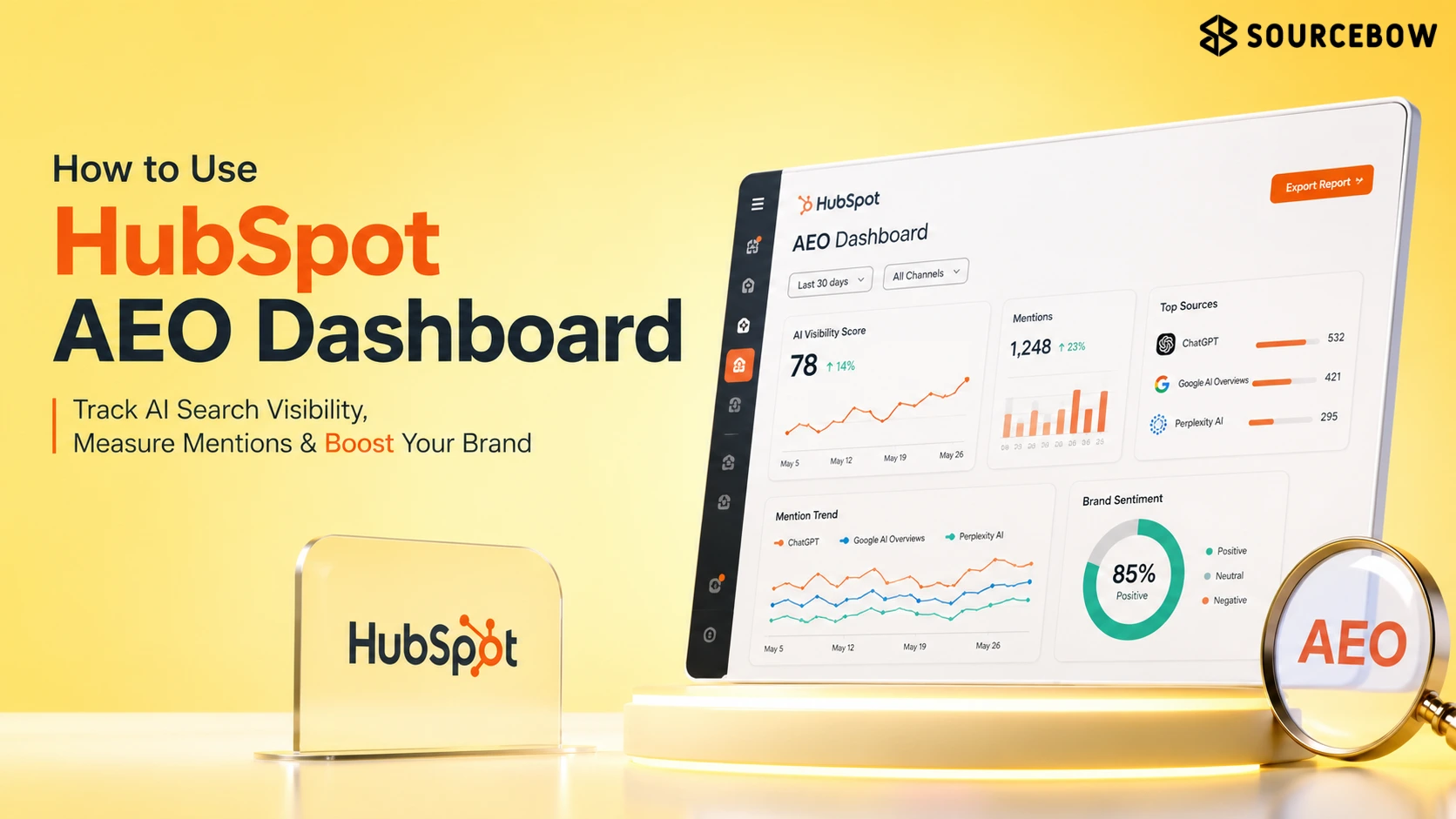
See how HubSpot AEO tracks citations, brand mentions, and competitor visibility across ChatGPT, Gemini, and Perplexity — then turns that into something you can actually act on.
The biggest shift here is simple: people are asking AI what to buy, and the answer can mention your brand, your competitor, or neither. That is the real promise behind the HubSpot AEO dashboard, and it is why this matters now.
The weird part is that this can feel like lost traffic at first, but the story is usually messier than that. You may get fewer casual clicks and still end up with better leads, because buyers often compare options inside AI answers before they ever reach your site. So, the visit might come later, but it can come with more trust already built in.
Quick Highlights
- AI answers can shape the sale before the click.
- Visibility is different across ChatGPT, Gemini, and Perplexity.
- Listicles and YouTube show up a lot in citations.
- HubSpot AEO turns those patterns into next steps.
Introduction
The biggest shift here is simple: people are asking AI what to buy, and the answer can mention your brand, your competitor, or neither. That is the real promise behind the HubSpot AEO dashboard, and it is why this matters now.
The article leans into the tension between lost website clicks and better-quality leads, especially when prospects have already compared options, ruled out competitors, and built trust before they ever land on your site.
What AEO changes when buyers start asking AI instead of Google
AEO is not just SEO with a new label. The question is no longer whether you rank high enough to get the click, but whether AI systems describe your brand accurately enough to shape the decision.
The raw example is blunt: prospects from AI sources can be 3 to 5 times more likely to convert, because by the time they click, they may already understand the trade-offs and what matters most.
This section sets up the core idea behind AI generated answer optimization and why “being mentioned” is a different goal from “being clicked.”
Why AI answers can send fewer visits but better leads
The point is not that traffic disappears and the story ends there. It is that someone may ask about the best tools, compare options, ask about drawbacks, and only then click through.
That sequence matters because the trust-building happens before the visit. The article frames this as a shift from search traffic to decision influence.
B2B to C is the right mental model here
The piece calls it B2B to C — business to bot to consumer — which is the cleanest way to think about the new path to purchase.
What matters is not only what the bot says, but how that answer lands with the consumer making the decision.
How to see where your brand shows up in ChatGPT, Gemini, and Perplexity
The practical move is to test the same question across multiple answer engines and watch what changes. A brand can appear in one, disappear in another, or be described very differently depending on the model.
The article uses a fresh account and a temporary chat in ChatGPT to avoid memory and custom-instruction bias, then compares the same prompt across ChatGPT, Gemini, and Perplexity.
This is where the HubSpot AEO dashboard starts to feel useful: it shows brand visibility in AI answers instead of forcing you to do the tracking by hand.
What you actually need to track in each answer
- Which brands are mentioned, including competitors
- How each brand is described — positive, negative, or missing entirely
- Which sources are cited
- How many sources appear in an answer, like the 10 cited sources shown in the ChatGPT example
Why the same question produces different sources
The article points out that Gemini and Perplexity return different answers and different source sets from ChatGPT. That is exactly why one-off checks are not enough.
Customers ask different questions by role and intent, so visibility has to be tracked over time across multiple tools.
What HubSpot AEO actually sets up for you after signup
HubSpot starts with the basics — role, company name, company size, and website — then analyzes the domain and pulls in what it can about the brand, competitors, and audience.
If you already use HubSpot, it can reuse existing data; if not, the setup still works from scratch in a fresh account.
The article also notes the free 28-day trial and that you can add brand name variations, switch the company to B2C, and edit the competitor list if the system misses anything.
The setup fields and inputs are straightforward
| Setup step | What HubSpot asks for | What it does with it |
|---|---|---|
| Basics | Role, company name, company size, website | Starts brand analysis |
| Domain review | Company domain | Pulls website information and identifies competitors |
| Trial | Free 28-day trial | Lets you test the dashboard |
Why the generated prompts are more like buyer questions than keywords
Instead of short phrases, HubSpot creates full questions such as: “How do AI tool directories help compare hundreds of options?”, “What is the best AI tools directory for productivity apps?”, and “Which AI tools directory includes user reviews and ratings?”
That is the key difference from SEO: you are not trying to rank for words, you are trying to become part of the answer.
What the citations report reveals about where AI gets its answers
The citations tab is where the pattern starts to get real. It shows what kind of sources answer engines use, and the mix is not what most site owners would expect.
One of the strongest facts in the piece is that 35% of citations were listicles, making them the biggest bucket by far. The next buckets were multimedia and blogs, while homepage, product pages, and documentation came after that.
The article also says the largest source channel was peer, meaning product or service companies that are not direct competitors, with review sites, owned, and earned also meaningful.
Which source types matter most in the citation mix
| Source type | What the article says | Why it matters |
|---|---|---|
| Listicles | 35% of citations, the largest bucket | One of the most actionable content types |
| Multimedia | Next biggest bucket | Shows AI is pulling from more than text pages |
| Blogs | Also a large source group | Still a major citation source |
| Homepage, product pages, documentation | Appear after the larger content buckets | Still matter, but they are not the whole picture |
YouTube keeps showing up for a reason
The dashboard example says YouTube was the number one top domain, which is presented as common rather than surprising.
Its transcripts are automatically generated and indexed, so a 10-minute video can behave like a 2,000-word article, especially when views and positive comments act as trust signals.
What the recommendations tab tells you to do next
This is the most action-oriented part of the dashboard. HubSpot combines the prompt results, citations, and source patterns into a prioritized list of things to fix or create.
One example recommendation was a listicle comparing AI tool directories for coding assistance, with a suggested title, summary, target audience, and primary and secondary keywords.
The reason given was specific: 50% of the citations for that prompt were listicles.
The two actions the article says you can take when visibility is weak
- Create your own listicle that answers the question better, using the suggested title as a starting point
- Reach out to the listicles already being cited and try to get Futurepedia included
Why this tab is more useful than a vague audit
The recommendations include suggested content, the reasoning behind it, and the citations that drove it. That makes the next move obvious instead of aspirational.
The article also notes that the list is short in a new account, but would grow much larger once the system has more data.
FAQ
These are the smaller doubts people have after they understand the dashboard idea but still want to know what it means in practice.
Q: Does AEO only matter if website traffic goes down?
No. The article argues that traffic can fall while lead quality improves, because buyers may reach your site later in the decision process.
Q: Why do AI tools cite so many listicles?
Because listicles made up 35% of citations in the example, which was the largest bucket by far. That makes them one of the clearest content types to target.
Q: Why does YouTube show up so often in AI citations?
Because transcripts are indexed, videos can function like long-form text, and views plus positive comments create a strong trust signal.
Q: Can smaller brands still show up in AI answers?
Yes. The article says answer engines pull from sources well beyond the top 10 Google results, and that smaller brands can surface where they would have struggled in traditional search.
Conclusion
The point of AEO is not to chase traffic for its own sake. It is to become the answer, get described accurately, and show up in the places buyers are already asking.
If you want to improve visibility in AI answers, start by checking where your brand appears, which sources shape those answers, and what the dashboard tells you to fix first.