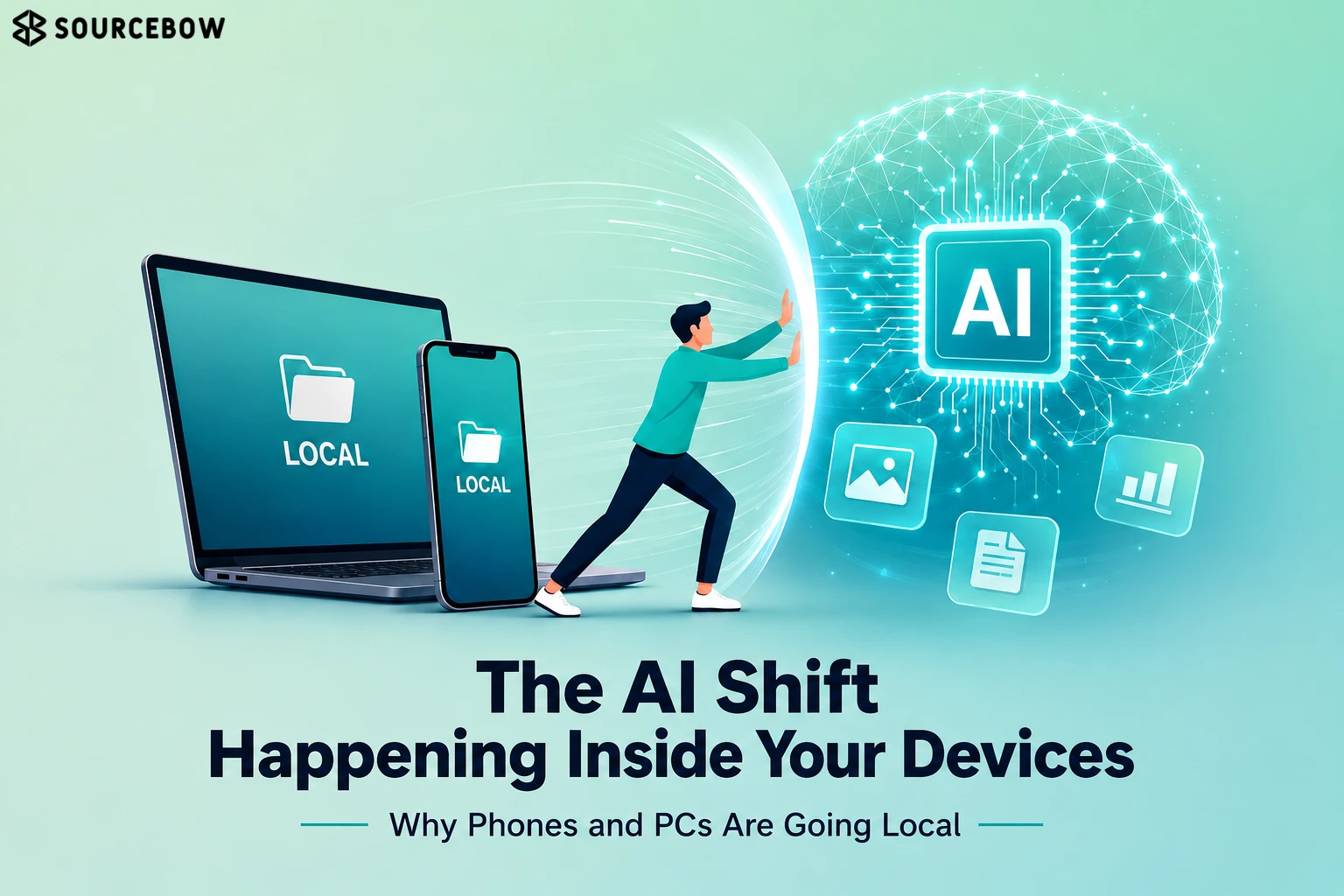
AI is moving on-device fast, and the biggest shift is that phones and PCs are now handling translation, writing tools, and privacy-first features locally instead of leaning on the cloud.
If you’ve been noticing your phone getting smarter in tiny but useful ways, or your laptop doing more without feeling sluggish, that’s not just hype. It’s the result of Edge AI devices for smartphones and PCs quietly changing what everyday computing looks like. The difference is simple, but it matters: the work happens on the device itself, so things feel faster, more private, and more reliable when the internet is weak or missing.
Quick Highlights
Introduction
AI is moving on-device fast, and that’s why Edge AI devices for smartphones are suddenly doing more than simple voice commands or photo tricks.
The real shift is that the work happens locally now, which changes speed, privacy, and what people can do when the internet is weak or missing. And honestly, that’s where the story gets interesting. A feature doesn’t feel futuristic because it has a fancy name. It feels futuristic when it saves you time without asking much from you.
What Edge AI actually is, and why it keeps showing up in phones, laptops, and PCs
Edge AI means the device does the AI work itself instead of shipping everything to a remote server.
That matters because modern hardware from Qualcomm, Apple, Intel, AMD, MediaTek, and NVIDIA is putting dedicated AI processors into the device, usually through NPUs, so the experience feels instant rather than network-bound.
This is the simplest way to understand the shift before getting into the features people actually notice. Instead of asking a server to think for you, the phone or laptop handles more of that thinking right there, in your hand or on your desk.
The basic device set behind Edge AI
The category is wider than phones. It already includes AI smartphones, AI PCs, smart cameras, wearables, smart home devices, industrial IoT equipment, autonomous robots, and connected vehicles.
That spread matters because it shows Edge AI isn’t a one-device trend. It’s becoming a design choice across a lot of products that need quick responses and local decision-making.
Why the cloud is no longer the default for every AI task
Cloud AI still has huge power, but it brings internet dependency, server delays, privacy concerns, subscription costs, and data transfer limits with it.
Edge AI is attractive because it cuts those trade-offs down with faster response times, offline functionality, lower latency, reduced cloud costs, better battery optimization for some workloads, and stronger privacy.
That’s the core reason this trend is moving from niche hardware talk into everyday consumer products. People may not use the phrase Edge AI devices for smartphones in daily conversation, but they absolutely notice when something works faster and doesn’t need a constant connection.
The parts inside the device that make local AI work
Modern processors split work across three engines: CPU for general tasks, GPU for parallel workloads, and NPU for AI inference.
The NPU is the one designed for image recognition, speech processing, language translation, AI assistants, object detection, and generative AI, and it does that work more efficiently than a CPU while using less power.
That’s a big deal in a phone or laptop, because battery life and heat are always part of the equation. A clever feature isn’t very clever if it drains your device in an afternoon.
Why smartphones are becoming the biggest edge AI product category
Phones are where most people first notice the change, because AI is being pushed into core features rather than isolated apps.
That shows up in smartphone AI photography, real-time language translation, AI writing assistance, voice assistants, battery management, and security features that depend on local processing.
Phones are also the most personal devices we own, which makes local processing feel even more valuable. The device knows your habits, your contacts, your photos, and often your private messages too. So, moving more of that intelligence onto the phone just makes sense.
AI photography now does jobs people used to associate with cloud processing
Phones can now handle AI scene recognition, night mode optimization, portrait segmentation, AI object removal, reflection removal, AI zoom enhancement, and HDR optimization directly on the device.
The point is not just better photos; it is that the result appears instantly without waiting on a server. You point, tap, and move on. That tiny bit of speed changes how often people actually use the feature.
Translation, writing, and voice features are becoming personal, not remote
Real-time language translation now includes offline translation, live subtitles, multilingual conversations, and AI voice interpretation.
AI writing assistance can rewrite text, summarize documents, generate replies, correct grammar, and change tone, while keeping sensitive information on the phone.
Voice assistants also respond faster, personalize better, and handle offline commands with lower latency and better privacy. And that last part matters more than people think. A voice feature that works reliably in the background feels a lot more natural than one that stalls because the connection dips.
Battery and security are now part of the AI story too
Machine learning is being used for background app control, adaptive charging, intelligent performance scaling, and smart resource allocation.
Security features now include face recognition, voice authentication, fraud detection, spam call filtering, and malware detection, with most sensitive biometric data staying local.
That combination is subtle but powerful. The best AI features don’t always look flashy. Sometimes they just help the phone stay cooler, last longer, and protect your data without making a big scene about it.
Why AI PCs are becoming a serious category instead of a marketing label
AI PCs are growing quickly because they can do real work locally, not just add a branded assistant on top of old hardware.
Microsoft, Intel, AMD, Qualcomm, and laptop makers are all investing heavily, and modern AI PCs with NPUs can handle billions of AI operations every second.
That changes productivity, meetings, creative work, and even coding when the internet is not ideal. If you’ve ever watched a laptop struggle while trying to run too many background tasks, this is the kind of upgrade that actually feels different.
What AI PCs are already doing locally
Document summarization, meeting transcription, AI note generation, email drafting, spreadsheet analysis, and presentation creation can all happen on-device.
Many of those features still work with limited internet connectivity, which makes the category feel more useful than a simple software layer. It’s not just a new label on a box. It’s a real shift in what the machine can handle before it starts leaning on the cloud.
Where local AI helps most in meetings, creative work, and development
Video conferencing features now include background blur, eye contact correction, noise cancellation, auto framing, lighting enhancement, and voice isolation, all in real time without heavy CPU strain.
Creative workflows benefit through photo editing, video editing, AI upscaling, background removal, image generation, and audio enhancement, while developers get code completion, bug detection, code explanation, documentation generation, and refactoring suggestions.
In practice, that means fewer interruptions and less waiting around. The machine can keep up with the workflow instead of constantly getting in the way.
Which chipmakers are actually powering this shift, and what they are shipping
The hardware story is not abstract anymore; it is tied to specific platforms and product lines.
Qualcomm is pushing the Snapdragon X Elite and Snapdragon 8 Elite series for AI PCs and flagship smartphones, Apple uses the Apple Neural Engine for Apple Intelligence, on-device Siri, AI image processing, and writing tools, and Intel Core Ultra processors include integrated NPUs.
AMD’s Ryzen AI chips accelerate local AI on Windows PCs, MediaTek uses AI Processing Units in flagship Dimensity chipsets, and NVIDIA is extending Edge AI through embedded computing and AI acceleration platforms.
| Company | Hardware / Platform | Edge AI focus |
|---|---|---|
| Qualcomm | Snapdragon X Elite, Snapdragon 8 Elite series | AI PCs and flagship smartphones |
| Apple | Apple Neural Engine | Apple Intelligence, on-device Siri, AI image processing, writing tools |
| Intel | Core Ultra processors | Integrated NPU workloads |
| AMD | Ryzen AI processors | Local AI on Windows PCs |
| MediaTek | AI Processing Units in Dimensity chipsets | Flagship mobile AI features |
| NVIDIA | Embedded computing platforms and AI acceleration technologies | Edge AI infrastructure |
Where Edge AI still runs into limits
The appeal is real, but the trade-offs do not disappear.
Dedicated NPUs raise manufacturing complexity and device cost, large models can exceed memory and processing limits, continuous AI workloads can create heat in compact devices, developers have to optimize for different chip architectures and operating systems, and local model updates need to stay efficient without eating storage.
That’s why cloud AI is not going away even as on-device AI gets better. The smartest systems are probably going to use both approaches, depending on what the task actually needs.
FAQ
These are the questions people usually ask after they understand the upside but still want to know where the line is.
Q: What is the difference between Edge AI and cloud AI?
Edge AI runs on the local device, while cloud AI runs on remote servers. The practical difference is that Edge AI usually gives lower latency, better privacy, and more offline use, while cloud AI offers far more compute power and scale.
Q: Why are AI phones and AI PCs important now?
Because they can handle common tasks locally: translation, writing, meetings, photos, and security features. That makes the device feel faster and more personal, especially when connectivity is weak.
Q: Can Edge AI work without internet access?
Yes, many edge AI features can work offline, including some translation, voice commands, and productivity tools. The more demanding the model, the more likely it still needs cloud support sometimes.
Q: Which companies are building NPUs for laptops and phones?
Major names include Qualcomm, Apple, Intel, AMD, MediaTek, and NVIDIA. Their chip platforms are a big reason Edge AI devices for smartphones and PCs are improving so quickly.
Conclusion
Edge AI is becoming the better fit for real-time, personal, and privacy-sensitive tasks, which is why on-device AI assistants and AI PCs with NPUs are moving from novelty to expectation.
The next step is simple: expect more work to happen on the device itself, and less of your everyday computing to depend on a server in the background.