Introduction
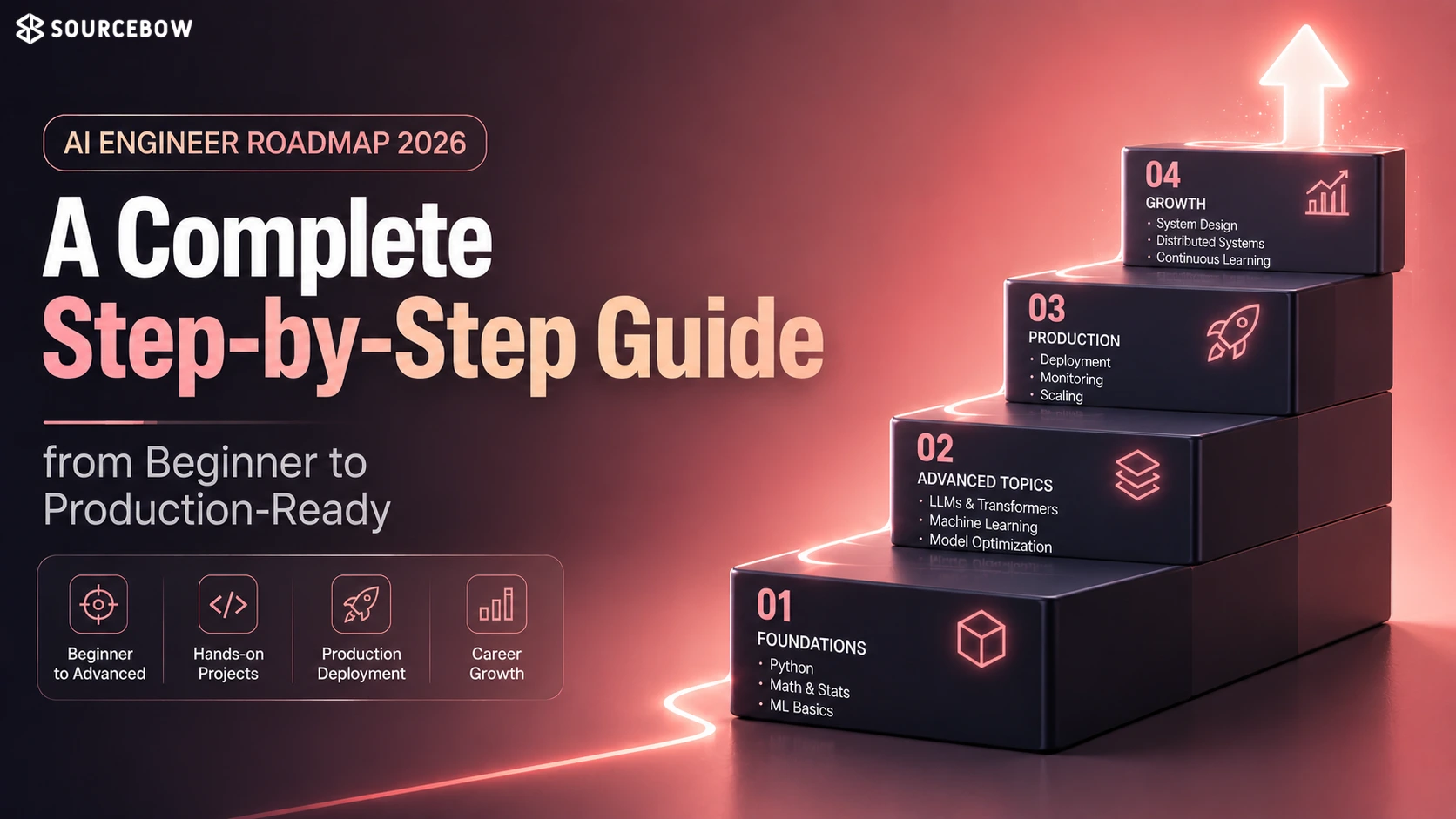
People keep reaching for ChatGPT APIs first, but the real AI Engineer Roadmap 2026 starts much earlier, with fundamentals that make the later stuff click instead of collapse. And honestly, that’s where a lot of beginners get tripped up. They jump to the shiny part, then wonder why everything feels like copying instead of understanding.
The AI Engineer Roadmap 2026 is really about sequence — learning in the order that prevents confusion later, not the order that looks exciting on social media. If you’ve felt that weird mix of motivation and overwhelm, you’re not alone. The path is clearer than it looks, but only if you stop treating it like a trend hunt.
Quick Highlights
- Start with foundations, not tools.
- Data work comes before model magic.
- Deployment is what makes projects real.
- LLMs are useful only with context and judgment.
Why people get lost before they ever build anything
The first mistake is usually motion without direction: videos, frameworks, then another reset when none of it sticks. You watch one tutorial, feel productive for an evening, and then three days later you’re back at square one, trying a different stack. That cycle says more about the lack of structure than the lack of talent, which is why a real AI learning roadmap matters more than one more tool list.
Look, this happens because the field is full of fast-moving surface noise. New models, new agents, new prompts, new libraries. It’s a lot. But the people who actually move forward are usually the ones who resist that impulse to hop around. They build a base first, even when it’s less glamorous.
The “roof before the walls” problem
Jumping into the newest model stack without the base layers is the same kind of mistake every time — it feels productive until the gaps show up. Then you hit a bug and don’t know whether it’s the data, the code, the model, or the way the whole system was wired together. That’s where the whole question of how to become an AI Engineer starts to look less like ambition and more like sequencing.
And sequencing matters more than people think. If your foundation is shaky, every new layer adds more confusion instead of clarity. If your foundation is solid, even advanced stuff feels oddly manageable, because you can place each new concept somewhere in your mental map instead of treating it like a random fact to memorize.
The quiet foundation under everything else
The early part of the path is less glamorous, but it’s the part that keeps the rest from turning into memorized fragments. This is where the boring-looking skills become the reason you can actually reason through problems instead of just following instructions.
Beginner foundations: Python, OOP, data structures, algorithms, Git & GitHub, SQL, linear algebra, probability, statistics, basic calculus.
None of that is there for decoration; it’s what makes later debugging, model thinking, and data work feel legible instead of mystical. If you’ve ever looked at a model pipeline and felt like everyone else was reading a secret language, this is the part that fixes that feeling.
Python is especially important because it shows up everywhere in an AI Engineer Roadmap 2026. You’ll use it for scripts, notebooks, APIs, automation, and eventually the glue that connects the different pieces of an application. OOP helps you organize code in a way that doesn’t collapse the second a project gets larger than a toy example. Git and GitHub keep your work usable, visible, and reproducible. And the math? It’s less scary when it’s tied to something concrete.
What belongs first, and what can wait
Some skills are load-bearing, others are just easier once the base is there. That doesn’t mean the “later” skills don’t matter. It just means they make more sense after you’ve done the groundwork. A lot of frustration comes from learning things in the wrong order, then blaming yourself when they don’t stick.
| Skill | Why it matters | What it unlocks later |
|---|---|---|
| Python | Core implementation language | Model work, APIs, automation |
| SQL | Working with real data | Cleaning, analysis, retrieval |
| Linear algebra | Vectors and matrices stop feeling abstract | ML intuition, embeddings, deep learning |
| Git & GitHub | Versioning and collaboration | Portfolio, team workflow, reproducibility |
Here’s the thing: you don’t need to become a math professor before you touch AI. But you do need enough comfort with the basics to follow what’s happening. Linear algebra, probability, and statistics show up in ways that feel surprisingly practical once you connect them to vectors, uncertainty, evaluation, and data patterns. The goal isn’t to memorize formulas. It’s to understand the shape of the problems you’re solving.
Why data work and model work are not the same thing
AI Engineer skills are often described as model skills, but the mess is usually in the data before a model ever enters the picture. That’s one of those quiet truths people learn the hard way. Missing values, duplicates, inconsistent formats, noisy records — those are the things real systems spend time on, which is why data engineering basics matter so much.
Data tasks that show up early: data collection, APIs, web scraping, cleaning, missing value handling, feature engineering, visualization, EDA.
Once you spend time here, you start to notice that a polished notebook can hide a lot. Real data is rarely neat. It’s often incomplete, weirdly labeled, and full of assumptions nobody wrote down. So if you want to build useful AI projects, you need to get comfortable with that mess instead of hoping the model will magically clean it up.
Where the friction actually lives
The useful projects here aren’t glamorous; they’re the ones that reveal how messy a dataset becomes once it leaves the clean tutorial world. You learn more from a half-broken dataset than from ten perfectly curated toy examples, because the friction is the lesson. That’s where you see what analysis actually involves.
Examples worth building: movie recommendation analysis, sales dashboard, customer behavior analysis.
These kinds of projects train the part of your brain that notices patterns, weirdness, and missing context. They also give you something portfolio-worthy without pretending the world is as tidy as a demo page. If you can handle data, your future self will thank you later when you’re debugging model inputs or building retrieval systems.
Machine Learning, before the hype starts doing the talking
This is the point where the roadmap turns from preparation into actual modeling, but the important split is still conceptual, not technical. In other words, the first thing to understand isn’t which algorithm is coolest — it’s what kind of question you’re asking in the first place. That distinction shapes the rest of the Machine Learning roadmap.
Supervised and unsupervised learning answer different kinds of questions, and once that clicks, a lot of the fog clears up. You stop treating every problem like a generic “predict something” task and start seeing the logic underneath the method.
Two ways of asking the machine for something
Supervised learning: house price prediction, spam detection, customer churn.
Unsupervised learning: customer segmentation, anomaly detection, clustering.
Supervised learning gives the model examples with answers. Unsupervised learning asks it to find structure without being told the “right” label. That difference sounds small at first, but it changes how you think about data, evaluation, and the entire workflow. And once you understand that, you’re no longer just trying models. You’re choosing methods with intent.
| Area | Typical use | Common tools |
|---|---|---|
| Regression / Classification | Prediction from labeled data | Scikit-learn, Pandas, NumPy |
| Tree-based models | Structured data problems | Decision Trees, Random Forest, XGBoost |
| Evaluation | Measuring whether the model is actually useful | Cross-validation, model metrics |
Evaluation deserves more attention than it usually gets. A model that looks clever can still be useless. Cross-validation, precision, recall, accuracy, and other model metrics exist because you need a way to know whether your idea is actually working. That’s not glamorous, but it’s the difference between a nice demo and a trustworthy system.
Deep learning is where the field starts feeling bigger than spreadsheets
Traditional ML handles a lot, but images, speech, and language push the work into a different shape entirely. This is where the field starts to feel less like structured tabular analysis and more like a living system that learns patterns in more complex spaces. The Deep Learning roadmap matters because neural networks, activation functions, loss functions, gradient descent, and backpropagation are the machinery behind that shift.
If the earlier steps felt like building a sturdy bicycle, deep learning is more like stepping into an engine with many moving parts. You don’t need to obsess over every mathematical detail on day one, but you do need to understand what the parts do. Otherwise, training looks like magic, and debugging becomes a guessing game.
What people usually misunderstand here
Frameworks like PyTorch and TensorFlow get attention, but the point isn’t to collect frameworks — it’s to understand why the training process behaves the way it does. People often think the framework is the skill. It isn’t. The framework is just the vehicle.
Simple project trail: handwritten digit recognition, image classifier, sentiment analysis.
Those projects are small enough to finish but rich enough to teach the real ideas. You’ll start seeing how data moves through a network, how errors get reduced, and why performance can improve or stall. That’s the kind of understanding that travels with you, even when the tools change.
LLMs and generative AI change the surface, not the need for judgment
This is the part that draws the most attention, which is exactly why it’s worth treating carefully. The temptation is to treat LLMs like a shortcut to intelligence, but that misses the point. The LLM roadmap includes prompt engineering, RAG, embeddings, vector databases, fine-tuning, AI agents, context windows, and function calling — but the useful question is what each piece is doing inside an application.
That’s where the real understanding starts. Prompt engineering is useful, sure, but it’s only one part of a larger workflow. RAG helps you bring in outside knowledge. Embeddings help you represent meaning. Vector databases help you search by similarity. Fine-tuning shifts model behavior. Agents orchestrate steps. Function calling connects language to actions. Once you see those roles clearly, the whole area feels a lot less magical and a lot more usable.
Useful tools, but only if they’re put to work properly
Common frameworks: LangChain, LlamaIndex, OpenAI SDK, Ollama.
Projects that make the ideas concrete: PDF chatbot, customer support assistant, AI research assistant, internal company knowledge bot.
The real shift is from “calling an API” to understanding how a generative AI roadmap turns into a product people can rely on. And that product mindset matters. A chatbot that answers well once is not the same as a system that behaves consistently across messy inputs, long conversations, or users who ask vague questions. Good AI work is less about sounding smart and more about being dependable.
If you’ve ever seen someone build a sleek demo that falls apart when you ask a slightly odd question, you already understand why judgment matters. Tools are useful. But product quality comes from choices: what data you index, how you retrieve it, when you refuse to answer, and how you keep responses grounded.
Why deployment separates experiments from actual systems
A notebook can prove a point; it doesn’t prove the thing works in the world. That’s a big distinction, and it’s the reason deployment matters so much in an AI Engineer Roadmap 2026. Once a model leaves the notebook, it has to survive real users, real latency, real failures, and real maintenance.
MLOps is where deployment, Docker, FastAPI, Kubernetes basics, MLflow, CI/CD, monitoring, logging, and cloud deployment turn the work into something durable. This is the stuff that makes your work repeatable instead of fragile. It’s also what pushes you into actual engineering territory, where reliability starts to matter just as much as model quality.
Production has its own personality
Deployment examples: deploy an ML model as an API, dockerize an LLM chatbot, deploy on AWS, Azure, or GCP.
That’s the moment the AI career guide stops being theoretical and starts looking like engineering. Production has opinions. It needs logging. It needs monitoring. It needs a clear way to fail without taking everything down. And once you’ve worked with that reality, you stop romanticizing the notebook and start respecting the system.
Even simple apps benefit from this mindset. FastAPI gives you a clean way to expose functionality. Docker keeps environments from drifting. MLflow helps track experiments and model versions. Cloud deployment makes your work accessible beyond your laptop. None of that is optional forever, even if it can wait until you’ve built confidence with the earlier stages.
FAQ
These are the smaller doubts that show up once the broad path makes sense but the next move still feels fuzzy. If you’ve been wondering about the edges of the roadmap, this is usually where the practical questions live.
Q: Can I learn AI from scratch without a math background?
Yes, if you start with intuition rather than trying to master every proof. The math matters, but not in the all-at-once way people imagine. In practice, many beginners do better when they first learn what the concepts mean in plain language, then circle back to the formulas once the ideas feel familiar.
Q: Do I need to know every LLM tool to get hired?
No. Employers usually care more about whether you understand the system than whether you’ve tried every new framework. Tools change quickly anyway. A person who understands retrieval, evaluation, and application design is usually much more valuable than someone who has only skimmed a long list of trendy libraries.
Q: Is MLOps necessary for beginners?
Not on day one, but ignoring it entirely leaves a major gap. A production-ready AI app has to live somewhere other than a notebook. You don’t need to become a full platform engineer immediately, but you should know the basics of deployment, monitoring, and how a model stays usable after the demo is over.
Q: What matters more in an AI portfolio: courses or projects?
Projects. A GitHub repo that shows judgment, iteration, and deployment usually says more than a stack of completed lessons. Courses can help you learn, of course, but projects show that you can connect the pieces and build something real. That’s what people actually look for.
Conclusion
The AI Engineer Roadmap 2026 works when it’s treated as a sequence of decisions, not a parade of shiny topics. That’s the core idea, and it’s easy to forget when the internet is constantly pushing the newest thing. But the path doesn’t have to be chaotic.
Learn the basics, build at every stage, deploy what you make, and keep adapting — that’s the part of how to become an AI Engineer that actually holds up. If you stay focused on understanding instead of collecting buzzwords, you’ll move forward in a way that lasts. And that’s really the whole game.