Introduction
If you’ve been wondering what is an agent harness, here’s the simplest way to think about it: it’s the layer that turns an AI model from a decent conversational engine into something that can actually do work. Not just talk about work. Do it. The interesting part is that the same model can look much smarter or much clumsier depending on the harness around it.
Quick Highlights
- It connects the model to tools and memory.
- It helps with long-running, multi-step tasks.
- It can make the same model feel far more capable.
- It handles the messy bits around execution and follow-through.
That’s why people keep bringing up things like Claude SDK and LangChain. They’re not just model wrappers in the casual sense. They’re part of the machinery that lets an AI agent plan, act, remember, and finish something without falling apart halfway through.
What an agent harness actually is, in plain terms
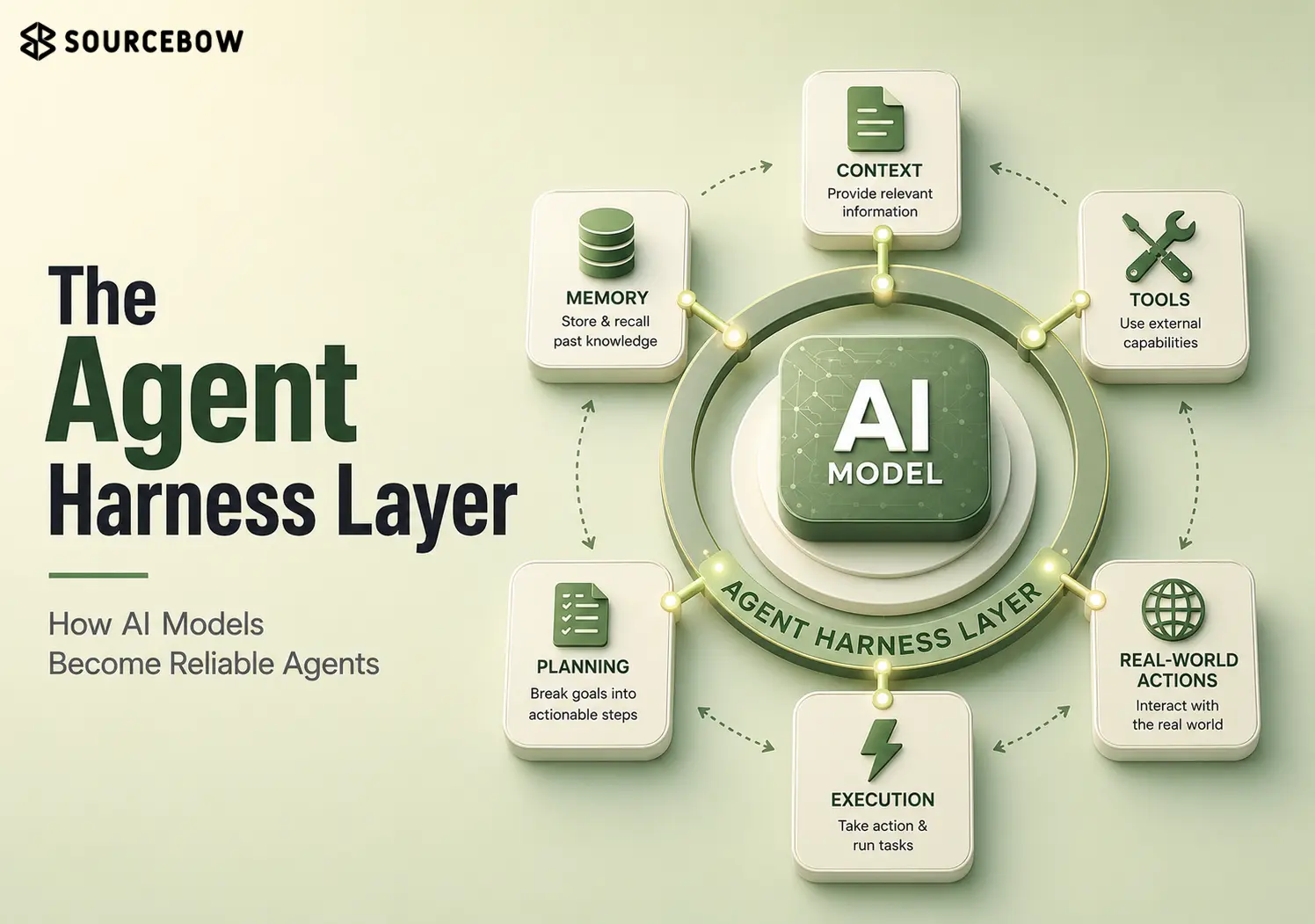
An agent harness is the software infrastructure around an LLM or AI agent that handles everything except the model itself. In plain English, it’s the stuff that gives the model hands, eyes, and continuity. The model generates the intelligence, but the harness makes that intelligence useful in the real world.
One architect describes it as the system that manages context from intent capture through specification, compilation, execution, verification, and persistence, which is why two products using the same model can behave so differently. That’s not a small detail. It’s the whole point. A smart model with a weak harness can still feel messy, forgetful, or stuck. A solid harness can make a model feel surprisingly capable.
Look at it like a chef and a kitchen. The model is the chef. The harness is the kitchen, the utensils, the pantry, the timers, and the cleanup crew. Without that environment, even a great chef is limited.
Why the term became useful once agents stopped being single-turn chatbots
The idea emerged as products moved from early ChatGPT-style chat interfaces to multi-step assistants that had to plan, act, and carry state across time. Once the conversation stopped being one-and-done, the support layer mattered a lot more. You could no longer rely on a single prompt-response cycle and hope for the best.
Today the stack often includes an orchestrator plus a harness, and that split matters because the model’s raw intelligence is no longer the main differentiator. Two systems can use the same LLM and still feel completely different. One might be able to search, save progress, check its own work, and continue later. The other might just sound good for a minute and then lose the thread.
Why harnesses emerged for long-running, tool-using work
Harnesses showed up because one prompt-response cycle is not enough for software projects, database queries, web APIs, UI work, or multi-session research. If you’ve ever tried to use an LLM for something that stretches beyond a single answer, you probably noticed the gap pretty quickly. It can draft, summarize, and suggest. But it doesn’t naturally keep moving unless something around it manages the process.
They solve the gaps that standard LLMs leave behind: fixed context windows, no built-in memory, no direct actions, and no reliable way to preserve progress over hours or days. That’s where the harness earns its keep. It catches the pieces the model can’t hold on to by itself and turns them into a working workflow.
Anthropic’s Claude Agent SDK uses compaction to condense past interactions, and their long-running coding workflow relies on an initializer/coding-agent pattern plus a claude-progress.txt log. That kind of setup is a pretty good example of why harnesses exist. The model is still the model, but now there’s a structure around it that keeps it from drifting.
The four failure modes the harness is really fixing
- Limited memory and context, including context windows that reset every session
- Tool use and external actions like web search, browsing, code execution, database queries, and image generation
- Structured workflows with planning, subtasks, and acceptance criteria
- Long-horizon task management for work that can stretch across hours or days
How an agent harness works from request to handoff
The harness sits between the user, the model, and the outside world, intercepting output, managing context, and feeding results back in. That middle position is what makes it so important. It’s not just a passive wrapper. It’s active infrastructure.
It handles intent capture, tool-call execution, context compaction, verification, and end-of-session handoff so the task can continue even after a pause. So if the model needs to search something, run code, save a file, or remember what happened earlier, the harness is the part doing the coordinating behind the scenes.
Tool calls, context, and verification are the three moments that matter most
| Step | What the harness does | Concrete detail from the raw content |
|---|---|---|
| Intent capture & orchestration | Turns the user’s goal into sub-tasks and next actions | The orchestrator may ask for a plan or next step before execution |
| Tool call execution | Detects commands, pauses generation, runs the tool, and returns the result | Examples include search(“climate change data”) and python(code) |
| Context management & memory | Builds the working prompt from relevant history and summaries | Uses compaction or summarization to stay within token limits and avoid context rot |
| Result verification & iteration | Checks output, runs tests, and asks for fixes if needed | One loop is literally “write code → run tests → fix errors” |
| Completion and handoff | Saves artifacts for the next run | Examples include files, summaries, progress.txt logs, and updated code |
That flow is what makes the experience feel continuous. You ask for something, the system breaks it apart, uses tools, checks itself, and then preserves enough state to keep going later. Without that, the assistant tends to feel like it’s starting over every time you blink.
What usually lives inside the harness layer
The harness is not one thing; it is a bundle of components that make an agent feel coherent instead of brittle. That bundle can be simple or pretty complex depending on the job. But the pattern is the same: keep the model connected to the right context, the right tools, and the right guardrails.
That bundle often includes tool integrations, memory systems, prompt management, planners, verification checks, and modular pieces that can be swapped or expanded. In practice, this is what gives the agent its shape. The model might be general-purpose, but the harness makes it behave like it has a job description.
The common components developers keep wiring together
- Tool integration layer: web search APIs like Parallel’s, database queries, calculators, code execution, image generators, and custom tools
- Default tools: file read/write, web search, and code interpreter support
- Memory and state management: short-term memory, long-term memory, working context, session state, and vector stores
- Context engineering: context isolation, context reduction, context retrieval, RAG systems, and different prompts for the first context window
- Planning and decomposition: planners, controllers, and initializer agents for large tasks
- Verification and guardrails: schema checks, logic checks, unit tests, safety filters, and source verification
- Modularity and extensibility: perception, memory, and reasoning modules that can be enabled or disabled
Now, not every system needs every piece. A lightweight agent might only need file access and a little memory. A bigger one might need planning, verification, and multiple tool types. But once you see the pattern, it’s hard to unsee it. The harness is basically the scaffolding that keeps the whole thing from wobbling.
Real examples of agent harnesses already shipping in the wild
The term is not abstract anymore; it already shows up in products and research with very different shapes. That’s actually what makes it useful. You can see the same concept working in multiple settings, even if the details differ a lot.
Claude Agent SDK, LangChain DeepAgents, and the ICML 2025 modular gaming harness all show the same pattern: the model gets stronger because the surrounding system is doing more work. The harness is quietly doing a lot of heavy lifting.
Three concrete implementations that make the idea easy to see
| Example | What it provides | Notable detail |
|---|---|---|
| Claude Agent SDK | General-purpose agent harness with context management and tool use | Automatic compaction, internal knowledge base search, and claude-progress.txt handoff |
| LangChain DeepAgents | Agent harness built on top of LangChain | Default prompts, tool handling, planning utilities, and virtual file system support |
| General Modular Harness for LLM Agents in Multi-Turn Gaming Environments | Perception, memory, and reasoning modules around a GPT-4-class model | ICML 2025 paper using the Gymnasium game API and improving win rates over an unharnessed baseline |
| Agentic application harnesses | Implicit harnesses inside products like AutoGPT, Microsoft Copilot chat for Office, GitHub Copilot X, and Cursor | Sandboxed code execution, Bing search, image insertion, and multi-step loops |
These examples matter because they show the harness isn’t just a theoretical architecture diagram. It’s already baked into tools people use every day. Sometimes users never even notice it directly, which is kind of the point.
Agent orchestration vs harness vs framework: what each one actually does
These terms overlap, but they are not the same layer of the stack. People blur them together all the time, and honestly, that’s understandable. They’re neighbors. But they do different jobs.
A framework gives you building blocks, an orchestrator controls the loop, and a harness supplies the capabilities and side effects that let the model act in the world. If you keep that simple split in mind, a lot of the confusion clears up fast.
Why framework, orchestrator, and harness get confused so easily
| Term | Main role | How it differs |
|---|---|---|
| Agent framework | Libraries and abstractions for tools, memory, and chains of prompts | LangChain and LlamaIndex are examples of building blocks |
| Orchestrator | Decides when and how to call the model | Focused on logic and control flow, including ReAct or tree-of-thought loops |
| Harness | Wraps the model with tools, memory, input/output handling, and environment support | Often uses a framework underneath, such as DeepAgents using LangChain |
| Test harness / evaluation harness | Software testing or benchmark measurement | Different from an agent harness unless the context explicitly says testing |
So, the easiest shorthand is this: the framework is the toolkit, the orchestrator is the conductor, and the harness is the stage, props, and backstage crew all rolled into one. That’s not perfect, but it’s close enough to be useful when you’re trying to understand how real agent systems are built.
FAQ
These are the doubts that usually come up after someone understands the basic idea but still wants to know where the edge cases are. And fair enough — this stuff can feel a little slippery until you see the boundaries clearly.
Q: Is an AI harness the same thing as prompt engineering?
No. Prompt engineering is one job inside the harness, but the harness also manages tools, memory, result handling, and the full interaction loop. So prompt work matters, just not in isolation.
Q: Do I always need a harness to use an LLM effectively?
Not for simple one-off Q&A or text generation, but once the task needs external data, multi-step work, or memory across sessions, some kind of harness becomes useful fast. That’s usually the point where the model stops feeling like a toy and starts feeling like a system.
Q: Can multiple models share the same harness?
Yes. A harness is model-agnostic in practice, so you can swap GPT-4 for another model, or even route between multiple models, without rebuilding the whole system. That flexibility is one reason harness design matters so much.
Q: Are harnesses only for text-based LLM agents?
No. The same pattern applies to robotics, reinforcement learning, game agents, and any sequential AI system that needs a body, tools, or an environment wrapper. The medium changes, but the idea stays pretty similar.
Conclusion
An agent harness matters because it is often the difference between a model that looks clever and a system that actually finishes the job. That’s the real takeaway. A model can sound smart on its own, but the harness is what helps it act, remember, check itself, and keep going.
If the task is simple, you can get by with a prompt; if the task is real work, the harness is usually where the win comes from. And once you notice that, it’s hard to unsee how much of AI usefulness lives outside the model itself.