Introduction
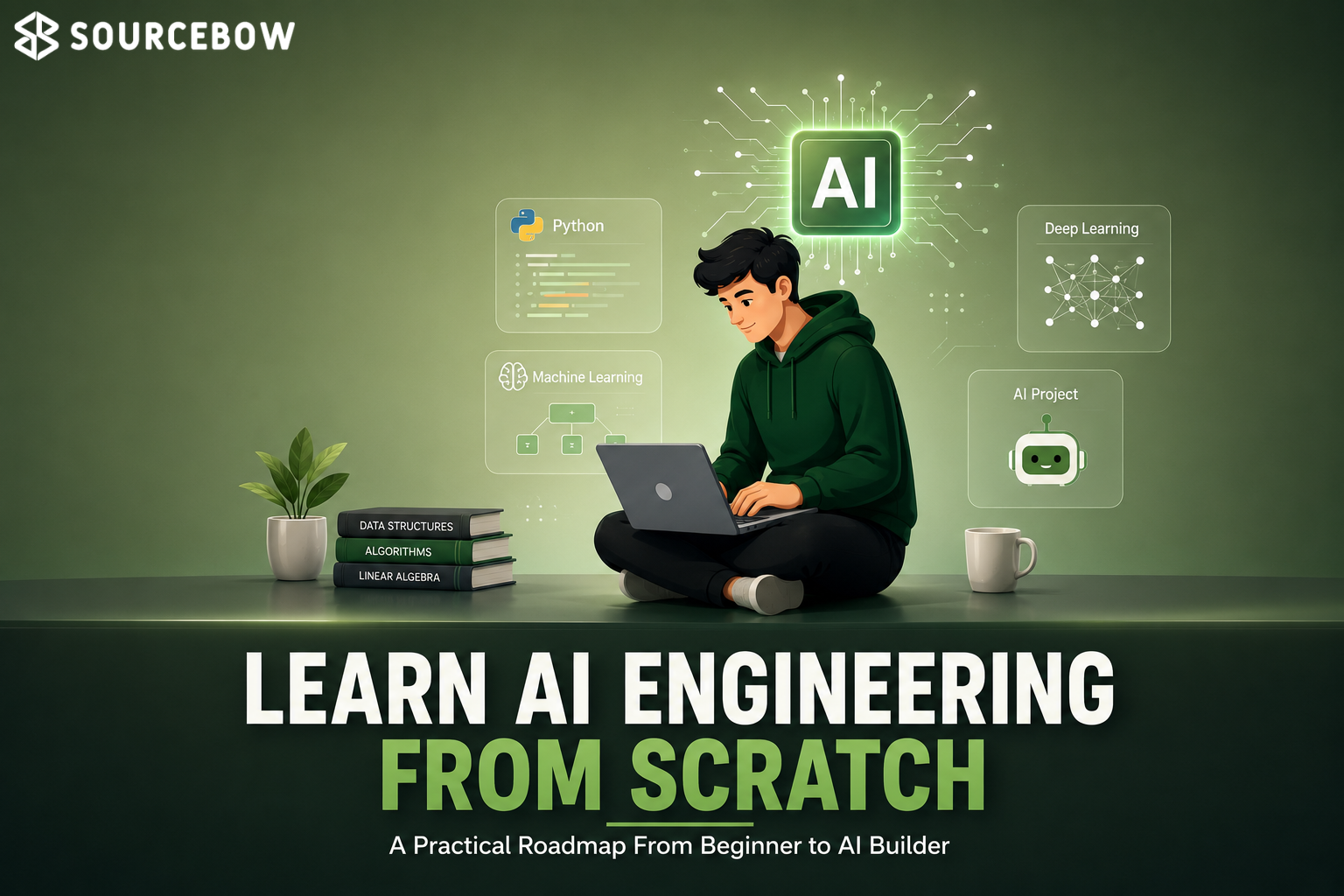
If I were starting from scratch today, I wouldn’t begin with a giant roadmap or try to memorize every shiny tool in the space. I’d focus on learning how real AI systems behave when they’re under pressure, because that’s where the useful lessons show up. The fastest path to confidence is not collecting notes. It’s building, breaking, and fixing things until the shape of the work starts to make sense.
That’s why LangGraph agent harness engineering is such a strong place to start. It pushes you toward the parts that matter in practice: observability, evaluation, and the ability to understand why a system did what it did. Once you start thinking that way, AI engineering stops feeling like a pile of disconnected topics and starts feeling like a craft.
Quick Highlights
- Start with systems, not slides.
- Learn why models fail before adding tools.
- Use observability early, not later.
- Choose frameworks based on control, not hype.
- Evaluate everything that ships.
The point is not to memorize a roadmap. It is to understand the pieces well enough to build, debug, and judge systems that actually ship. And honestly, that shift in mindset changes everything. You stop asking, “What should I learn next?” and start asking, “What breaks here, and why?”
Why LLMs fail in the ways engineers keep running into
To learn AI engineering well, you need a simple mental model of how LLMs work during inference. That’s where a lot of the so-called mystery disappears. Autoregressive next-token prediction is the basic mechanism behind generation, and it explains a lot more than people expect. Hallucination isn’t some magical defect floating above the system. It’s a side effect of how the model predicts the next token based on patterns it has seen before. The same idea also helps explain why counting, arithmetic, and precise step-by-step reasoning can get shaky unless you give the model help with tools or structured logic.
Then there are the knobs that look minor at first but matter a lot in practice. Tokens, context windows, temperature, top-p, and top-k all change the behavior of the system in ways that affect cost, repeatability, and output style. If you’ve ever seen the same prompt give you three slightly different answers, that’s not random noise. It’s the result of sampling choices and model limits working together.
Embeddings and cosine similarity are useful too, but here’s where it gets interesting: embedding space is not the same thing as human meaning. It can help you retrieve related content, cluster documents, or compare semantic closeness, but it doesn’t “understand” in the way beginners sometimes hope. That gap matters, especially when you start relying on retrieval for real use cases.
Frontier closed models and open-weight models do not create the same options
There’s also a practical split that changes what you can do next. Anthropic, OpenAI, and Google represent one side of the ecosystem, while Llama, Qwen, and DeepSeek sit on the open-weight side. That difference is not just philosophical. It affects whether you can fine-tune, host the model yourself, inspect behavior more deeply, and control your costs more directly. If you’re learning AI engineering, that tradeoff is worth understanding early, because it shapes the kinds of systems you can realistically build.
RAG only starts with retrieval, not with “put documents in the prompt”
RAG contextual retrieval is one of those terms that sounds more complicated than it is at first. The basic pattern is simple: pull relevant chunks from a knowledge source and give them to the model. But if you stop there, you’re only doing the bare minimum. Naive RAG is just vector search plus prompt stuffing, and that version is often where beginners get stuck because it seems to work until it suddenly doesn’t.
The real work begins when you notice that retrieval quality depends on much more than similarity scores. Hybrid search, reranking, and chunking strategy can change whether the model gets something useful or something vaguely related but misleading. A chunk that says “it costs $200” is nearly useless if the surrounding context says what “it” refers to. That’s the logic behind Anthropic’s contextual retrieval: preserving the meaning of the source matters as much as pulling the right snippet.
So if you’re building a retrieval system, don’t think only about “Can I fetch text?” Think about whether the fetched text still makes sense on its own. That’s the difference between a demo and a system people can trust.
When long context replaces RAG, and when it does not
Now that some models support 1M+ tokens, it’s fair to ask whether RAG is always needed. The answer is no. For smaller datasets, long context can be simpler and cleaner than maintaining a full retrieval stack. Sometimes the best engineering choice is to skip the vector database entirely and just give the model everything it needs in one shot.
But long context is not a universal replacement. Once your dataset grows, your information changes often, or you need strong retrieval precision, RAG becomes the more sensible pattern again. The real skill is knowing which setup is easier to maintain for the problem in front of you. That judgment call is part of becoming an engineer, not just a prompt user.
- Naive RAG: vector search → stuff into prompt
- Advanced RAG: hybrid search + reranking + chunking strategy
- Contextual Retrieval: keeps chunks meaningful in source context
- Agentic RAG: the model decides whether to retrieve and what to use
Frameworks are tools, but the real question is what kind of control you need
When people first get into AI engineering, they often ask which framework is “best.” That’s usually the wrong question. A better one is: how much control do you need, and how much complexity are you willing to manage? LangChain is the broad toolkit. It’s fast to get working, has a huge ecosystem, and connects to a lot of things without much friction. That makes it a decent place to prototype.
LangGraph exists because the original LangChain abstractions started to feel leaky once agents got more serious. In plain English, that means the system became harder to debug and reason about. LangGraph leans into state, control flow, and explicit structure, which is exactly what you want when agent behavior matters. Then there’s CrewAI, which goes in a different direction with role-based agents. Instead of a graph of steps, you get a crew: a researcher, a writer, a reviewer, and so on. It’s a different mental model, and sometimes that model fits the job better.
The ecosystem around each framework matters too. You’re not only choosing syntax. You’re choosing docs, examples, community support, and how much churn you’re willing to tolerate while learning.
The named resources worth actually using for each framework
For a more grounded path, Roberto Infante’s AI Agents and Applications: With LangChain, LangGraph, and MCP is a useful book to keep nearby. The free learning platform at learncrew is also worth a look, especially since it’s reportedly helped 100K+ developers get oriented. And yes, the official docs matter too. That sounds boring, but in practice it saves a lot of guessing.
There’s also a useful note about framework churn that shows up in the same ecosystem: tools move fast, names shift, and abstractions get rewritten. If you treat frameworks as interchangeable magic boxes, that churn will frustrate you. If you treat them as tools with different control surfaces, it becomes much easier to choose.
- LangChain — broadest ecosystem, most integrations
- LangGraph — built for more control and cleaner agent behavior
- CrewAI — role-based agents collaborating as a crew
Evaluation, harness engineering, and observability are what separate demos from systems
This is the part many people skip at first, and it’s usually the part that saves them later. LLM evals and observability are what turn a cool prototype into something you can trust. Evaluation means measuring quality systematically, not just reacting to whether the output “feels good.” Harness engineering is the layer that routes tool calls, manages memory and state, and handles errors without the whole thing falling apart. Observability is what lets you see what actually happened after the fact, which is priceless when a system behaves oddly in production.
That’s the difference between a chatbot and an agent. A chatbot can seem fine until a user asks something unexpected. An agentic system needs guardrails, tracing, and a way to inspect the chain of events. That’s where tools like LangSmith debugging agent loops, Langfuse, and MCP stop being buzzwords and start becoming the boring, important infrastructure that keeps the system honest.
If you want to learn AI engineering from scratch the smart way, this is the habit to build early: don’t just ask whether something works once. Ask whether you can measure it, explain it, and fix it when it stops working.
The resources that make this part concrete
Anthropic’s “Building Effective Agents” is one of the clearest references for thinking about agent and harness design. It helps connect the abstract idea of an agent to the actual engineering needed to make one useful. The Model Context Protocol spec has also become a major standard for connecting agents to tools and data. If you’ve ever wished your system had a cleaner way to talk to external services, that’s exactly the problem MCP is trying to solve.
For practical evaluation work, Hamel Husain’s writing on error analysis and LLM-as-judge is especially helpful because it stays close to what you can actually do. Simon Willison is also worth following for the skeptical perspective, since he’s good at cutting through hype and asking what’s truly shipping. And when it comes to seeing the full picture of behavior, LangSmith and Langfuse are two observability tools that make a real difference once systems start getting messy.
- Anthropic — Building Effective Agent
- Hamel Husain — error analysis and LLM-as-judge writing
- Simon Willison — skeptical commentary on what is actually shipping
- Observability tools: LangSmith and Langfuse
FAQ
These are the questions people usually run into once they stop collecting links and start thinking about what really matters first.
Q: Should I start with LLM internals or RAG?
Start with LLM internals for inference first. If you don’t understand tokens, context windows, and next-token prediction, RAG and agents will feel like random mechanics instead of design choices. Once the model basics are clear, retrieval starts making a lot more sense.
Q: Is LangGraph better than LangChain for agents?
LangGraph is the better fit when you need more control and visibility into agent behavior. LangChain is still the broader starting point when you want speed and a larger integration ecosystem. So the answer depends on whether you’re optimizing for quick setup or for control and debuggability.
Q: When should I use long context instead of RAG?
For smaller datasets, long context can be enough, especially now that some models handle 1M+ tokens. Once retrieval, freshness, or scale starts to matter, RAG becomes the more useful pattern. The right choice is usually the simpler one that still solves the actual problem.
Q: What makes an AI system production-ready?
It’s not theory. It’s the ability to build, evaluate, observe, and maintain the system after it starts failing in normal use. If you can’t trace issues, measure quality, or recover from errors, the system isn’t really ready yet, no matter how impressive the demo looked.
Conclusion
The goal is not to “learn AI engineering” as a vague topic. It’s to become the kind of builder who can ship and maintain real-world AI systems without panicking the moment things get weird. That means understanding how models behave, how retrieval works, how frameworks differ, and how evaluation and observability keep the whole thing honest. Those pieces are what separate casual experimentation from real engineering.
Once those ideas click, the roadmap matters less than your judgment. And honestly, that’s the real win. You stop chasing the next resource and start building with enough clarity to trust your own decisions.