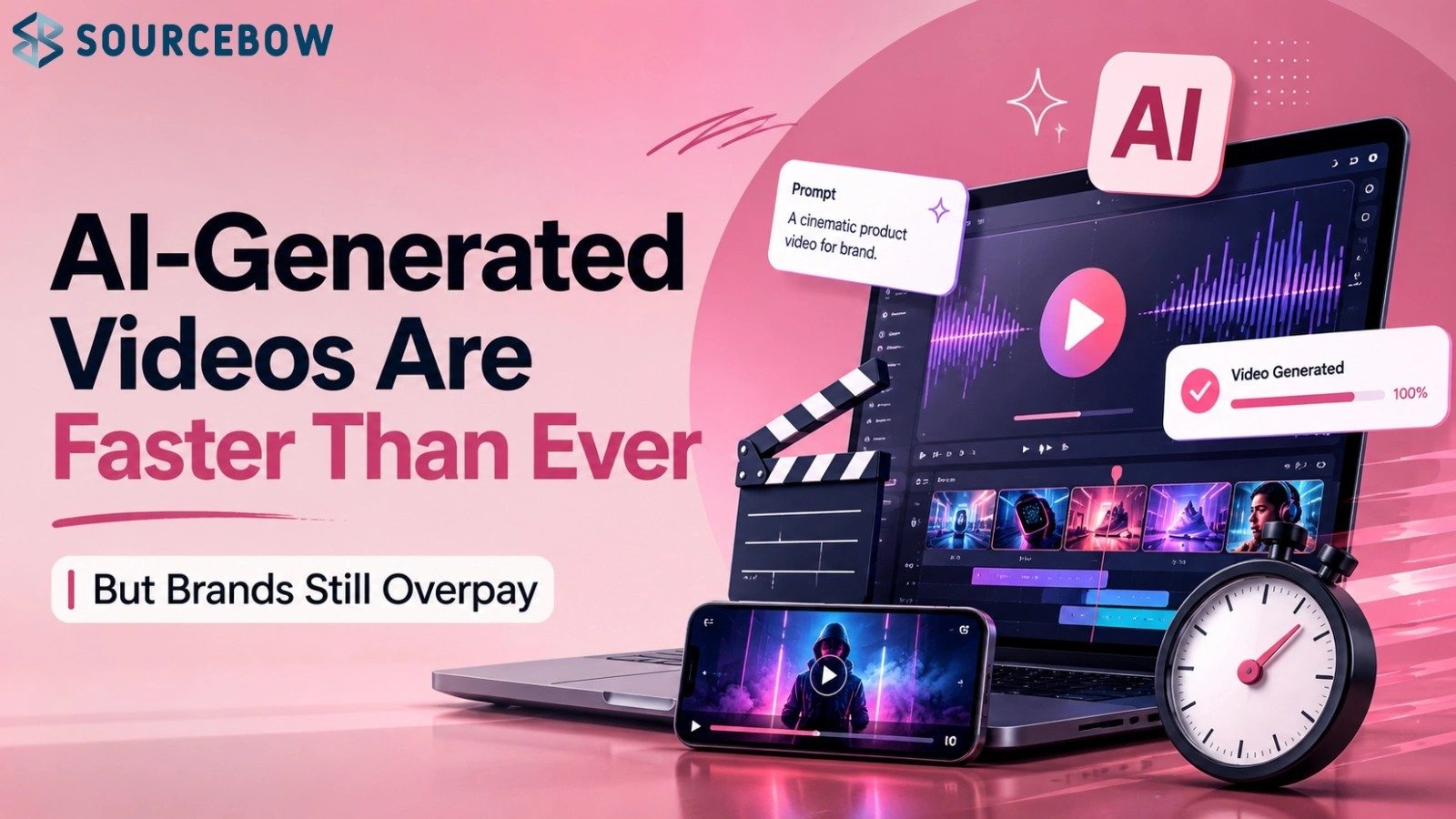
AI-generated videos are showing up in more marketing decks, more pitch meetings, and more brand experiments than ever. And yes, they can be fast. But speed is only one part of the story, and honestly, it’s the part people fall for first.
The bigger question is whether synthetic video can actually carry a brand without quietly damaging trust, consistency, and creative quality along the way. That’s where the conversation gets a lot more interesting.
Quick Highlights
AI-Generated Videos sound futuristic. Here’s the part most brands miss.
If you’ve sat through a marketing meeting lately, you’ve probably heard someone say AI should be able to “just make the video.” It sounds efficient. It sounds modern. It sounds like a shortcut to more content with less budget.
But AI-generated videos are not magic, and they’re definitely not a creative mind in a box. They’re better understood as machine-generated visuals built from pattern prediction. That distinction matters more than most teams realize, because it explains why the output often looks impressive at first glance and then falls apart when you need it to feel real, on-brand, and emotionally convincing.
In 2026, generative AI video creation is everywhere in the conversation. Adoption has surged across content teams, and workplace productivity reports still show strong interest in automation. At the same time, consumer skepticism toward synthetic content is rising too. That combination creates a weird tension: more brands want to use AI, but more audiences are learning to spot it.
So the real issue isn’t whether AI can generate video. It’s whether it can generate the kind of video that actually helps a brand in the long run.
What AI-Generated Videos actually are and how they work
Let’s keep this simple. Traditional AI has been around for a long time in things like Netflix recommendation systems, fraud detection, and search ranking. It helps computers identify patterns and make useful predictions. Generative AI goes a step further. Instead of just sorting or recommending, it creates new content — text, images, audio, and now video.
Under the hood, this usually involves neural networks and deep learning. Those are systems trained on massive datasets so they can learn patterns in language, motion, faces, scenes, and style. If you type a prompt, the model interprets it through natural language processing, or NLP, and tries to predict what comes next based on everything it has seen before.
That’s the key idea. It doesn’t understand in the human sense. It predicts.
Think of it like a hyper-fast pattern engine. It can mimic structure, pacing, and visual style with surprising confidence, especially as multimodal systems improve in 2026. But it is still assembling output statistically. It is not sitting there with a real intention, a brand point of view, or a gut feeling about what your audience needs to feel at second seven of the ad.
That’s why generative media can be useful for drafts, concepting, and early exploration. It’s also why it can struggle the moment the work needs emotional nuance, specific brand alignment, or storytelling that feels lived-in rather than assembled.
And yes, the growth has been real. More teams are using automated video creation for social ads, explainers, product demos, and internal content. But faster production does not automatically mean better communication.
Why AI-generated videos still feel a little off
This is where the uncanny valley shows up. The face looks close enough. The movement is almost right. The lighting seems fine. But something in your brain says, “Nope.”
That reaction is not random. Humans are very sensitive to tiny mismatches in motion, timing, facial expression, and physics. If a hand bends strangely, a blink lands too late, or a person’s expression doesn’t quite match the spoken words, the illusion starts to crack. You might not be able to explain exactly why, but you feel it.
That’s a huge problem for marketing because brands don’t just need video that looks polished. They need video that feels believable. Audiences are incredibly quick to detect synthetic storytelling, even when they can’t name the technical flaw. A lot of the time, what they’re reacting to is emotional mismatch. The video is saying one thing, but the rhythm, movement, or tone suggests something else.
We saw a version of this public reaction when Toys “R” Us faced backlash over an AI-generated ad. Instead of looking innovative, the campaign left many viewers uneasy, even annoyed. That kind of response matters, because it can turn a brand’s attempt at novelty into a trust problem.
There’s also the broader recall issue. Advertising studies consistently show that emotion improves memory and brand recall. If a video feels cold, stiff, or mechanically assembled, it may still be “watched,” but it doesn’t always stick. And if the viewer senses the shortcut, the brand can lose a little credibility every time.
Here’s the annoying part for marketers: the more synthetic content floods the internet, the easier it becomes for audiences to spot. So even as the technology improves, audience tolerance may be dropping.
Are AI-generated videos a legal and brand risk?
Short answer: yes, and not just in a theoretical way.
There are already lawsuits emerging around AI-generated content, and that uncertainty is a real headache for businesses. Some of the noise is about training data. Some is about likeness. Some is about voice replication. And some is about whether a brand can safely use machine-generated media without accidentally stepping into legal or
reputational trouble.
One of the most talked-about examples has been the Scarlett Johansson lawsuit reference around AI voice usage, which made a lot of people in the industry pay attention. Voice, image, and video all raise different questions, but the theme is the same: if your tool learned from data it shouldn’t have used, or if it outputs something that resembles a
real person too closely, the risk is not just technical. It becomes legal, ethical, and commercial at once.
That’s why brand teams need to think beyond the immediate campaign. The bigger issue is long-term brand liability. A video might be fine today and still create headaches six months later if a rightsholder complains, a platform changes policy, or regulators tighten the rules.
In 2026, global AI regulation is moving toward stricter disclosure, consent, and provenance expectations. The details vary by region, but the direction is clear: brands are being pushed to know where content came from, how it was made, and whether a real person’s voice, face, or data was involved.
There are also data privacy concerns. Voice, image, and video datasets are sensitive by nature. If your team is testing tools without understanding what gets stored, reused, or trained on, that’s a risk you probably don’t want sitting inside your content workflow.
So yes, deepfake video concerns are part of the picture. But the larger problem is trust. One bad synthetic ad can do more than annoy people. It can make your audience question how carefully your brand thinks.
Can AI vs human creativity really be called a fair competition?
Not exactly. They’re solving different problems.
AI vs human creativity is often framed like a battle, but that’s a little misleading. Humans don’t just create by combining patterns. They bring memory, taste, cultural context, instinct, humor, timing, and emotional judgment. That’s not something neural networks can truly replicate, even when they generate convincing output.
AI is very good at remixing what already exists. Humans are better at deciding what should exist next.
That difference matters in AI video marketing because marketing is not just about producing something watchable. It’s about making people feel something specific about a product, service, or brand. A decent-looking video that says nothing new is still a weak asset if it doesn’t connect emotionally.
This is where many teams get trapped. They confuse efficient content with memorable storytelling. They assume more volume equals more impact. But a stream of generic synthetic content can blur a brand faster than it builds one. Over time, audience trust can erode when everything feels slightly interchangeable.
Authenticity is turning into a competitive advantage in 2026, especially for brands that want to stand out in a sea of automated output. That doesn’t mean every video must be hand-crafted frame by frame. It means the core idea, message, and emotional shape should still be led by human judgment.
Look at it this way: AI can draft the sentence, but humans decide whether the sentence actually matters.
Is AI video automation really making teams more productive?
This is the productivity paradox, and it’s one of the most under-discussed parts of the conversation.
On paper, video automation should save time. It can accelerate idea generation, rough cuts, voice experiments, and visual mockups. But in real workflows, the savings often get eaten up by cleanup. Teams spend time correcting awkward motion, fixing bad transitions, checking for bias, rewriting prompts, replacing odd facial expressions, and bringing the content back into brand alignment.
That extra work is why the “AI saves time” promise often feels incomplete.
One reason this matters is that almost 80% of workers in some reports said AI tools increased their workload rather than reducing it. That doesn’t mean the tools are useless. It means the work shifts. Instead of creating everything from scratch, people spend more time reviewing, editing, approving, and redoing.
For video teams, that can become exhausting fast. A concept that looks like a 30-minute shortcut can easily turn into a two-hour revision cycle. And if the content is for a brand launch, product release, or campaign with legal review, the bottlenecks multiply.
So the real question for AI video automation is not, “Can it produce something quickly?” It’s, “Can it produce something useful without adding hidden costs?”
Sometimes yes. Often not as much as vendors imply.
Where AI video tools actually fit in marketing
Now, to be fair, none of this means the tools are pointless. They’re just better in some lanes than others.
AI video generation limitations become easier to accept when you assign the tools the right job. They’re good for prototyping, rough visual exploration, test concepts, internal explainers, and quick draft variation. They can also help teams move faster when the stakes are low and the goal is simply to see an idea take shape.
That’s the healthy version of AI in marketing: support, not replacement.
Here are a few places where synthetic content can be genuinely useful:
- Storyboarding early campaign ideas
- Testing different openings or hooks
- Generating placeholder visuals for internal review
- Creating low-risk social content variations
- Speeding up concept development before human polish
But once the content needs emotional depth, legal safety, or brand-specific storytelling, human direction becomes essential. That’s especially true when a campaign needs to feel culturally aware or subtly persuasive. Those are not areas where prediction systems excel on their own.
The best current approach is hybrid. Let the tools handle speed where it makes sense. Let people handle judgment where it really matters.
AI-generated videos vs human-led video production
| Factor | AI-Generated Videos | Human-Led Production |
|---|---|---|
| Speed | Fast drafts | Slower creation |
| Creativity | Pattern-based | Original thinking |
| Emotional depth | Limited | High |
| Legal certainty | Unclear | Safer |
| Brand alignment | Inconsistent | Strategic |
| Audience trust | Lower | Higher |
| Editing requirements | Often high | Controlled |
That table isn’t meant to say one side is “good” and the other is “bad.” It’s more about fit. If you need a draft, AI can help. If you need a persuasive story that protects brand authenticity, human-led production still has the edge.
So what’s the future of AI-generated videos in marketing?
The future probably isn’t full replacement. It’s boundaries.
Brands that use AI content wisely will likely define very clear creative boundaries around where automation is allowed and where human oversight is mandatory. That’s a healthier model than pretending every workflow should be automated just because the tools exist.
We’re likely to see more hybrid AI-creative production models in the next phase. A team might use machine-generated visuals for concept testing, then move to human-led filming or editing for the final campaign. Or they might use AI for internal training content while keeping public-facing work more tightly controlled.
That’s also where “human-made” branding could become more valuable. In a market crowded with synthetic media, being visibly human can become part of the message. Not because AI is evil or unusable, but because people are getting more selective about what feels worth paying attention to.
And honestly, that makes sense. The more automated the internet becomes, the more audiences may crave proof of actual thought, taste, and care.
A few practical takeaways before you bet your brand on it
If you’re evaluating AI video tools right now, keep it simple. Don’t ask whether they can generate something. Ask what kind of work they’re best at, what risks come with the output, and how much human correction they actually require.
That’s the part vendors tend to glide over.
Here’s the short version:
- Use AI for drafts, not final authority.
- Assume legal review may still be needed.
- Expect editing time, not just generation time.
- Protect voice, likeness, and dataset privacy.
- Prioritize audience trust over novelty.
AI video tools are improving fast. No question about that. But improved technical output doesn’t automatically solve emotional storytelling, brand fit, or the weird little trust signals people pick up almost instantly. That gap is why so many teams still find themselves reworking what looked perfect in the prompt window.
So if you’re thinking about your next campaign, maybe the better question isn’t “Can AI make this video?” It’s “Should it, and what does my brand lose if it does?”
That’s where the real strategy starts.
If this is the conversation happening in your team right now, it may be worth looking at how human-led storytelling and AI-assisted workflows can work together instead of competing. Sometimes the smartest move is not choosing sides. It’s setting the right creative boundaries.
Related reads: AI in marketing strategy, video storytelling best practices, brand authenticity guides, and the future of creative automation.