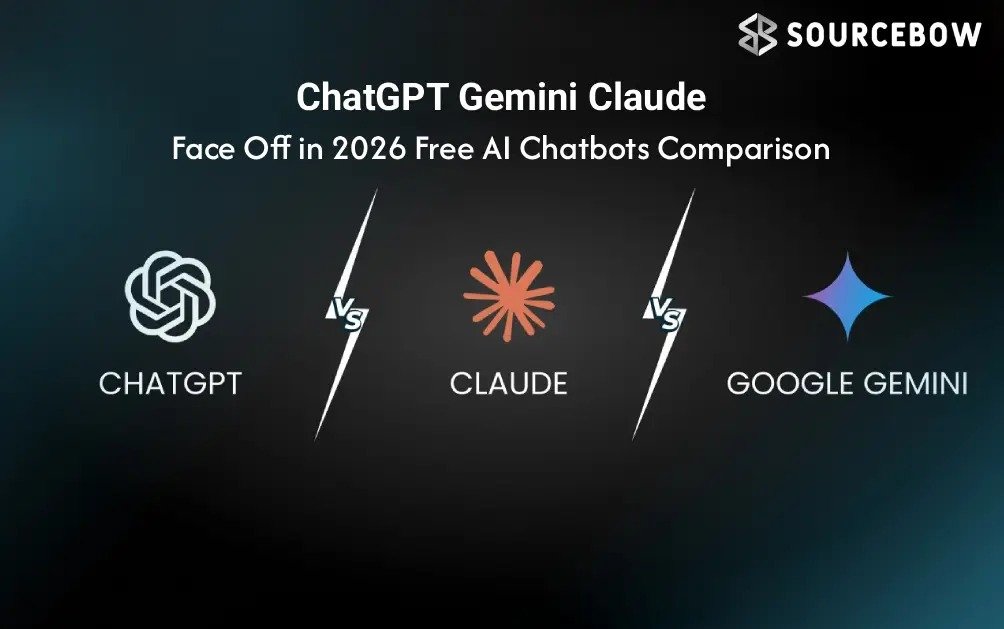
ChatGPT vs Gemini vs Claude in 2026
Three AI Chatbots Everyone Is Talking About and Which One Actually Fits Your Work
Artificial intelligence chatbots are no longer some futuristic experiment. They quietly slipped into daily routines. One moment it is helping write an email. Next moment it explains a confusing topic, creates an image, or fixes a line of code that refused to behave all morning.
People now open an AI chatbot the same way they open a search engine. Quick question. Quick help. Done.
Among the many tools floating around today, three names keep popping up again and again. ChatGPT, Gemini, and Claude. Each one offers a free version. Each one promises powerful capabilities. But spend some time using them and something interesting happens.
They start to feel different. Almost like three assistants with different personalities sitting at the same desk. And that difference matters when deciding which AI chatbot actually fits daily work in 2026.
Why AI chatbots suddenly feel like everyday tools
Not long ago, AI chat tools were mostly experimental. People opened them out of curiosity. Ask a random question, laugh at the strange answer, close the tab. That phase disappeared quickly.
Today AI tools help write blog posts, summarize long reports, generate images, draft captions, explain complicated science ideas, even help plan travel. Students use them while studying. Developers use them when debugging code. Writers use them to break through creative blocks.
It almost feels like having a second brain sitting beside the keyboard. Still, not all AI assistants behave the same way. Some are flexible. Some are great researchers. Others act like careful editors.
That is where the differences between ChatGPT, Gemini, and Claude begin to show.
ChatGPT feels like the reliable all rounder
Among the three, ChatGPT often gives the feeling of that friend who is good at almost everything. Not necessarily the absolute best at one single thing. But dependable across many tasks.
Writing help. Coding questions. Document summaries. Content ideas. Image generation. Even explaining confusing topics in simple language. It handles all of that pretty smoothly.
The free version alone is surprisingly capable. Long articles can be summarized quickly. Blog outlines appear in seconds. Coding errors often get fixed with a short explanation that actually makes sense.
Image creation is another place where ChatGPT quietly shines. Type a simple prompt and a polished image appears without endless prompt tweaking. That convenience matters more than people expect.
Developers also tend to rely on it heavily. Generating scripts, debugging code, or explaining programming logic happens quite naturally inside the chat.
One big reason behind this versatility is its evolving architecture. Modern versions built on advanced GPT systems improved contextual understanding and conversation flow. The chatbot remembers earlier parts of the discussion and responds with better continuity.
It is not perfect though. Some critics say the writing style sometimes feels a bit structured or slightly formulaic. Occasionally the tone becomes overly neat. But for most everyday tasks, the balance of speed, flexibility, and features keeps ChatGPT at the center of the AI conversation.
For many users, it simply feels like the easiest AI assistant to start with.
Gemini leans heavily into research and discovery
Gemini takes a slightly different path. Instead of acting purely like a conversational assistant, it behaves more like an intelligent research companion connected to a massive information network.
That makes sense because Gemini sits inside the broader Google ecosystem. Ask about a current news story. A trending topic. A complicated subject that normally requires opening ten browser tabs. Gemini usually responds with a structured explanation that feels close to a smart search engine conversation. This connection to real time information gives Gemini a noticeable advantage when researching fresh topics.
Students and researchers often appreciate this style. Rather than jumping between websites, the chatbot gathers information and explains it in a single response.
Another interesting strength is its ability to process huge amounts of text. Some versions support extremely large context windows. In simpler terms, the system can read and analyze very long documents in one go. Think research papers, long datasets, or even entire code bases.
Gemini also blends smoothly with tools many people already use daily. Gmail threads can be summarized. Google Docs can be drafted quickly. Presentation slides appear faster than expected.
For people already working inside Google services, that integration feels natural.
But there are small trade offs. Sometimes the responses feel slightly less polished compared with other AI models. Writing tasks occasionally come across as less refined. The information is there, but the tone may feel more informational than conversational.
Still, when the goal is research or exploring complex topics, Gemini becomes extremely useful.
Claude shines when writing and deep reading matter
Claude takes yet another direction. If ChatGPT feels like the versatile helper and Gemini feels like a research engine, Claude often feels like a thoughtful editor sitting beside the screen.
Its biggest strength shows up when working with writing.
Long essays. Professional reports. Detailed explanations. Claude tends to produce responses that sound measured and calm. Almost as if someone carefully reviewed every sentence before sending it back.
That tone makes it popular among writers, researchers, and professionals who deal with large documents.
Handling lengthy text is one area where Claude performs impressively. Entire reports, books, or complex documentation can be analyzed without the system losing track of context.
Another quality that stands out is its cautious approach to information. Claude often acknowledges uncertainty rather than confidently inventing answers. That habit makes it attractive for situations where accuracy matters.
Legal writing, academic work, technical documentation. Those areas benefit from careful reasoning rather than flashy creativity.
However, Claude currently lags slightly in visual features. Built in image generation is not as developed compared with ChatGPT or Gemini. The focus remains strongly centered around text based interaction.
And while its reasoning is impressive, it lacks the large plugin ecosystem that some other AI tools support.
Still, when the job involves thoughtful writing or deep reading, Claude often feels surprisingly capable.
Picking the right AI chatbot really depends on how it will be used
One interesting truth appears after spending time with all three tools.
There is no universal winner. Each chatbot quietly reflects a different philosophy about how artificial intelligence should assist people.
ChatGPT aims to be versatile. A flexible assistant capable of handling creative work, coding, explanations, and visual generation.
Gemini focuses on information. Its connection to Google services and real time data makes it powerful for research and discovery.
Claude concentrates on careful thinking. Writing, editing, and reasoning tasks often feel smoother inside its environment.
For everyday users, ChatGPT or Gemini often feel like the most complete packages. They combine multiple abilities in one place and handle daily tasks comfortably. when the work revolves around detailed writing or analyzing long documents, Claude deserves serious attention.
The quiet truth about AI chatbots in 2026
Something interesting is happening with AI tools. Instead of replacing each other, they are slowly becoming specialized companions. People switch between them depending on the task.
One chatbot helps brainstorm ideas. Another summarizes research. A third refines the final piece of writing. And since most platforms offer free versions, experimenting with multiple assistants has become normal.
The real advantage today is choice.
AI chatbots are no longer just clever experiments sitting in tech labs. They have become everyday digital partners quietly helping people work faster, learn quicker, and solve small problems throughout the day.
Pick the one that fits the workflow best. And chances are, another one will still sit in a nearby browser tab. Just in case.