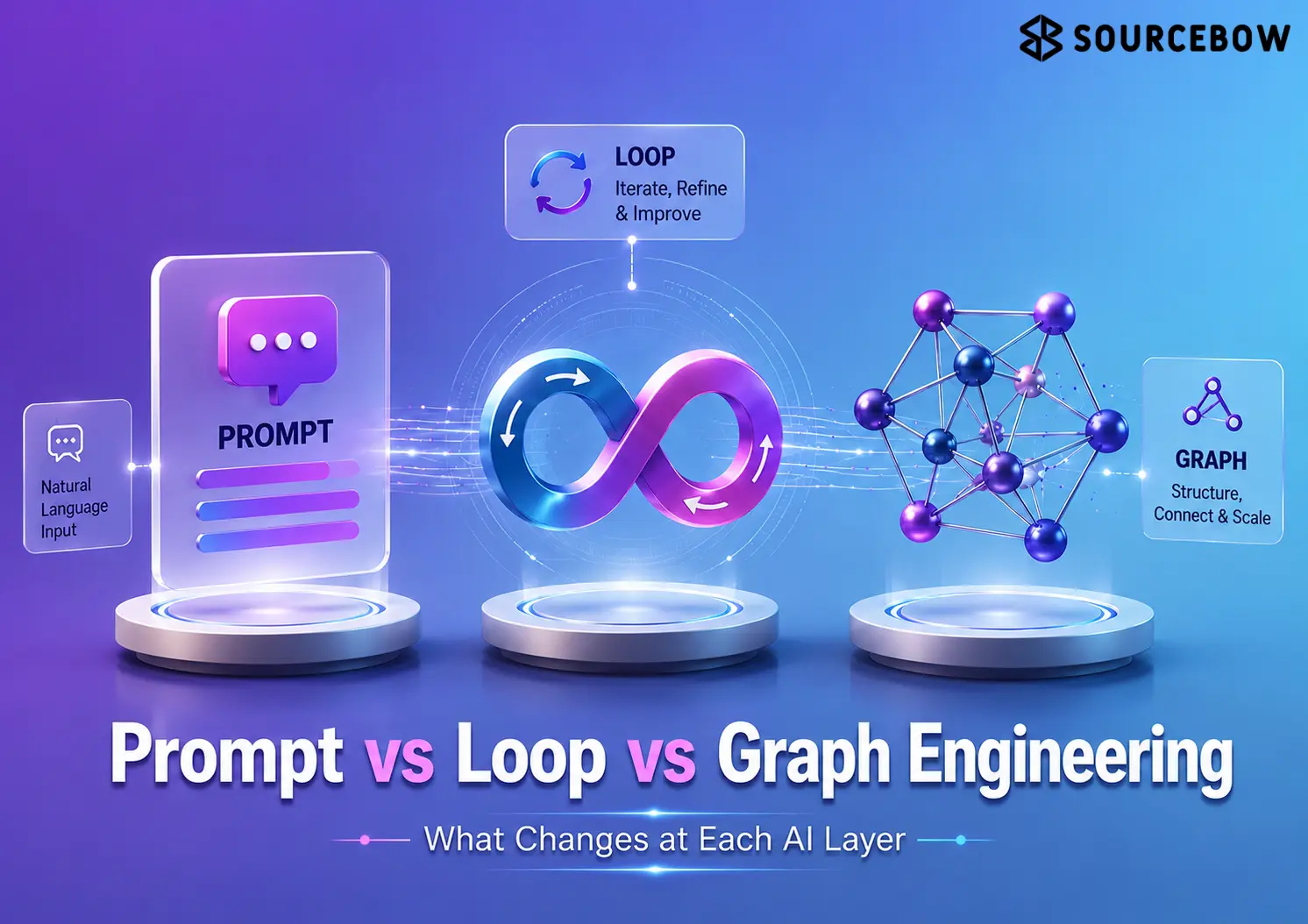
Prompt, loop, and graph layers now define how AI agents behave — and the real question is when a single prompt stops being enough. Prompt vs Loop vs Graph Engineering helps frame that shift, showing how AI systems move from simple instructions to repeated execution and finally to more structured workflows. Once you see the difference clearly, a lot of confusing AI agent design choices start making sense.
Here’s the thing: the vocabulary changes fast, but the underlying problem is pretty simple. You’re trying to figure out how much control lives in a prompt, how much belongs in a repeated cycle, and when the whole system needs a more explicit structure. If you’ve ever wondered why one setup feels tidy while another feels like it keeps slipping out of your hands, this is usually why.
Quick Highlights
- Prompt engineering controls one response.
- Loop engineering controls repeated action.
- Graph engineering controls multi-agent structure.
- The stop condition is often the real challenge.
- Choose the smallest layer that still proves done.
Introduction to Prompt vs Loop vs Graph Engineering
Prompt, loop, and graph layers now define AI agent design, and the shift matters most when a simple prompt stops holding the whole process together.
That tension is what this piece is really about: when a human is still in the loop, when the loop itself becomes the product, and when many agents need a graph instead of a chain of prompts. The focus is on loop engineering for coding agents, but the comparison runs across all three layers.
Look, this isn’t just a naming trend. It’s a control problem. A prompt tells a model what to do once. A loop keeps a process going until some condition changes. A graph organizes multiple actors, branches, and dependencies so the work can split and rejoin without turning into chaos. Once the work gets bigger than one clean response, the layer you choose starts to matter a lot.
Why prompt engineering stops being enough once the work becomes unattended
A prompt controls one model response, but it assumes a human is still there to judge and revise. Once the work becomes high-volume, multi-step, or automatically chained into the next step, that assumption breaks.
Anthropic’s guidance on prompt engineering still matters here: separate system prompts into labeled sections such as background information, instructions, tool guidance, and output description, using XML tags or Markdown headers. The point is not to write less, only to specify behavior more cleanly.
Even so, prompt engineering does not disappear. Anthropic’s multi-agent research writeup says it was the main fix for coordination failures, and early versions that spawned 50 subagents for simple queries were corrected by prompting rather than topology.
That’s an important distinction. People sometimes talk about prompt engineering like it becomes obsolete the second you automate something. Not really. It just moves down a level. It becomes the language for steering behavior, while something else takes over responsibility for repetition, checking, and coordination. So the prompt is still there, but it stops being the whole system.
And honestly, that’s where many beginner designs go off the rails. They try to make one clever prompt do the work of a manager, a QA reviewer, a scheduler, and a memory system. That’s too much for one instruction block. It’s like asking one sentence to act like an entire team.
What loop engineering adds: automation, stop conditions, and state
Loop engineering sits one floor above the prompt and makes the agent’s cycle the thing being designed. The core shift is from “what should it say?” to “what should it keep doing until it is actually done?”
The public discussion surged in June 2026, after a widely shared post argued that engineers should stop prompting coding agents and start designing the loops that prompt them. Anthropic’s Claude Code team described the same shift on stage that week.
This is where the work starts feeling more operational. A loop isn’t just repetition for its own sake. It’s a controlled sequence: try something, inspect the result, decide whether to continue, and then either stop or branch into a new action. In other words, loop engineering asks you to think like a system designer, not just a writer.
The six primitives that show up in real loop designs
The most detailed breakdown names six pieces: automations, worktrees, skills, plugins and connectors, sub-agents, and state. They are not decorative extras; they are the machinery that makes unattended runs possible.
- Automations: a schedule or event that performs discovery and triage without supervision
- Worktrees: isolation so parallel agents cannot edit the same files
- Skills: project knowledge written once in a
SKILL.md, instead of re-explained every session - Plugins and connectors: MCP-based access to the issue tracker, database, or staging API
- Sub-agents: a maker/checker split, because the model that wrote the code grades it too generously
- State: a markdown file or board outside the conversation, because the model forgets between runs
These six primitives sound technical, but the idea behind them is pretty intuitive. If a loop is going to run without a person babysitting every move, it needs a way to wake up, know where it is, access the right tools, avoid collisions, and remember what happened before. Otherwise it keeps starting over like it has amnesia.
And that’s the real leap from prompt engineering to loop engineering: you stop treating the model as the only moving part. You begin designing the surrounding system. The prompt is still important, but now it’s one component inside a larger runbook.
Why stop condition is the real failure mode
Two in-session commands make the point sharply: /loop reruns on a cadence, and /goal runs until a written condition is actually true, with a separate small model checking after each turn. Claude Code and the Codex app both ship equivalents.
The hard part is not running the loop. The hard part is knowing when “done” is real, because a loop that cannot mechanically distinguish done from stuck just keeps spending tokens.
That’s the trap. People assume automation means efficiency, but a bad stop condition can make the whole thing quietly expensive. If a loop keeps chasing a vague target like “improve this” or “make it better,” it has no ground truth. It can only keep going. So loop engineering is really about defining finish lines that the system can verify, not just hope for.
In practice, that means you want something testable: a passing suite, a validated schema, a rubric score, or a second model acting like a checker. If you can’t measure completion, you don’t have a loop design problem so much as a decision problem.
Why graph engineering matters when one agent is no longer the unit of work
Graph engineering is the newest label and the least settled, but the underlying idea is straightforward: loops make agent behavior programmable, and graphs make agent organizations programmable.
In July 2026 the discussion moved there, and the important structural point is that production multi-agent systems run two graphs at once: one stable, one temporary.
This is the part that starts to matter once the system stops being “one agent doing one thing” and becomes “several agents coordinating over time.” A graph gives shape to that coordination. It shows who depends on whom, where a branch can split, where it can rejoin, and what happens when a path turns out to be unnecessary. Without that, multi-agent work becomes a pile of clever steps with no real architecture behind them.
The org graph and the work graph do different jobs
| Graph | What it does | How it behaves |
|---|---|---|
| Org graph | Answers who owns what | Stable; long-lived agents hold named roles, own a zone, and accumulate context over time; changes on redeploy |
| Work graph | Answers what is happening right now | Ephemeral; task nodes exist only while the work does, edges split for parallel paths, merge on convergence, and disappear when evidence makes a branch unnecessary |
The distinction matters because graph engineering is not just “more agents.” It is a way to keep ownership and execution separate without pretending they are the same thing.
That difference becomes especially useful when teams start scaling up. One layer can hold long-term responsibilities, while another handles moment-to-moment execution. If you’ve ever watched a project get tangled because nobody knew whether a task was a standing responsibility or a temporary branch, you’ve seen why this matters.
Why the label is newer than the practice
The skepticism is fair. Sub-agents with defined purpose already form a graph, and the technology came before the word.
LangGraph shipped its graph API before the term became common, and Anthropic’s five workflow patterns from December 2024 — prompt chaining, routing, parallelization, orchestrator-workers, evaluator-optimizer — were graph topologies described in prose. The shared name simply made the decision points easier to talk about: nodes, edges, state.
So the label is newer than the underlying pattern, but that doesn’t make it fake. It just means people finally found a way to describe something that had already been happening. That’s often how good technical language arrives: first the practice, then the name, then everyone suddenly notices it was always there.
What LangGraph actually makes explicit
LangGraph’s concrete artifact is a StateGraph declared over a state schema. Nodes are registered with add_node; edges are wired with add_edge and add_conditional_edges; START and END are marked; then the graph compiles.
Nodes are plain functions that receive state and return partial updates. Context does not cross a node boundary unless an edge carries it, and that is the failure mode in one sentence.
That last sentence is worth sitting with. It’s easy to imagine graphs as fancy diagrams, but they’re really about making information flow explicit. A node shouldn’t magically know what happened elsewhere unless the graph says it should. Once you start thinking in those terms, a lot of weird coordination bugs become easier to see.
How to decide whether you need a prompt, a loop, or a graph
The cleanest test is to ask the questions in order and stop at the first “no.” The first missing condition usually tells you which layer the work belongs to.
If a person reads every output before anything acts on it, prompt engineering is enough. If “done” can be checked by tests, a schema, a rubric, or a second model, the stop condition can be automated; if not, there is only a budget.
If the task fits inside one agent’s context and one domain, build the loop. If independent branches need to run at the same time, it becomes a graph problem and you need nodes, edges, shared state, and failure routes.
That’s the practical decision tree, and it’s more useful than trying to chase the newest label. A lot of teams reach for graph engineering too early because it sounds sophisticated. Others stay at the prompt layer too long because it feels safer. The better question is simpler: what has to be controlled for this work to finish without a human constantly patching the gaps?
The published numbers point to the cost of climbing the stack
| Claim | Result | What it implies |
|---|---|---|
| Internal research eval | +90.2% | Higher layers can pay off when the task structure is real |
| Token usage | Roughly 15× the tokens of a chat | The overhead is material, not theoretical |
| Token spend variance | 80% | Cost alone explains most of the spread |
The final caution is that two engineers can build the same loop and get opposite outcomes. One uses it to move faster on work they understand deeply; the other uses it to avoid understanding the work at all. The system cannot tell the difference.
That’s a little uncomfortable, but it’s true. Structure doesn’t replace judgment. It only makes judgment easier to scale when the team actually knows what it’s doing. If the underlying task is fuzzy, higher-level orchestration can just help you make mistakes more efficiently.
FAQ
These are the doubts that usually show up after the basic distinction is clear, but before the architecture feels trustworthy.
Q: Is prompt engineering still useful once you build loops?
Yes. Prompting still fixes coordination failures, and even Anthropic’s multi-agent work shows that the prompt layer remains the lever underneath the higher layers.
Q: What is the real stop condition for an AI loop?
Not “it seems finished,” but a mechanical check: tests, a schema, a rubric, or a second model. If you cannot verify done programmatically, the loop is just burning tokens.
Q: What is the difference between graph engineering and sub-agents?
Sub-agents are part of the picture, but graph engineering makes the organization explicit: long-lived roles in an org graph, task-specific branches in a work graph.
Q: When does a graph make more sense than a loop?
When independent branches need to run at the same time, share state, and converge or cancel based on evidence. If everything still fits inside one agent’s context, a loop is usually enough.
Conclusion
Prompt engineering vs loop engineering vs graph engineering is not a fight between methods; it is a question of which layer of control the work actually needs. A prompt handles one response, a loop handles one agent’s cycle, and a graph handles many agents working with shared structure.
The practical move is to choose the smallest layer that can still prove the work is done. If you need broader coordination, add structure only when the task forces it.
So the real takeaway is pretty simple: don’t climb the stack just because the terminology sounds more advanced. Start with the least complicated setup that gives you reliable control, and only move up when the work genuinely demands it. That way, you’re not just building something fancier — you’re building something that actually fits the problem.