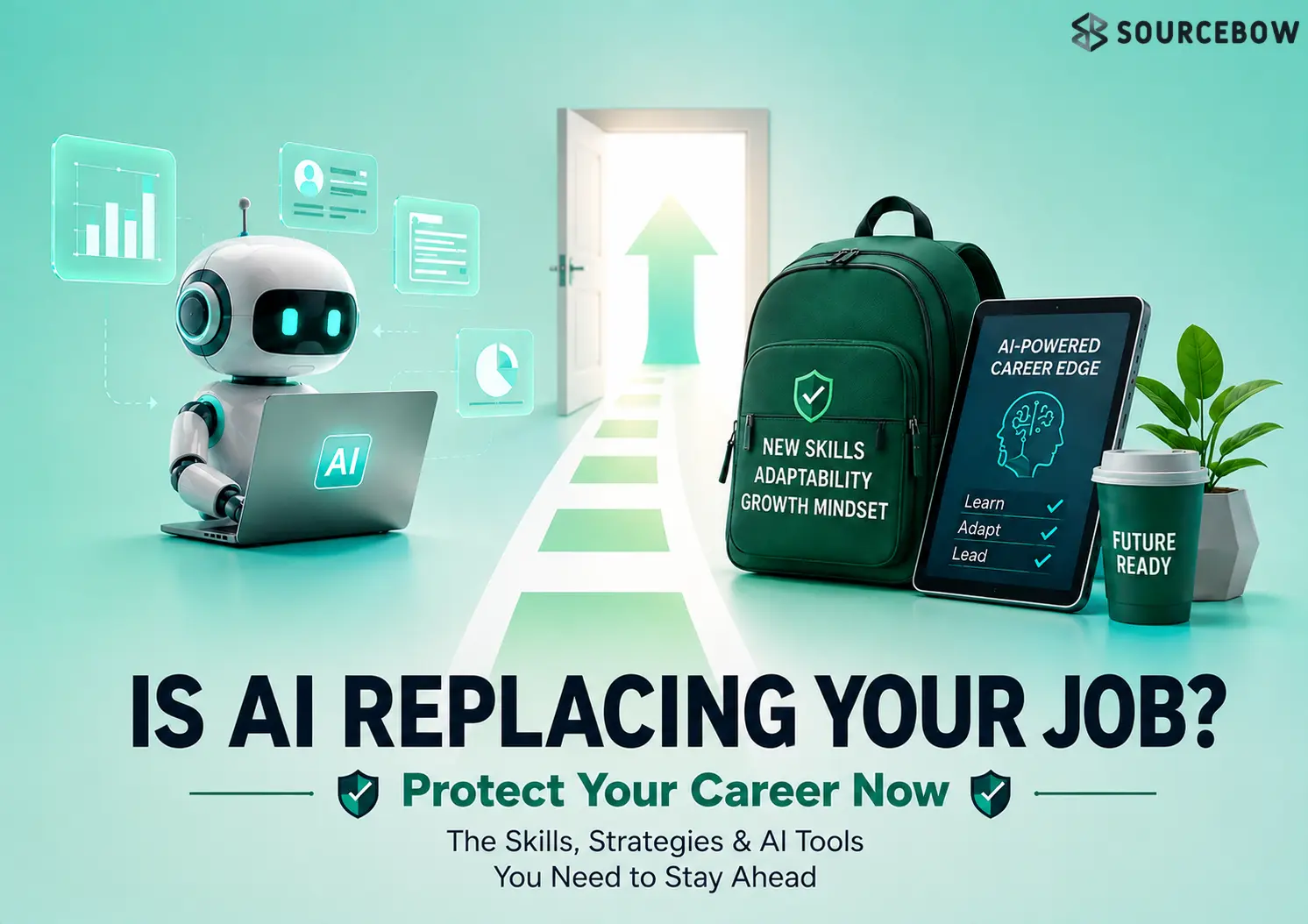
AI is reshaping white-collar work fast, and the real threat is to people who keep measuring themselves by speed alone.
If you’ve been feeling a little uneasy about where work is headed, you’re not imagining it. The pace is different now. AI can draft, analyze, plan, and even finish tasks that used to eat up half your day, and that changes the rules in a pretty uncomfortable way. The phrase AI job displacement career sounds abstract until it starts showing up in the work you do every week.
Quick Highlights
- Speed alone is no longer a safe advantage.
- Entry-level white-collar work is under the most pressure first.
- AI fluency for professionals is becoming a basic career skill.
- Judgment, ownership, and adaptability matter more than ever.
- Long-term value comes from solving problems, not just producing output.
Introduction
If AI is reshaping white-collar work fast, then the safest career move is not pretending the change is far off. The phrase AI job displacement career now feels less theoretical when AI can already draft, analyze, plan, and finish work that used to take a human hours.
The real shift is this: the old question, “Can AI do my job?” is useful, but it’s not the best one. A better question is, “What do I still do better when the work stops being mostly about efficiency?” That’s where your future starts to get clearer.
And honestly, that’s a healthier place to think from. Because if you only compare yourself to a machine on speed, you’ll almost always lose. But if you start looking at judgment, trust, creativity, and ownership, the picture changes a lot.
Why entry-level white-collar jobs are the first ones under pressure
The first jobs exposed are the ones built around predictable computer work: reports, summaries, research, and analysis. That is exactly where the biggest pressure lands first, which is why entry-level white-collar jobs are the clearest warning sign.
There’s a practical reason for that. Entry-level work often has patterns, and patterns are where AI gets strong very quickly. If the task can be repeated, templated, or checked against examples, it’s much easier to automate than work that depends on context, people, and judgment calls.
Dario Amodei warned in 2025 that AI could eliminate roughly 50% of entry-level white-collar jobs within 1–5 years, with unemployment possibly rising to 10–20% in that same 1 to 5 year window. The piece also cites Matt Shumer’s viral post, read by 80 million people, and Citrini Research’s comment that “human intelligence has been the scarce input” — a line tied to the Dow dropping 820 points.
That may sound dramatic, but the broader point is simple: the market is paying attention because this isn’t a distant theory anymore. It’s a live shift, and people at the beginning of their careers feel it first.
What AI already does across legal, healthcare, customer service, and coding
The article uses real examples to show that this is not a future problem. In legal work, AI can do research and analyze and draft contracts; in healthcare, it can read scans, analyze lab results, review medical journals, and suggest diagnoses.
It also notes that AI was struggling to write code in 2023 but is now writing much of the code at a growing number of companies. The comparison matters because it shows how quickly the baseline is moving. What felt impressive two years ago can feel ordinary now, and that speed is exactly why caution makes sense.
Customer service is changing too. More of the front-line conversation is being handled by AI agents that can answer, sort, route, and even resolve issues without a human stepping in right away. Once you see that pattern across industries, it becomes harder to pretend this is isolated to one field.
| Area | Earlier state | Current capability |
|---|---|---|
| Code generation | 2023: struggled to write code | 2026: writing much of the code |
| Reasoning | Three years ago: could generate text but struggled to reason | 2026: solves complex problems step-by-step |
| Project execution | 2022: needed constant prompting | Today: agentic systems plan and execute multi-stage projects on their own |
| Human nuance | Once missed it entirely | Now beginning to recognize emotion and adapt responses |
The comparison is the whole story in miniature. AI doesn’t need to be perfect at everything to change the job market. It only needs to become good enough at the tasks people used to be hired for.
How to stop competing with AI on efficiency
The central shift is simple but uncomfortable: if your value is mainly processing information, summarizing documents, or generating predictable output, AI will beat you on speed. Competing on productivity alone is where people become replaceable.
That’s where it gets interesting, though. The answer isn’t to panic or reject AI. It’s to stop defining your worth by how quickly you can get through repetitive work. In many careers, speed was always a useful trait, but it was never the full picture.
The stronger move is to compete on value instead of output. That means asking what you uniquely contribute when the data is already there, the draft already exists, and the first pass is no longer the hard part.
What “compete on value” means in real work
This is where the piece gets concrete: lawyers are not just doing AI contract analysis, customer service is already being handled by more capable AI agents than many call center workers, and knowledge work is being squeezed from several directions at once.
The point is not that humans vanish. It is that the human role has to move toward judgment, interpretation, and outcome ownership. You’re no longer the person paid only to produce the material. You become the person who decides what matters, what’s risky, what’s smart, and what should happen next.
Think of it like moving from being the person who assembles the ingredients to the person who understands what the meal should actually be. AI can help with the prep. It still needs direction, taste, and context.
Why AI fluency for professionals is becoming a career requirement
The article treats AI fluency for professionals as a survival skill, not a nice-to-have. Jensen Huang’s warning from May 2025 at the Milken Institute Global Conference makes the point bluntly: you are more likely to lose your job to someone who uses AI than to AI itself.
That line lands because it shifts the real competition. The risk isn’t just automation. It’s also the coworker, candidate, or competitor who learns faster, tests tools faster, and builds better output with less friction. In other words, AI becomes an amplifier, and the people who know how to use it gain a real edge.
The advice is to spend time each week using new AI tools to draft communications, analyze data, brainstorm strategy, simulate customer conversations, and stress-test ideas. That is how the article defines the Preparedness Mindset from Build a Better Future: 7 Mindsets for Navigating the Age of Acceleration.
What people should practice each week
- Draft communications with AI
- Analyze data with AI
- Brainstorm strategy with AI
- Simulate customer conversations with AI
- Stress-test ideas with AI
Those tasks are not just software practice. They train you to become the translator between technology and business results, which is a much sturdier place to stand. Once you can do that, you’re not simply using tools. You’re shaping decisions.
And that’s the part many people miss. AI fluency isn’t about becoming technical for the sake of it. It’s about becoming more effective in the real work environment you already live in.
Why human agency in careers matters more than job titles
The piece keeps returning to human agency in careers because AI replaces tasks faster than it replaces responsibility. If you define yourself as someone who writes copy or prepares reports, you are exposed; if you own a problem, you are harder to automate away.
That’s the difference between being task-shaped and being problem-shaped. A task can disappear. A problem usually stays around until someone takes real responsibility for it.
That is the logic behind moving closer to problems, not tasks. The article points to customer retention, product innovation, culture, risk, and growth as better identity anchors than specific deliverables.
The kinds of moves that signal adaptability
The examples are practical: propose AI-enabled services, redesign workflows, volunteer for experimental projects, or build expertise outside your formal job description.
This is where the Adaptability and Human Agency Mindsets show up in real life, not as abstract terminology but as a way of expanding your role before disruption shrinks it. You don’t wait to be asked. You start becoming useful in places that matter more.
It might mean helping your team make a process faster and better, or it might mean spotting a customer problem before it becomes a complaint. Either way, you’re moving closer to the center of value creation.
How the preparedness mindset for work keeps value compounding
The last layer is longer-term: careers are marathons, not sprint responses to the news cycle. The preparedness mindset for work asks you to think in five-year increments instead of quarterly panic.
That’s a useful shift because it pushes you out of reactive mode. Instead of only asking what’s threatened right now, you start asking what’s building, what’s fading, and where your experience could become more valuable over time.
The article’s three forward-looking questions are worth keeping intact: what skills will matter more five years from now, what emerging problems will organizations struggle to solve, and where can you become known as a trusted guide.
What to invest in if you want your value to compound
The long view points toward leadership presence, interdisciplinary thinking, ethical judgment, and strategic foresight. Those capabilities matter more, not less, when machines get better at routine work.
In fact, the better AI gets at the mechanical parts of white-collar work, the more valuable those human skills become. Someone still has to make sense of the tradeoffs, build trust across teams, and decide what kind of outcome is actually worth pursuing.
The conclusion lands on a familiar historical pattern: the printing press eliminated scribes but created publishers, and the internet disrupted travel agents while creating digital marketing, cybersecurity, and platform entrepreneurship.
That doesn’t mean disruption is painless. It means change usually destroys one shape of work while opening another. The people who do best are rarely the ones who insist the old shape should stay forever.
FAQ
These are the doubts that usually come up after the bigger career questions have already been answered.
Q: Is AI really replacing entry-level white-collar jobs already?
Yes, at least in the areas that depend on repetitive computer work. The article points to Dario Amodei’s warning about roughly 50% of entry-level white-collar jobs being at risk within 1–5 years.
Q: What should I do if my job is mostly reports, analysis, or drafting?
Stop treating speed as your main value. The stronger move is to use AI for the routine parts and shift your work toward judgment, problem-solving, and ownership of outcomes.
Q: How often should professionals use AI tools to stay relevant?
The article’s answer is weekly, not occasionally. It specifically recommends using AI for communications, data analysis, strategy, customer conversations, and idea testing.
Q: What does it mean to move closer to problems?
It means defining your value by the business problem you help solve, such as retention, innovation, risk, or growth, rather than by a narrow task like writing copy or preparing reports.
Conclusion
The safest response to AI job displacement is not hiding from the technology, but becoming better at working with it while moving toward judgment, agency, and higher-value problems.
If you want to stay relevant, learn fast, adapt deliberately, and choose roles where your value compounds instead of disappearing.