Introduction
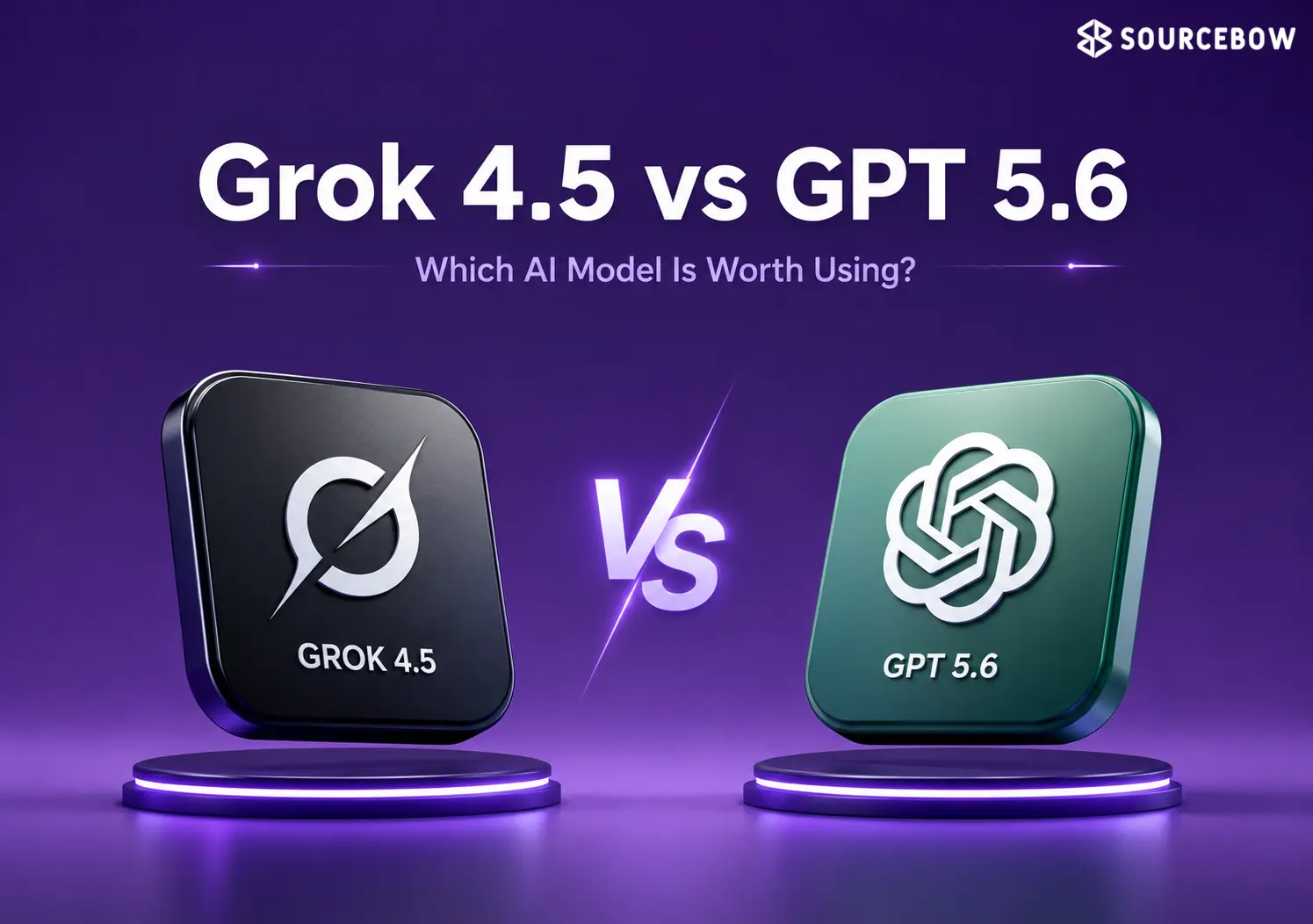
The Grok 4.5 vs GPT 5.6 comparison is already becoming one of the biggest AI discussions of the year. Grok 4.5 is now live on OpenRouter with a 500K context window, $2/$6 pricing, and #1 agentic tool use. That combination makes people stop and ask a practical question: does it actually offer better value than GPT 5.6?
If you’re comparing Grok 4.5 vs GPT 5.6, the biggest differences aren’t just benchmark scores. Pricing, context window, accessibility, voice capabilities, and real-world workflows all play a role in deciding which model is the better fit.
The real question isn’t which model has the flashiest announcement. It’s which one changes the practical day-to-day decision. That’s where Grok 4.5 starts to look interesting, because it doesn’t just promise performance. It promises a usable mix of value, reach, and flexibility. And if you’ve been watching model releases for a while, you know that’s rare enough to matter.
Quick Highlights
- Grok 4.5 stands out on price and access.
- 500K context changes longer, messier workflows.
- Agentic tool use is a big part of the appeal.
- OpenRouter makes it easier to try now.
Grok 4.5 vs GPT 5.6 Which model stands out first
There’s a reason Grok 4.5 ends up at the center of the conversation first. It has the cleanest value story in the batch. Strong agentic tool use, huge context, and pricing that looks pretty sharp next to the field. That combination is easy to understand even if you’re not deep into model benchmarking every day.
The numbers are doing a lot of work here. #1 on agentic tool use, 500K context, and $2/$6 per 1M tokens is the kind of pricing that catches attention fast. It’s roughly half of Opus pricing, which means the comparison isn’t subtle. People can immediately see the gap and start asking a practical question: where does this model save money without forcing a big compromise?
It also being live on OpenRouter matters more than people sometimes admit. Access isn’t a footnote. It’s part of the product story. A model can sound impressive in a launch post, but if it’s hard to try, hard to route into workflows, or hard to compare side by side, a lot of the hype evaporates pretty quickly. OpenRouter changes that. It makes Grok 4.5 something people can actually test, not just talk about.
What the pricing comparison actually says
Grok 4.5: $2/$6 per 1M tokens
Opus: roughly 2× the price
The appeal is not just that Grok 4.5 is cheaper. It’s that the gap is large enough to make people rethink where they spend inference budget. That matters a lot for anyone running real workloads. If you’re only using a model once in a while, a small price difference doesn’t mean much. But if you’re processing lots of traffic, writing agents, doing multi-turn tasks, or handling long prompts, that gap can turn into a real operational decision.
So, the conversation shifts from “Which is best?” to “Which is good enough for this job at a price that doesn’t sting?” That’s a much more useful question, and it’s exactly why Grok 4.5 is getting compared first. It doesn’t need to win every category to feel compelling. It just needs to make the economics feel sane.
Why the 500K context window matters
A 500K context window changes the shape of the work, especially for long documents, agent loops, and messy multi-step tasks. That’s not just a technical detail. It’s a workflow thing. If you’ve ever had to split a large file into chunks, lose track of earlier instructions, or constantly remind a model of what it already knows, you already understand why this matters.
Think of it like moving from a small desk to a huge table. Suddenly, you can keep more things in view at once. For coding, research, synthesis, and multi-step tool use, that can be the difference between something that feels smooth and something that feels brittle. And when you combine that with #1 agentic tool use, the model starts to look less like a benchmark trophy and more like a practical working system.
That’s the part people are latching onto. Not just “big context,” but “big context that supports actual use.” Those are different things. The first is a spec. The second is a reason to care.
GPT-5.6 is a flagship launch, but the evidence still feels open-ended
In the Grok 4.5 vs GPT 5.6 debate, GPT-5.6 represents the premium flagship approach, while Grok 4.5 focuses on balancing performance with lower operating costs.
But here’s the thing: the evidence still feels open-ended. Almost every benchmark we’ve seen so far is OpenAI’s own, which means the real test is still ahead. That doesn’t make the launch meaningless. It just means you shouldn’t confuse a strong announcement with a settled verdict. A lot of model launches look very different once neutral evals enter the picture.
For now, GPT-5.6 is more interesting as a product moment than as a decision-ready comparison. That’s not a knock. It’s just a reality check. People will absolutely test it, talk about it, and compare it. But the confidence level should stay a little cautious until independent results catch up.
The three-tier naming tells you this is a family, not a single model
sol, terra, and luna are the three tiers tied to GPT-5.6. That naming is worth paying attention to because it tells you this is probably not being treated like one isolated release. It reads more like a family, or a platform layer, than a single clean product drop.
And that matters. When a launch comes with tiers, the comparison becomes more layered. People don’t just ask whether it’s better. They ask which tier is actually useful, where the tradeoffs sit, and how the lineup fits into the broader product strategy. In other words, the naming itself hints that this is bigger than one model number.
Why “wait for neutral evals” is the right caution
Self-reported benchmarks can still be useful. They’re not worthless. But they’re also not enough to tell you whether GPT-5.6 wins outside OpenAI’s own framing. That’s just the honest answer. If you’ve been around these releases for a while, you know the pattern. Launch claims sound strong, early demos look promising, and then independent testing fills in the actual picture.
Until neutral evals arrive, the model is a headline, not a settled recommendation. That doesn’t mean ignoring it. It means watching it with the right level of skepticism. And honestly, that’s usually the smartest way to handle any flagship launch. Be interested, but don’t overcommit too early.
GPT-live is about voice, not intelligence
GPT-live brings full-duplex voice to ChatGPT, which means it can listen and speak at the same time. That’s a pretty big UX change, even if it doesn’t sound like one on paper. The difference is subtle until you actually imagine using it in a real conversation. Instead of waiting for clean turn-taking all the time, the flow feels more natural and closer to how people actually talk.
The important detail is what it is not. It’s not a smarter brain. It’s a much more natural conversation layer. That distinction matters because it keeps expectations realistic. A lot of people hear a new voice feature and assume the underlying model must be dramatically better. Not necessarily. Sometimes the win is in how it feels, not how it reasons.
That makes GPT-live feel like a product upgrade, not a model breakthrough. And that’s still valuable. In fact, sometimes that’s the better kind of valuable because it changes what people can tolerate in daily use. If the interaction is smoother, they’ll use it more. Simple as that.
Full-duplex voice is the whole point
The model can overlap listening and speaking instead of waiting for one side to finish cleanly. That sounds small until you try to use something that doesn’t do it well. Then it suddenly feels obvious. Humans interrupt, clarify, backtrack, and jump in mid-thought all the time. Full-duplex voice makes the conversation follow that natural rhythm a lot better.
That changes the feel of chat even if the underlying intelligence stays basically the same. And for many people, that’s enough. They don’t need a completely different model family. They need a voice interface that doesn’t feel clunky. GPT-live is trying to solve that exact annoyance.
SWE-1.7 is the speed play, but only inside Devin
SWE-1.7 from Cognition is the most extreme performance claim in the batch. 1,000 tok/s on Cerebras and about $1.97 per task is wild on the surface. It’s the sort of number that makes you read it twice just to make sure you didn’t miss something. Fast and cheap is a tempting combo, especially when so many systems force you to choose one or the other.
But the catch is just as important. It’s Devin-only, with no API. That means the model isn’t being presented as a general-purpose option you can plug anywhere. It’s tied to one workflow, one environment, and one product experience. So while the performance story is strong, the usability story is narrower than the headline might suggest.
That doesn’t make it uninteresting. It just makes it different. SWE-1.7 is not trying to be the broadest choice. It’s trying to be the fastest and most efficient choice inside a very specific system. And if you’re already in that system, those numbers probably feel exciting for a good reason.
The two numbers that define SWE-1.7
- 1,000 tok/s on Cerebras
- ~$1.97 per task
- Devin-only access
- No API
The list above tells the whole story pretty quickly. The speed and cost are the headline. The access restriction is the asterisk. Together, they explain why SWE-1.7 gets attention without turning into a universal recommendation. It’s a great example of how model news is never just about raw metrics. The surrounding product shape matters just as much.
And that’s where the practical question comes in: do you want a model, or do you want a packaged experience? For SWE-1.7, the answer is clearly the latter. If Devin is your environment, the numbers are compelling. If not, the model stays more like an internal benchmark than a general tool you can adopt tomorrow.
Which one is actually worth your attention?
When comparing Grok 4.5 vs GPT 5.6, the honest answer depends on what you’re optimizing for. Grok 4.5 is the value and access pick. GPT-5.6 is the flagship bet. GPT-live is about voice UX. SWE-1.7 is the raw speed play inside Devin. That’s why the launches feel busy but not identical. They’re not competing on the same axis, even if they all arrive in the same conversation.
So the smartest move is to compare use case first and hype second. That sounds simple, but people forget it all the time. A model can be amazing and still not be the right fit for your actual work. A cheaper model can be the better choice if it’s good enough and much easier to access. A voice feature can be more valuable than a stronger benchmark if it changes how often people use the product. Those tradeoffs are the real story.
If you’re trying to decide where to pay attention first, start with the thing that directly changes your workflow. For a lot of people, that’s still Grok 4.5 because it combines strong tool use, a huge context window, and a price that doesn’t feel inflated. It’s the kind of release that makes practical people stop and do the math.
FAQ
These are the smaller doubts people usually have after the first comparison pass. The little stuff, really. The questions that decide whether a model gets tested, bookmarked, or ignored.
Q: Is Grok 4.5 cheaper than Opus?
Yes. At $2/$6 per 1M tokens, it is roughly half of Opus pricing, and that’s a huge part of why it stands out. The price gap is large enough to matter for real usage, not just casual comparison.
Q: Is GPT-5.6 ready to replace older models yet?
Not confidently. The launch is real and the tiers are public, but neutral evals are still the missing piece. Until that broader testing shows up, it’s smarter to treat GPT-5.6 as promising rather than fully settled.
Q: Does GPT-live make ChatGPT smarter?
No. It makes the conversation feel more natural because it can listen and speak at the same time. That’s a UX improvement, not necessarily an intelligence jump, and that distinction matters.
Q: Can you use SWE-1.7 through an API?
No. It is Devin-only, so the speed and cost claims are tied to that environment rather than a general-purpose API. If you’re outside Devin, the value story changes a lot.
Conclusion
The Grok 4.5 vs GPT 5.6 comparison doesn’t have a universal winner. If you care about lower pricing, OpenRouter availability, a 500K context window, and strong agentic tool use, Grok 4.5 currently offers one of the strongest value propositions. If you’re waiting for OpenAI’s latest flagship capabilities and broader ecosystem improvements, GPT-5.6 remains worth watching as independent evaluations become available.
The rest are worth watching for different reasons, and some of them may prove more important later. But right now, the model that looks easiest to justify is the one already live on OpenRouter. In a space where launches often feel louder than useful, that kind of practical clarity stands out.