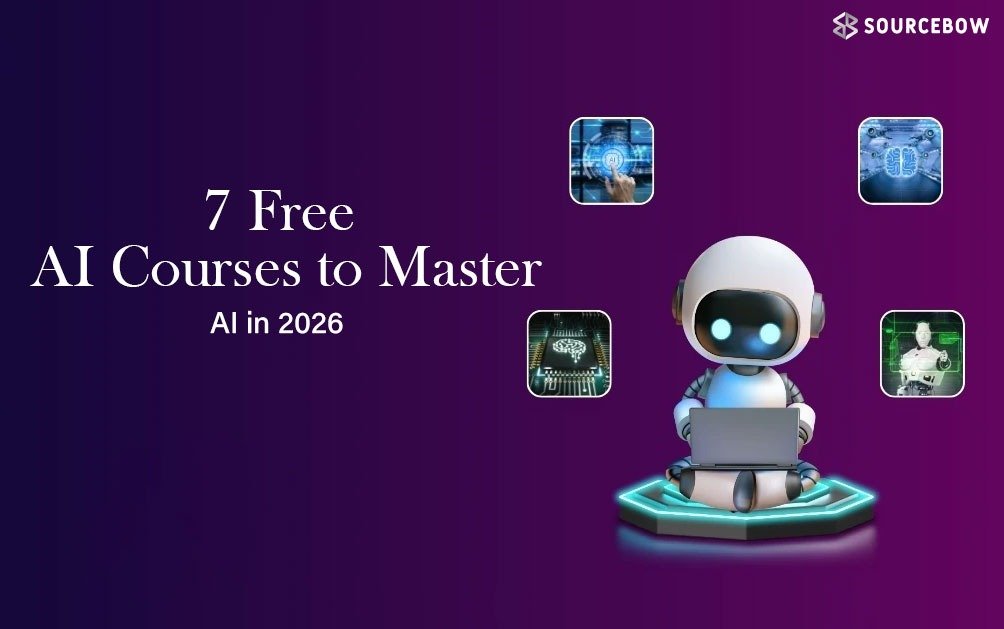
AI is everywhere now, but most people are still stuck using it only like ChatGPT, asking questions and getting answers. That’s fine, but in 2026 the real advantage comes from going a step further. It’s about building things with AI, connecting tools together, and launching solutions that actually solve problems.
This guide shares seven free AI courses that take you from the basics of AI to hands on app building and smart automation. Short, practical, and focused on real skills you can use right away. Think of it as a practical road map for earning skills that employers and clients actually value this year and beyond.
Foundations without the fluff: CS50 and prompt engineering
First up are two pillars that set the stage for everything that comes next. The goal is to move from curious to capable, fast.
- CS50x 2025 Artificial Intelligence (Harvard CS50) — a free, beginner-friendly primer that dives into how AI works, what large language models are, and the basics of machine learning and deep learning. You’ll walk through topics like generative AI, prompt engineering, and the inner workings of AI systems. It’s a broad overview, but it clears up a lot of confusion about what AI can and cannot do.
- OpenAI Academy: Introduction to Prompt Engineering — a free entry point to crafting better prompts. It starts with turning a vague prompt into a precise request by defining context, role, and expectations. The course shows how small changes in phrasing unlock bigger, more reliable results from AI models.
- OpenAI Academy: Advanced Prompt Engineering — takes prompts to the next level with real-world examples, structured prompts, and templates. It’s perfect for leveling up from just getting by to shaping outputs that fit a project.
Why this matters: prompts are the everyday toolkit for working with AI. Mastery here makes every other course more effective because you’ll get better, faster results from the models you’re using.
Going beyond basics: using and mastering AI tools
With the fundamentals in place, the next steps focus on how you actually use AI tools to get work done—efficiently and confidently.
- Andre Karpathy: Using AI Tools Effectively — a concise, practical guide (presented by a renowned researcher) that covers LLMs thinking models, internet search strategies, deep research techniques, and how to leverage tools like the Python interpreter and advanced data analysis features. It also touches on different tool families (image input, OCR, video input) and how to pair them with your workflow.
- Vibe Coding 101 with Replit (DeepLearning.AI) — a hands-on course about vibe coding for building apps and landing pages quickly. Learn the basics of using Replit to prototype and launch projects, plus a practical five-skill framework that helps outline a project from idea to prototype to delivery.
- Claude Code in Action (Anthropic) — a free course focused on coding with Claude. It covers core tools, context management, conversation flow, integration with GitHub, and workflow control. Great if coding with AI assistants is part of the plan.
- Microsoft: Generative AI for Beginners — is a solid, well rounded starting point. It explains LLMs, how different models compare, prompt writing, and how to build simple but practical apps like chat interfaces, databases, and image generation tools. It also touches on open source models and RAG, which are honestly must-know concepts if you want to build real world AI systems that scale.
Hands-on paths: building apps and automations with AI
One of the biggest advantages of AI is the ability to create working projects quickly. Three programs stand out for turning ideas into tangible outputs.
- Build and Sell AI Agents by Nate Herk — a practical, eight-hour course focused on no-code or low-code approaches using platforms like N8N. It covers how to design multi-step workflows, work with JSON and data types, and connect tools via APIs. The goal is to end up with intelligent agents that can automate real business processes.
- Instructors emphasize a framework for agentic code development, including how to structure product requirements (PRD), integrate external data sources, and deploy prototypes that can be tested by users.
- Across the board, expect hands-on labs that culminate in a practical project—like a functional workflow or a small app—so learnings translate into portfolio-worthy work.
At-a-glance: seven courses at a glance
If you want a quick comparison, here’s a compact table that outlines focus areas, what you’ll build, and who it’s best for. (Inline table for quick scans.)
| Course | Focus | What you’ll build | Best for |
|---|---|---|---|
| CS50x 2025 AI | AI foundations, models basics | Concepts, terminology, and a solid mental model | beginners seeking clarity |
| OpenAI Academy: Prompt Engineering (Intro) | Prompt crafting basics | Effective prompts and outputs | practical users wanting better results |
| OpenAI Academy: Prompt Engineering (Advanced) | Advanced prompts, templates | Complex tasks and multi-step prompts | those chasing higher-quality outputs |
| Andre Karpathy: Using AI Tools | Tool use and thinking models | Integrated AI workflows | people who want depth in tooling |
| Vibe Coding 101 with Replit | App prototyping with Replit | Landing pages and small apps | designers and developers building quick demos |
| Claude Code in Action | Coding with Claude | coding workflows and integration tasks | developers exploring AI-assisted coding |
| Microsoft Generative AI for Beginners | LLMs, prompts, and app-building | end-to-end AI app ideas | builders seeking a broad overview |
| Build and Sell AI Agents | No-code AI agent workflows | multi-tool automation | automation enthusiasts and freelancers |
These courses aren’t about chasing hype—they’re about equipping a real, practical skill set that pays off in 2026: understanding AI, prompting effectively, building apps, and automating complex tasks. The best part? they’re free, accessible, and beginner-friendly, so there’s no barrier to starting today.
Wrapping up: what’s your next move?
With seven solid courses in your toolkit, the real question isn’t whether AI skills matter anymore, it’s where to start. A smart move is to begin with the CS50 AI foundation to build confidence, then choose one or two hands on tracks like Vibe Coding with Replit or Build and Sell AI Agents to apply ideas fast. After that, adding a prompt engineering course helps keep outputs clean and sharp as your projects start to scale.
So, which course will you start with to shape your AI-enabled career in 2026? Share the plan in the comments and get the conversation going.