DSLMs Are Outperforming LLMs Where Business Value Matters
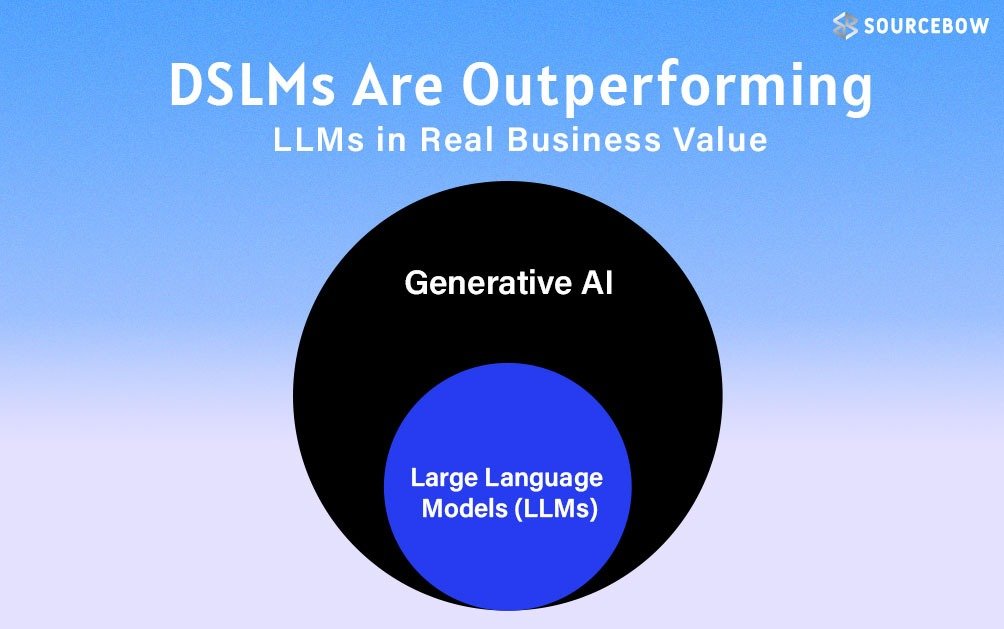
For the past few years, Large Language Models or LLMs have been the poster children of generative AI. Applications built on these models can compose messages, create code, summarize documents, and even converse with people. These models are very impressive, to say the least.
However, as companies progress from experimenting to deploying, a subtle paradigm change is unfolding. The newer generation of generative AI models, known as Domain-Specific Language Models or DSLMs for short, is set to provide a more measurable and tangible benefit compared to the current generation.
But this doesn’t imply that LLMs are becoming irrelevant. What it actually means is that companies are realizing an important point. Intelligence isn’t everything. What’s more valued is relevance, efficiency, accuracy, and cost.
Let us break this down in a simple way.
What Is the Difference Between LLMs and DSLMs in Generative AI?
What Large Language Models(LLMs) Are?
LLMs are trained on a huge amount of publicly available data crawled from the internet. This includes books, articles, discussion forums, code repositories, and the like. The use of LLMs is noted for its versatility. You can query them about anything, and they will generally have a sensible answer. This common knowledge does come with trade-offs.
- They lack deep understanding of specific industries
- They may hallucinate facts
- They require heavy prompting to stay accurate
- They are expensive to run at scale
LLMs are great for broad tasks but struggle when precision matters.
What Are Domain-Specific Language Models (DSLMs)?
DSLMs are trained or fine-tuned on focused, high-quality datasets related to a specific domain. This could be healthcare, finance, legal systems, customer support, e-commerce, or even internal company data.
Their goal is not to know everything. Their goal is to know one thing very well.
Because of this focus, they often perform better where it actually counts.
Why Business Value Matters More Than Raw Intelligence in AI Models?
In business, success is not measured by how smart a model sounds. It is measured by outcomes.
- Does it reduce costs
- Does it improve accuracy
- Does it save time
- Does it integrate smoothly with systems
- Does it reduce risk
This is where DSLMs start to shine.
LLMs can generate impressive demos. DSLMs generate dependable results.
Key Reasons DSLMs Are Outperforming LLMs in Real Business Value
1. Higher Accuracy in Real-World Tasks Using DSLMs
Accuracy is critical in fields like healthcare, finance, law, and compliance. A single wrong answer can cause serious damage.
Because DSLMs are trained on curated and domain-relevant data, they make fewer mistakes. They understand context that general models often miss.
For example, a healthcare DSLM understands medical terminology, clinical workflows, and treatment protocols far better than a general LLM.
Less hallucination means more trust. More trust means real adoption.
2. Lower Operational Costs With DSLMs
Running large language models requires powerful infrastructure. High memory usage, large token counts, and frequent API calls can become expensive very quickly.
DSLMs are smaller and more efficient.
- They need fewer parameters
- They process shorter, focused inputs
- They require less compute power
For companies deploying AI at scale, this difference directly impacts the bottom line.
Lower cost per task equals higher return on investment.
3. Faster Response Times With DSLMs in Customer-Facing Systems
Speed matters, especially in customer-facing systems.
Because DSLMs are optimized for specific tasks, they respond faster. There is no need to search through irrelevant knowledge. The model already knows what matters.
- Better user experience
- Higher customer satisfaction
- Smoother automation
In real-time applications, this speed advantage is a big deal.
4. Better Alignment Between DSLMs and Business Goals
LLMs are built to be helpful in general. DSLMs are built to be useful in context.
A sales DSLM understands product catalogs, pricing logic, objections, and buying signals. A legal DSLM understands contracts, clauses, and regulations.
This alignment reduces the need for complex prompt engineering and manual corrections.
The model works the way the business works.
5. Easier Compliance and Data Control With Domain-Specific AI
Many organizations cannot send sensitive data to public AI models. Regulations, privacy laws, and internal policies make this risky.
DSLMs are often deployed in private environments. They are trained on approved data and operate within controlled systems.
This makes them easier to audit, monitor, and secure.
For regulated industries, this alone can be a deciding factor.
6. Improved Long-Term Reliability of DSLMs
General models change frequently. Updates can alter behavior in unpredictable ways.
DSLMs are more stable. Because they serve a narrow purpose, changes are controlled and tested carefully.
This consistency matters when AI becomes part of daily operations.
Reliability builds confidence. Confidence leads to long-term use.
Real-World Use Cases Where DSLMs Outperform LLMs
Customer Support Automation With DSLMs
A DSLM trained on product manuals, past tickets, and company policies can resolve issues faster and more accurately than a general chatbot.
It understands the product deeply and speaks in the company’s tone.
The result is fewer escalations and happier customers.
Financial Analysis and Reporting Using Domain-Specific Models
In finance, small errors can be costly.
- Generate accurate summaries
- Detect anomalies
- Assist in compliance checks
They provide focused intelligence without unnecessary noise.
Healthcare Decision Support With DSLMs
Doctors do not need creative answers. They need precise ones.
Healthcare DSLMs assist with diagnostics, documentation, and treatment planning while respecting medical guidelines.
This improves efficiency without replacing human judgment.
Legal Document Review Powered by DSLMs
Legal language is complex and specific.
DSLMs trained on case law, contracts, and statutes can review documents faster than human teams while maintaining accuracy.
This saves time and reduces legal costs.
Why LLMs Still Matter in the AI Ecosystem?
It is important to be clear. LLMs are not obsolete.
- Research
- Ideation
- General writing
- Learning and exploration
They are excellent starting points.
But for large-scale deployments, DSLMs often provide higher value.
Think of LLMs as general tools, while DSLMs are precision instruments.
The Future of Generative AI Is Hybrid, Not One-Sided
Many organizations already combine the two approaches.
- LLMs to explore and create
- DSLMs for execution and operations
This hybrid approach provides flexibility without sacrificing any iota of reliability.
In the fullness of time, AI will continue to shift its focus away from size and more onto usefulness.
A bigger model is not always a better model.
Key Takeaways for Businesses Evaluating DSLMs vs LLMs
- Do we want general intelligence or domain expertise?
- Are the activities critical in terms of accuracy and compliance?
- Will it scale across teams?
- What is the long term cost
In many cases, DSLMs offer a clearer answer.
They may not make headlines, but deliver results silently.
Conclusion: Why Domain-Specific Language Models are more better?
Generative AI is still developing quite quickly. Large language models themselves were what kickstarted innovation, but value really only comes from focus.
Domain-specific language models continue to prove that smarter does not necessarily mean bigger; sometimes, it means better trained, better aligned, and better suited.
As businesses move from experimentation to execution, DSLMs are becoming the models that matter most.
The future of AI will not be defined by who knows the most words. It will be defined by who delivers the most value.