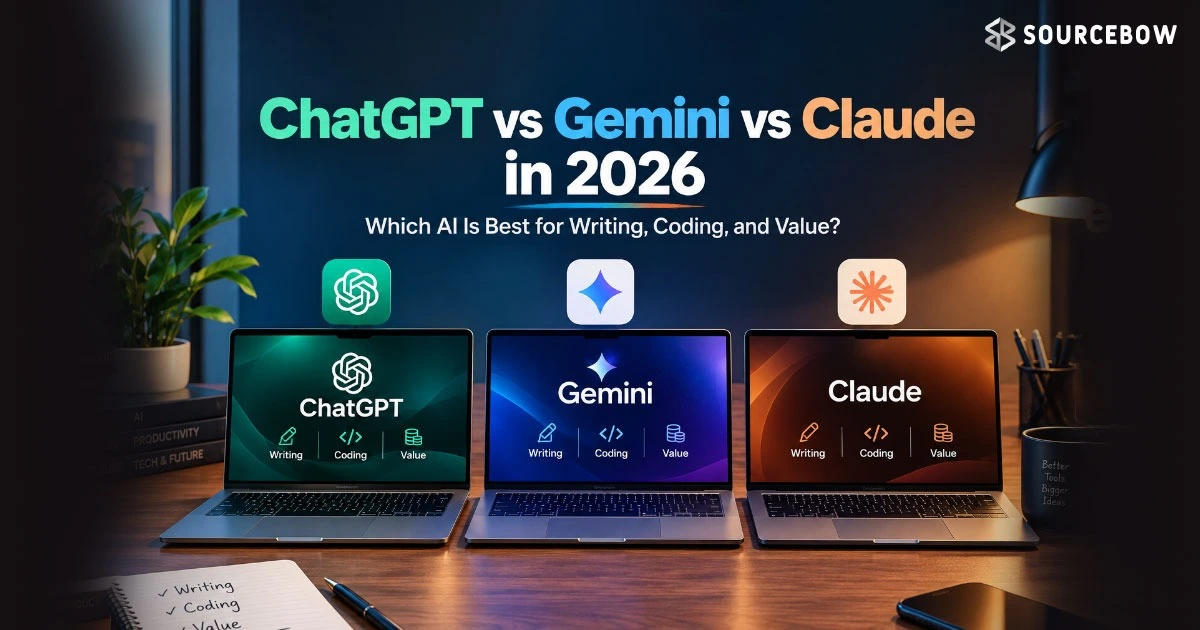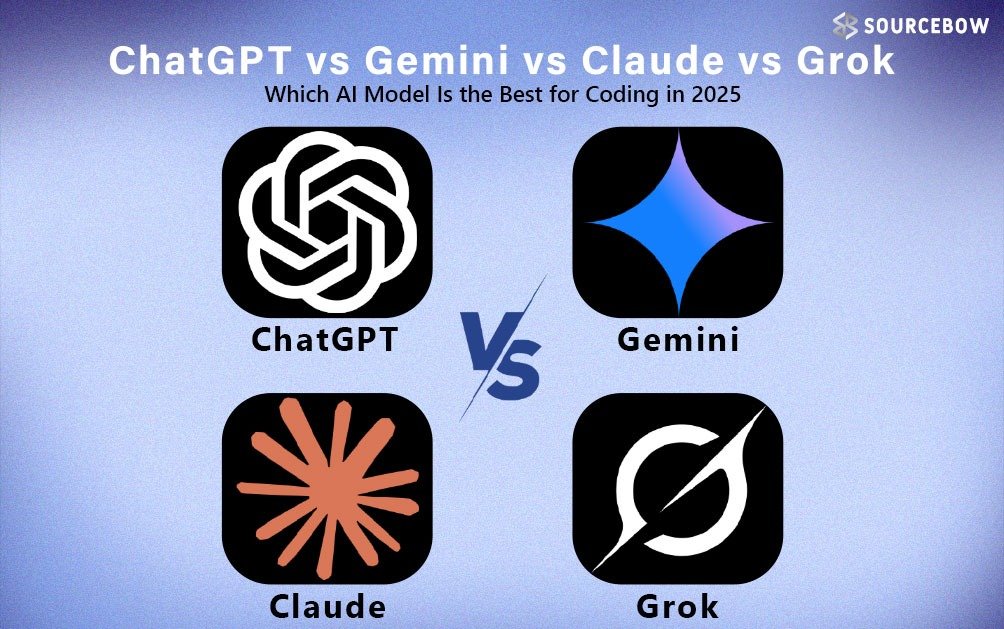
Which AI Model Is Best for Coding in 2026?
Choosing an AI model or coding partner in 2025 feels a bit like picking a favorite power tool — they all do similar things, but each shines at different jobs. Below I’ll walk you through how OpenAI’s ChatGPT (GPT-5 family), Google’s Gemini, Anthropic’s Claude, and xAI’s Grok compare for real-world coding: where they win, where they stumble, and which one to reach for depending on your task.
At a glance — the short verdict
- Best for deep, production-grade code and large repos: ChatGPT (GPT-5 family) strong on complex front-end, debugging, and multi-file projects.
- Best for Google ecosystem, tooling, and cost-effectiveness: Gemini great integrations with Google Cloud/Workspace and solid code-assist features.
- Best for safer, long-horizon engineering tasks and agentic workflows: Claude (Opus 4.5 and up) built for longer reasoning chains and multi-step agents.
- Best for quick prototyping and lightweight iteration: Grok fast, snappy, and optimized for rapid prototyping, though it can be hit-or-miss on correctness.
ChatGPT (GPT-5 family)
GPT-5 brought a noticeable jump in coding ability not just cranking out snippets, but reasoning about architecture, debugging across files, and producing polished front-end designs. In real terms: if you hand it a messy repo and ask for end-to-end fixes, it’s more likely than its predecessors to keep state, propose sensible refactors, and generate UI that “looks like you meant it.” That makes it excellent for complex feature work, code reviews, and tasks where correctness + polish matter.
Practical tip: use GPT-5 when you need fewer rounds of back-and-forth and want a high-confidence initial draft (for example, complete React components, integration tests, or refactors).
Google Gemini: the team player
Gemini’s strengths are practical: deep integration with Google tools, solid multimodal understanding (handy when you feed screenshots or docs), and dedicated “Code Assist” products for teams. For organizations already on Google Cloud or using Workspace heavily, Gemini often wins on workflow it plugs into build systems, code reviewers, and CI/CD more naturally. For typical feature tasks and CRUD-style apps it’s fast, reliable, and cost-effective.
Practical tip: pick Gemini for collaborative environments and when you want tight coupling with Google services (Cloud functions, Sheets, Docs automation).
Claude (Opus 4.5+): the steady architect and agent builder
Anthropic’s Claude has leaned heavily into long-horizon reasoning and “agentic” coding workflows — where the AI model can orchestrate multi-step tasks, call tools, persist memory, and iterate on a problem autonomously. The Opus 4.5 line is explicitly marketed for handling longer coding sessions more efficiently (fewer tokens, better pass rates on extended tests), which is valuable when you need the model to keep context across big tickets: think complex data pipelines, modeling tasks, or autonomous test generation.
Practical tip: use Claude when you’re building agent pipelines (automated debugging agents, test generators) or when you need robust long-context performance and cost-efficiency across long sessions.
Grok: the rapid prototyper (with caveats)
Grok’s proposition is speed. AI Models tailored for “code fast” workflows excel at producing quick prototypes and small utilities with near-instant responses. That’s brilliant in hackathons, brainstorming, and iterative front-end tweaks. The trade-off: accuracy and completeness can lag behind the big three, so outputs often need closer human review and testing before production use.
Practical tip: choose Grok when you want immediate, throwaway code to iterate on ideas but plan to validate and harden anything critical.
Benchmarks and reality checks
Benchmarks (SWE-Bench, LMArena, independent tests) show that while raw scores give a signal, real-world performance depends on prompt engineering, tool integrations, and how you structure the AI’s environment (agents, access to repo, test suites). GPT-5 and Claude variants tend to lead on multi-file, long-horizon tasks; Gemini is very competitive when factoring in ecosystem benefits; Grok shines on latency and rapid cycles.
Which one should you pick — practical recommendations
- If you’re building production software and want fewer surprises: start with GPT-5.
- If your team lives in Google Cloud/Workspace: try Gemini for its integrations.
- If you need agentic workflows, long sessions, or cost-efficient long-context runs: test Claude Opus 4.5+.
- If you want instant prototypes and iterative tinkering: Grok is your rapid playground.
Final thought
There’s no single “best” ai model. The best ai model really depends on what the project needs, the tech stack you’re using, and how much risk you’re okay with.
A practical way to work with ai model is to quickly prototype with Grok or Gemini, and then polish and improve the code with GPT-5 or Claude.
Make sure to have automated tests and CI checks in place before shipping anything generated by AI model.
Think of these models like super-smart teammates — incredibly helpful, but they still need good engineering oversight.