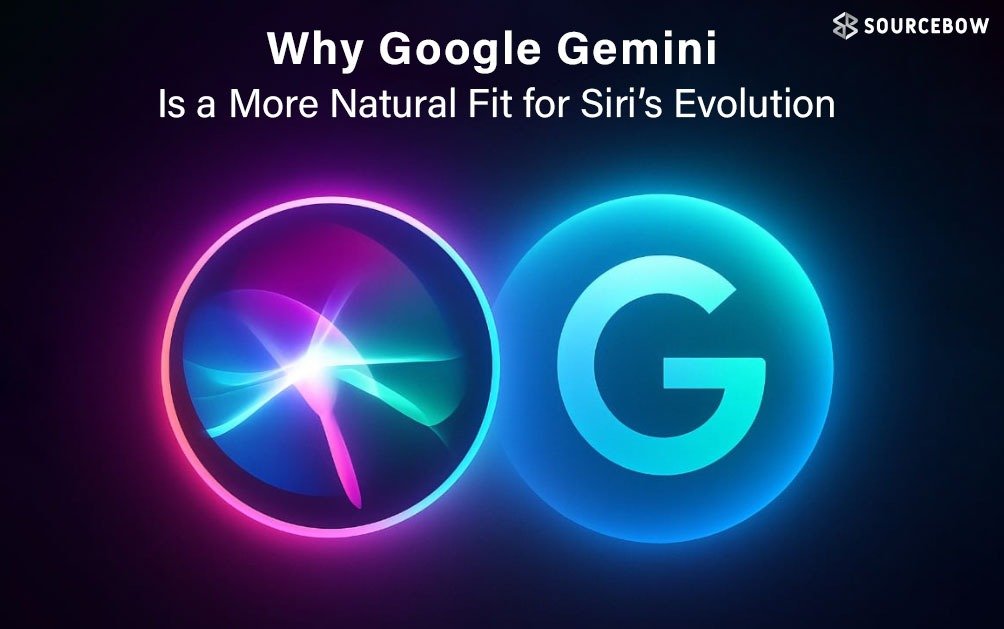
Why Google Gemini Is a Better Fit for Siri Than OpenAI’s ChatGPT
The year 2026 is a very pivotal year for Apple, and they have shocked the industry by making a mammoth shift as they passed ChatGPT, which originated from the company OpenAI, with the purpose of running the intelligence of a voice assistant program, Google’s Gemini, that will power the new Siri and the new Apple Intelligence. This is not a new development in the industry and is a very important development as it is a presentation of their predictions for the future in terms of voice assistants.
Well, let’s analyze why it is more logical for Siri to have Gemini than ChatGPT in simpler terms.
1. Gemini Is Built for Real‑World Conversations with Real-Time Context
One of the reasons Google’s Gemini is strong for voice assistants is how it handles live, real-world context. Gemini is deeply connected to Google’s search and information systems, which means:
- It can pull in up-to-date facts and live data quickly.
- It stays current without needing constant manual updates from developers.
- With a virtual assistant like Siri, it means even more intelligent answers to your question about the weather, news, facts, and what’s happening in real time.
ChatGPT, on the other hand, tends to rely on an established model and plugins so as to extract real-time information, which sometimes may contribute to the performance and the seamlessness involved while having live conversations.
That is, the Siri with the Gemini model should appear more aware of what is happening in the present and less concerned with what it learned in the past.
2. Gemini Handles Multimodal Inputs Naturally
Google designed Gemini from the start to understand text, voice, images, and even video all as part of the same experience. For a voice assistant:
- Siri can listen to spoken questions.
- Gemini can combine that with visual context (like what’s on your screen or photo).
- This means you can ask more natural questions like “What’s in this photo?” or “What’s happening here?” and get good answers.
ChatGPT can handle text and voice via extensions, but Gemini’s multimodal design is more native to this kind of integrated assistant experience.
Imagine holding your phone up to a menu or a street sign and having Siri not only read it but explain it. That’s an example of what a multimodal model like Gemini enables.
3. It Fits Naturally with Apple’s Vision for Personal Intelligence
A big focus for the next Siri is something Apple calls personal intelligence — the assistant should understand more about you and what you care about, while still protecting your privacy. Under the new deal, Apple will use Gemini at a core level within its own system.
Gemini can use contextual clues from apps and services (like calendars, emails, photos — within privacy limits) to better understand your needs. For example:
- Making more helpful suggestions tailored to you.
- Giving answers that connect many pieces of your personal info.
- Offering proactive help before you ask.
That makes Siri feel less like a tool you query and more like an intelligent assistant that gets you. ChatGPT is powerful, but the current architecture isn’t tied into operating systems and personal data in this same deep way.
4. Gemini Is Part of a Larger Ecosystem That Scales Easily
Google’s AI strategy spans billions of users and a huge network of products — from Android phones to Chrome, Gmail, YouTube, and more. This gives Gemini two big advantages:
- Tight System Integration: It can be embedded deeply into device systems and apps.
- Scalability: Google constantly trains and updates Gemini based on massive data flows and patterns.
For Siri, this means access to rich data sources without re‑building them from scratch. ChatGPT works well for many tasks, but it doesn’t have the same built‑in access to a vast ecosystem of consumer data streams that Google owns.
5. Gemini Excels at Understanding Complexity and Factual Precision
In head‑to‑head tests and performance benchmarks across a range of tasks, Gemini has shown strong reasoning abilities, especially in handling structured information and complex queries. In some recent comparisons, industry observers noted that Gemini models were outperforming ChatGPT in areas like reasoning, coding tasks, and multimodal understanding, even prompting a strategic response from OpenAI’s leadership.
For a voice assistant that must answer a wide variety of questions — from “How do I fix this error?” to “Summarize my email thread” — that deeper understanding helps Siri deliver more useful, accurate responses to users’ everyday questions.
6. Gemini Improves Siri’s Ability to Do Things, Not Just Answer Questions
A voice assistant doesn’t just answer queries — it helps you get things done. With Gemini under the hood, Siri could:
- Draft emails or messages for you.
- Summarize long threads or documents.
- Give helpful overviews of complex topics.
- Provide suggestions that feel proactive and relevant.
Emerging reports suggest that future Siri features powered by Gemini will offer things like improved conversational memory, travel planning help, emotional support, and automated document creation.
ChatGPT can also write and summarise content, but integrating those capabilities into a fully system‑level assistant across an operating system — with deep access to tools and apps — is where Gemini has an edge.
7. Trusted Privacy and On-Device Control
One concern with bringing a third-party AI into a system like Siri is privacy. Apple has positioned this partnership carefully so that:
- Google won’t share things like your Apple data with advertisers.
- The systems will respect Apple’s strong privacy controls.
- Computations can often happen securely within Apple’s ecosystem.
So users get the benefit of Google’s AI power without giving up control of personal data. This blend of privacy and performance makes Gemini a compromise that fits Apple’s values better than a more general cloud‑only AI model.
Conclusion: A Better Match for an Intelligent Siri
Choosing an AI engine for Siri isn’t just about which model writes better sentences. It’s about how the model:
- Understands real‑time context.
- Connects with apps and services.
- Handles multimodal input.
- Works with system‑level integration.
- Balances power with privacy.
Google’s Gemini checks every one of those boxes in ways that better align it with being a more natural fit for Siri’s next chapter. ChatGPT remains a powerful conversational model, and it will likely continue to play a role in specific contexts, but the breadth of capabilities and depth of integration of Gemini make it the better choice to be at the core of Siri going forward.
If you want Siri to feel smarter, more helpful, and more attuned to your real world needs, then Gemini gives Apple a stronger foundation than traditional models like ChatGPT.