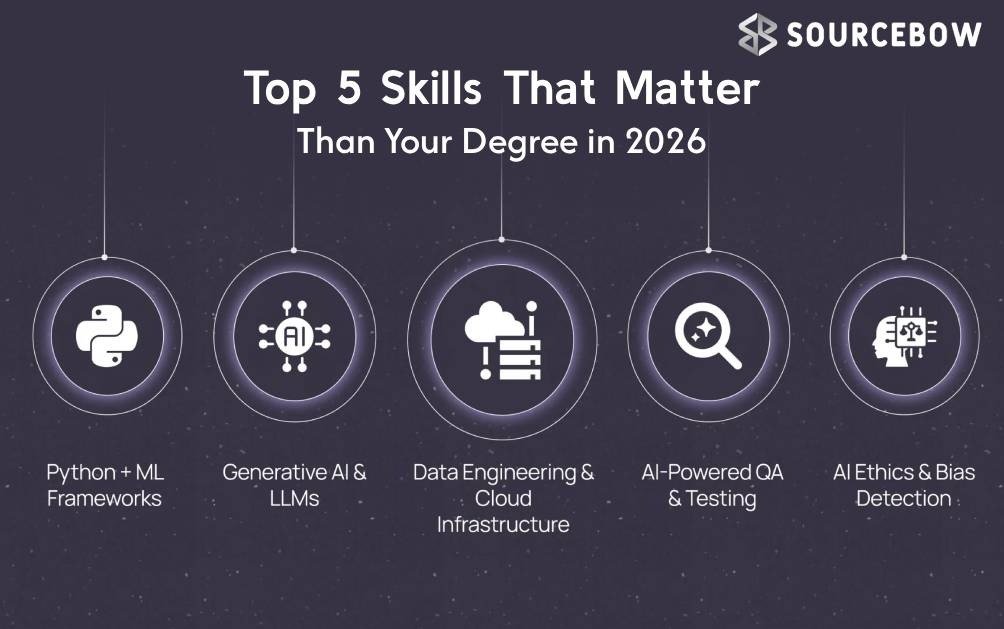
If you’ve ever looked at a job posting and thought that a degree would automatically unlock the door, you’re not alone. Yet the workplace is shifting in real time. Top 5 skills In 2026, hiring decisions are leaning more toward what you can actually do, how quickly you adapt, and how well you solve real problems, rather than a perfectly polished degree alone. It’s a quiet revolution, but a powerful one, and it matters whether you’re just starting out or looking to level up.
Here’s the truth many future-focused professionals already sense: the rules of career growth have quietly changed. Employers are increasingly looking at practical skills, proof of work, and the ability to apply tools in everyday tasks. Certifications, side projects, freelancing, and active community contributions are often weighed as heavily as, or even more than, a line on a resume. The big question isn’t just what you studied; it’s what you can do with what you’ve learned starting today.
Recent observations from hiring professionals show a broad shift: recruiters are hiring for skills, not just titles or degrees. Across regions, many organizations report that a meaningful portion of their hiring decisions now hinge on demonstrated capabilities, portfolio work, and the capacity to learn on the fly. In practice, this means building a track record of work through projects, contributions, and concrete outcomes often trumps a perfect academic record.
The signs are very clear in India. The market is changing rapidly. New technology-related jobs are coming into existence in new sectors. Companies are not just trying to catch up with what’s cool, but rather aligning their needs with those that continue to evolve. Furthermore, companies need to show that they can use AI tools, think using data, and collaborate across functional areas in their company. The overriding message is that employability will be based on capability and adaptability rather than on simply having earned so many credentials.
Below are five skill areas in which LinkedIn’s rise and demand data identifies as being the most valuable for 2026, in order to help the reader create a map for competent and capable employment. Skill sets are about building a broad, credible, transferable set of competencies that provide useful capabilities across many industries, as opposed to developing in-depth expertise in a single area. The intent is practical by providing the reader with information on what to learn, how to practice, and how to validate one’s ability to demonstrate these required skills in the workplace.
The Key Shift to Know About: Degrees Are Not Your Only Differentiator
The value of a degree is still present. It opens doors, provides structure, and demonstrates tenacity to hiring managers. However, the job market is shifting toward the importance of skills that can translate into different roles and industries. You do not have to abandon your degree; instead, you should supplement it with proof of your competency.
Below are reasons why this transition is significant:
- Access to knowledge through online education is now available to everyone, regardless of where they live, as well as through numerous self-paced methods.
- Boot camps and certifications provide quick access to targeted capabilities that can be obtained faster than traditional degree programs.
- Through real-world projects and hands-on assessments, recruiters are able to determine what you can do based upon what you demonstrated versus what you studied.
- With remote hiring processes, there is global competition for prospective employees, so proof of results is becoming increasingly essential.
- Thanks to AI tools and the use of technology, the value of memorization and rote knowledge has decreased while the value placed on practical application and creative problem-solving has increased.
To summarize, although a degree provides you with a starting point or a lane on the highway, it is your strong skill set that allows you to drive down the highway successfully.
1. AI and Automation Are Not Just For Engineers Anymore
AI is no longer just something people talk about. It’s a working tool in writing, coding, design, marketing, research, and operations. The goal for each professional should be to become an expert user of AI tools rather than an engineer of AI. Think of AI as amplifying your ability to perform daily tasks, not replacing your judgment.
Here is how to do this:
- Achieve fluency in using AI tools related to your own area of work, such as automating repetitive data entry tasks, generating draft content, or helping with code reviews.
- Develop prompt engineering skills by learning how to write quality prompts, interpret results, and refine outputs for practical use.
- Practice workflow automation by identifying repeatable processes and building lightweight automation solutions to save time and reduce errors.
- Understand the basic operations of large language models and how to use APIs, so you can integrate existing AI services into your workflows rather than building them from scratch.
Core Capabilities & Skills
- Use AI & Automation: Prompt engineering, tool selection, and task orchestration to improve quality, reduce time, and eliminate manual processes.
- LLMOps & API Integration: Model monitoring, API usage, and reliability tracking to integrate AI-powered features into products or services.
- Automation Tools: RPA fundamentals, scripting, and workflow editors to streamline operations.
Tip: Find one small project that will provide measurable benefits from AI, such as automating a report generation process or drafting a document using an AI tool.
Sample Starter Idea: Identify a task you perform regularly and draft a prompt using a free AI tool. After one week, compare the before and after outcomes.
Mini Graph: Demand for AI Skills by 2026
- AI Literacy: 88%
- AI Tool Experience: 84%
- Automation Mindset: 72%
2. Data and Analytics: Convert Data into Actionable Insights
Data is the currency of today’s world. Making informed decisions based on measurable inputs is more important than ever. The modern data stack allows organizations to turn raw data into concise, quantified, actionable stories that guide decision-making.
The most successful professionals in this space don’t just run reports. They ask strong questions, simplify complex information, and communicate insights clearly to non-technical audiences.
What to focus on:
- Develop strong querying skills and practice extracting data from structured sources such as CSV files, CRM systems, and databases.
- Learn to tell stories with data. Explaining what the numbers mean is as important as the numbers themselves.
- Understand ethical considerations including privacy, bias checks, and responsible reporting.
- Gain hands-on experience with data visualization and communicating uncertainty in findings.
3. Cloud, Security and Infrastructure Awareness
- Introduce basic cloud concepts and understand how services fit into larger architecture.
- Gain basic knowledge of incident management and real-time monitoring.
- Learn fundamentals of threat detection, vulnerability assessment, and secure-by-design principles.
- Practice documenting and communicating risk to both technical and non-technical teams.
Quick Reference:
- Cloud Infrastructure: 76%
- Real-Time Monitoring: 74%
- Threat Detection: 70%
4. Business and Growth: Strategy, Implementation and Communication
This stack goes beyond technical excellence. It’s about converting ideas into value. It includes understanding markets, shaping go-to-market strategy, and communicating in ways that align teams to achieve results.
What to develop:
- Relationship management and stakeholder alignment.
- Influencing outcomes without formal authority.
- Go-to-market planning and growth modeling.
- Comfort with metrics, experiment design, and interpreting shifts in data.
5. People and Leadership: Collaboration That Scales
Modern leaders are not only managers. They enable others to perform at their best. Collaboration, stakeholder handling, team coordination, and budget awareness all matter.
How to grow:
- Practice cross-functional collaboration on small projects.
- Work with product, design, sales, and engineering teams whenever possible.
- Develop a basic understanding of budgeting and project management.
- Strengthen written and spoken communication through concise updates and visual storytelling.
Quick Reference Checklist
- Start with a clear statement of what you want to accomplish and why it matters.
- Show benefits using specific data or success metrics.
- Explain how you adjusted your plan based on what you learned.
Upgrading Your Skills: A Step-by-Step Plan
Building these five skill areas does not require a massive overhaul. Set small, measurable goals and build capability over time.
- Select one skill area and identify two projects you can complete in 6 to 8 weeks.
- Set aside time for hands-on experience. Build a portfolio piece or contribute to real-world work.
- Document outcomes, gather feedback, and refine your approach.
- Share progress publicly through a portfolio or blog.
- Balance breadth and depth. Develop fluency in several areas while deepening expertise in one or two aligned with your goals.
Action Plan Example
- Month 1–2: Focus on AI & Automation. Automate a weekly report and document results.
- Month 3–4: Add Data & Analytics by building a dashboard that tracks project metrics.
- Month 5–6: Add cloud computing basics and infrastructure awareness into the same project stream.
Final Insights: Preparing for the 2026 Job Market
While a degree may help you access opportunities, staying employed and growing in a fast-moving environment depends on your skills. The goal is to build transferable capabilities rather than chase every new trend.
Focus on AI literacy, communication, critical thinking, adaptability, and execution. These are durable capabilities that support collaboration, data interpretation, system protection, growth, and team development.
This path is personal. Start where you are. Choose one project that fits your context and demonstrate your progress over time.
So here’s the closing question: which skill stack will you strengthen this quarter, and what small project will you complete to prove it?
If you want a simple starting point, begin with AI and Automation. Design a small project that saves time or improves a process. Then share the results with a peer and gather feedback.