AI Tools Comparison: Sarvam, ChatGPT, and Gemini
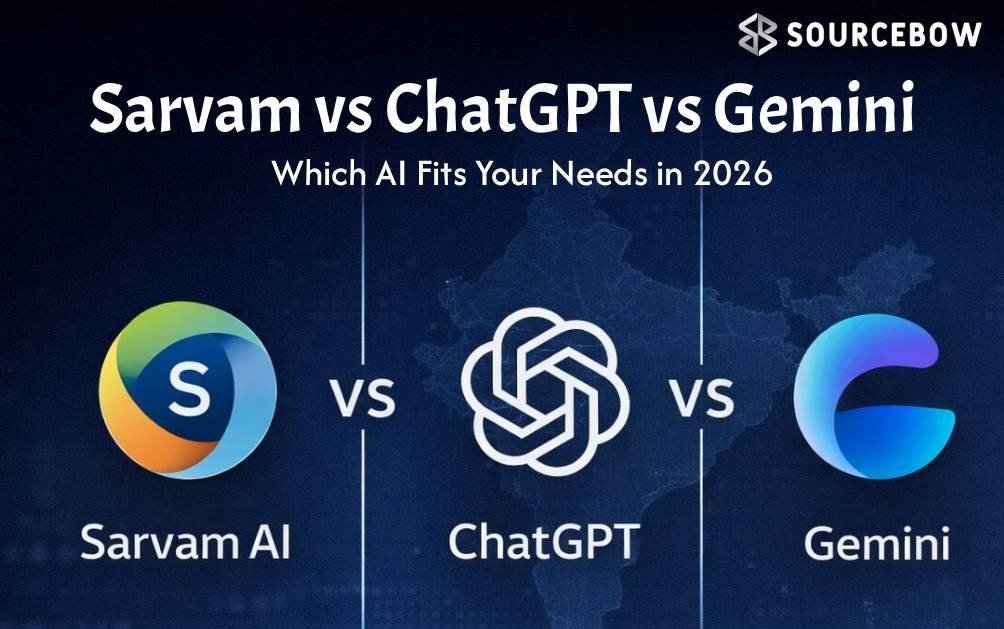
AI tools are everywhere these days. You might notice three big names in the conversation: . Each aims to help you write, code, plan, and learn — but they don’t all do the same things in the same way. The goal here is to figure out which one feels like a fit for daily work in 2026.
So the big question isn’t which AI is the strongest on paper. It’s which AI actually fits your workflow — the one that slides into daily tasks without forcing a full shift in how work gets done.
Sarvam AI – India-Focused Intelligence
Sarvam is built with a tight focus on Indian languages and regional AI infrastructure. While global models dominate headlines, Sarvam subscribes to a different mission: multilingual access at scale for local teams and users. If daily work involves Hindi, Tamil, Telugu, Bengali and others, Sarvam’s design can feel naturally tuned to those needs.
Here’s a breakdown of Sarvam’s advantages:
- Sarvam supports an extensive range of Indian languages, including efficient and accurate processing of regional scripts and terms.
- The platform has been developed with governments and public sector organizations in mind, based on how these entities work.
- It has been built to scale across millions of users regardless of system load.
- Sarvam facilitates translation and cross-language communications among teams.
Some examples of how these strengths manifest themselves in real-world applications are: translating customer feedback into local insights; supporting bilingual responses to municipal websites; and providing guidelines in local languages. The functionality of Sarvam is heavily based on reliable, language-sensitive toolsets that take into account local cultural differences, rather than on creative writing ability.
Potential Drawbacks
- Sarvam is not as good at producing high-quality creative writing as many other global products in this space.
- Sarvam is limited to use with a small number of major global tools with little chance of integrating additional tools that do not operate in India.
- There are fewer third-party plugins and community-oriented resources available.
As a result, Sarvam is a good choice for companies/teams looking to develop apps for the public sector, multicultural groups, and/or organizations needing localization. For creative campaigns or worldwide product launches, it may feel early-stage compared with more globally integrated peers.
ChatGPT – The Versatile All-Rounder
ChatGPT has become a familiar default for many users worldwide. You’ll find it helping students, developers, marketers, and founders alike, with a kn ack for adapting tone and approach across a wide range of tasks.
Where it shines:
- Long-form writing — essays, reports, guides that read well and flow nicely
- Coding help — supportive in multiple programming languages, building snippets, debugging ideas
- Research explanations — breaking down complex topics into digestible steps
- Idea structuring — turning rough concepts into organized plans
- Content creation — blog outlines, drafts, revisions, and edits
- Learning through conversation — a training partner that can run through topics interactively
One neat thing is how well it adapts tone. As each user identified their writing style, and whether it was written informally, formally, professionally, or technically, there is no limit to what can be generated based on those styles. Whether you’re a student, blogger, developer, or startup founder, ChatGPT often serves as an easily accessible thinking partner.
Drawbacks
- May overexplain or require follow-up clarification at times
- Quality of output is dependent on quality of input and accuracy of context
- Some premium features can only be accessed through paid plan
Despite its limitations, ChatGPT is still one of the most well-rounded AI platforms currently available. It provides much more than just answer generation; it provides users with a collaborative partner throughout the drafting, editing, explaining, and revision processes.
Gemini – Google’s Integrated Brain
Gemini is Google’s AI ecosystem player, with a superpower that many teams already lean on: deep integration with the Google suite. If a daily routine revolves around Docs, Gmail, Sheets, and Drive, Gemini can feel remarkably native.
Indicators of how Gemini works.
- Google Integration — The ability of Gemini to use all parts (Doc, G-mail, Drive and other apps) within the Google Suite smoothly. Helps when collaborating.
- Timely Answers – Gemini gives fast, current responses using the most recent data available.
- Multi Modal Inputs – Gemini accepts text and images combined and is useful for summarized notes or annotations quickly.
- Fast and Fact-Based Responses – Provides you with the basics of what’s being written without you needing to read through other sources.
Overall, the place where Gemini is best utilized is as a smart assistant to operate within the entire suite of tools part of Goggle as a way to help you users accomplish day to day tasks efficiently without having to spend time finding the information they may need to accomplish what they are working on.
Gemini has limitations also, due to the way it operates and only gives shorter and/or less descriptive answers than most of its competitors.
Creative writing can feel less natural Value tends to scale with how deeply the Google ecosystem is used
That makes Gemini a natural fit for teams that live in Google Docs and Gmail, who want quick answers and easy collaboration, with the added bonus of image understanding in some setups.
Direct Comparison
To put it into a simple frame, here’s a quick side-by-side that highlights where each AI tends to shine and where they’re a tad lighter. The table uses plain, practical language so it’s easy to skim and compare at a glance.
| Feature | Sarvam | ChatGPT | Gemini |
|---|---|---|---|
| Indian Language Support | Strong | Moderate | Moderate |
| Creative Writing | Basic | Excellent | Good |
| Coding Support | Limited | Strong | Strong |
| Research Help | Moderate | Detailed | Quick & Accurate |
| Ecosystem Integration | India-focused | Broad tools | Google ecosystem |
| Best For | Regional use cases | Students & creators | Google-heavy users |
Directly comparing the three shows that the choice often boils down to the workload. If regional languages and local scale are the top priorities, Sarvam can save a lot of translation effort. If a broad set of tasks and creative exploration are the daily rhythm, ChatGPT remains a flexible partner. And if the daily toolbox revolves around Google apps and real-time data, Gemini can feel like a natural extension of the existing setup.
Which One Should You Choose?
Here’s a practical guide to decide, without turning it into a test lab for three weeks:
- Choose Sarvam if regional and multilingual support is non-negotiable. It’s especially strong when local language nuances and government or enterprise workflows matter more than flashy copy.
- Choose ChatGPT if a versatile thinking partner is the goal. Gemini is versatile enough for you to be able to write long-form text, debug code, explain your ideas, and create structured plans.
- If you’re a Google user and all of your daily workflow takes place in the Google ecosystem, then using Gemini will give you access to useful tools for quick facts, seamless integration, and real-time collaboration with any Google application, such as Docs, Gmail, and Sheets.
Ultimately, the best way to use multiple AI tools in 2026 is to know which one to use at what time. Most productive workflows will involve having access to more than one type of AI, so that you can switch back and forth between them as tasks change.
So what does this mean for you as a reader of this article? Map out some of your regular tasks so that you can identify what type of AI tools could help support you effectively. Determine which of these tasks would provide you with the greatest possible ROI (return on investment) based on the amount of time it takes you to produce high-quality results with both quick turnaround times and the proper degree of linguistic anaphylaxis and/or relative ease with which they will allow you to integrate into your current workflow. Begin by testing each of the three types of tool on small-scale, real-world tasks—not full-blown projects. The best tool will reveal itself by how naturally it fits into the routine, not by a sales pitch or a feature list.
And a gentle nudge: the real benefit comes from experimenting with all three and selecting the right tool for theright job. If the work invo lves multilingual support, regional contexts, or heavy Google ecosystem use, that could tip the balance toward Sarvam or Gemini. Otherwise, ChatGPT likely remains the most flexible companion for diverse writing and problem-solving tasks. The important thing is to keep the toolbox dynamic and aligned with how daily work actually gets done.
What’s your current AI workflow like? Is there a tool that you reach for first, or does the day begin with a quick comparison across multiple assistants? Sharing that practical experience can help others decide what to try next.