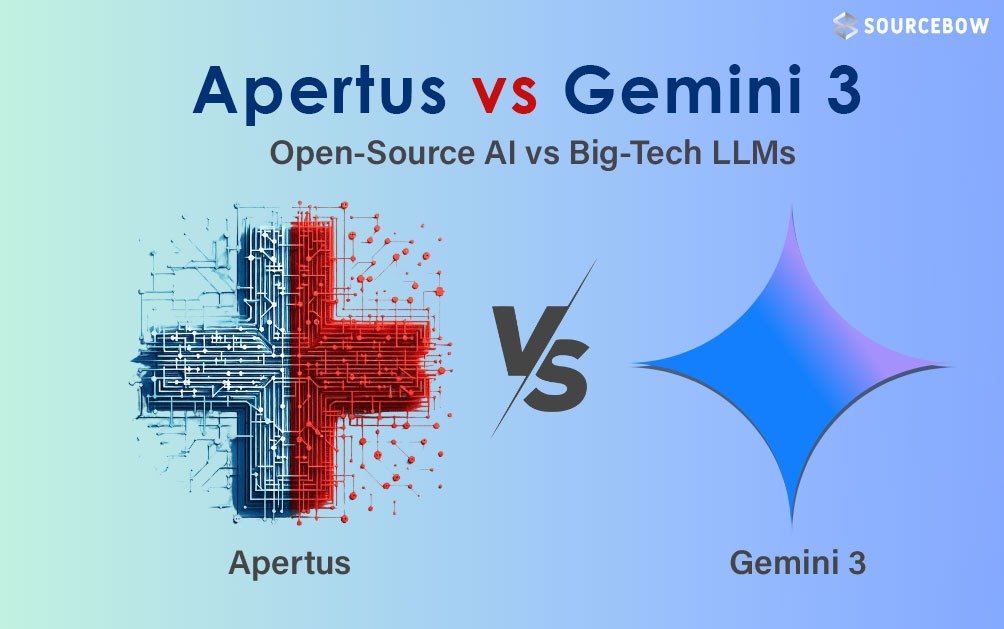
Apertus vs Gemini 3: Open-Source AI vs Big-Tech LLMs Explained Simply
The evolution of Artificial Intelligence is taking place at a fast pace. In a matter of months a new model appears claiming to be better in reasoning, faster in providing answers, and even conducting smarter conversations. On one side of the spectrum, there are AI models backed by big tech companies, such as Gemini 3, constructed by Google using immense financial resources, infrastructure, and closed systems. On the other side, there are open-source solutions like Apertus which are dedicated to transparency, community power, and freedom.
Actually, this is not merely a technical comparison, but it has become a larger debate on who gets to control AI, its manner of construction, and who gets the profit from it.
To let the reader grasp the argument before we actually go for the hands-on comparison of Apertus vs Gemini 3, we shall do so in a simple and human manner. There will be no sophisticated technical terms used, no exaggeration, but rather a clear understanding of how open-source AI contrasts with big-tech large language models, plus the implications for developers, businesses, and daily users.
Understanding the Basics of Apertus vs Gemini 3
Apertus and Gemini 3 are two sides of the same coin. Before we can start the actual comparison, we need to clearly visualize what they symbolize.
What Is Apertus in the Open-Source AI Debate?
Apertus is an open-source AI language model project. The main point of the project is very straightforward: AI should be open, modifiable, and available for the public. The source code can be viewed by anyone, altered by anyone, trained by anyone, and implemented by anyone with no one company’s restrictions applying to them.
Apertus is not under the control of any tech magnate. Its development is powered mainly through the contributions of the community, independent developers, and organizations that support the idea of free AI research and development.
What Is Gemini 3 and Why It Represents Big-Tech LLMs?
Gemini 3 is Google’s latest large language model, designed to compete at the highest level with models like GPT-4 and Claude. It is built using Google’s massive data centers, proprietary datasets, and advanced infrastructure.
Gemini 3 is powerful, polished, and deeply integrated into Google products like Search, Android, Workspace, and Chrome. However, it is closed-source, meaning users cannot see how it works internally.
Open-Source AI vs Big-Tech AI: The Core Difference
The real difference between Apertus and Gemini 3 is not just performance. It is philosophy.
| Aspect | Apertus | Gemini 3 |
|---|---|---|
| Source Code | Open to everyone | Fully closed |
| Control | Community and users | |
| Customization | High | Limited |
| Transparency | Full | Minimal |
| Infrastructure | Flexible | Google-owned |
| Cost Model | Often free or self-hosted | Paid or usage-based |
This difference affects everything from privacy to innovation speed.
Transparency and Trust in Apertus vs Gemini 3
Apertus: You Can See What Is Going On
With Apertus, developers can inspect the model architecture, training approach, and updates. This builds trust. If something goes wrong, the community can identify it, fix it, or fork the project.
For researchers and developers, this openness is a big deal. It allows learning, experimentation, and independent audits.
Gemini 3: Trust the Brand
Gemini 3 asks users to trust Google. You cannot see how data is processed or how responses are filtered. While Google follows strong internal policies, users have no way to verify claims directly.
For businesses dealing with sensitive data, this can be a concern.
Performance and Intelligence: Apertus vs Gemini 3
Gemini 3 Clearly Has the Edge Today
There is no denying it. Gemini 3 benefits from Google’s scale. It performs extremely well in:
- Complex reasoning
- Multimodal tasks (text, images, video)
- Long-context understanding
- Real-time information integration
For users who want polished, ready-to-use AI with minimal setup, Gemini 3 feels smooth and powerful.
Apertus Is Catching Up, Not Competing Head-On
Apertus is not trying to beat Gemini 3 at raw scale. Instead, it focuses on practical intelligence. For many tasks like:
Apertus performs well enough, especially when fine-tuned for specific use cases.
In real-world applications, “good enough and controllable” often beats “best but locked.”
Customization and Flexibility in Open-Source AI
This is where Apertus shines.
Apertus: Built to Be Modified
- Fine-tune the model on your own data
- Deploy it on your own servers
- Adjust outputs to match your brand voice
- Remove restrictions that do not fit your use case
This is ideal for startups, researchers, and enterprises that need AI tailored to their workflows.
Gemini 3: One Size Fits Most
Gemini 3 offers customization through prompts and APIs, but the core model stays the same. You cannot change how it fundamentally behaves.
For general use, this is fine. For specialized needs, it can feel limiting.
Privacy and Data Control in Apertus vs Gemini 3
Apertus: Your Data Stays With You
Since Apertus can be self-hosted, organizations have full control over data. This is critical for industries like healthcare, finance, and law.
No external servers. No hidden data usage policies.
Gemini 3: Cloud-First by Design
Gemini 3 operates within Google’s ecosystem. While Google claims strong data protections, data still passes through third-party infrastructure.
For many users, this is acceptable. For others, it is a deal-breaker.
Cost and Accessibility of Open-Source AI vs Big-Tech LLMs
Apertus: Lower Barrier Over Time
Apertus itself is often free. Costs depend on infrastructure and maintenance, but there are no per-prompt fees or surprise bills.
For developers in emerging markets or small startups, this matters a lot.
Gemini 3: Premium Power Comes at a Price
Gemini 3 is usually offered through subscription plans or API usage fees. While pricing is reasonable for businesses, it can become expensive at scale.
Big power, big bills.
Innovation Speed in Apertus vs Gemini 3
Open-Source Moves in Parallel
Apertus benefits from a global community. Improvements happen in parallel, not in a single company roadmap. Bugs are fixed faster. Features evolve organically.
However, coordination can be messy.
Big-Tech Moves Strategically
Gemini 3 evolves based on Google’s priorities. Updates are polished but slower and more controlled. Innovation is powerful, but not always aligned with user needs.
Real-World Use Cases for Apertus vs Gemini 3
Who Should Choose Apertus?
- Developers who want control
- Startups building AI-driven products
- Researchers and educators
- Privacy-focused organizations
- Companies avoiding vendor lock-in
Who Should Choose Gemini 3?
- General consumers
- Businesses needing instant performance
- Teams already using Google tools
- Users who want minimal setup
The Bigger Picture: The Future of AI
The Apertus vs Gemini 3 debate reflects a bigger shift in AI.
Big-tech models will continue to dominate in raw power. They have resources that open-source projects cannot match easily.
But open-source AI is not trying to win that race. It is building an alternative future where AI is shared, adaptable, and accountable.
Just like Linux did not kill Windows but changed the software world forever, open-source AI like Apertus may quietly reshape how AI is built and used.
Final Thoughts on Apertus vs Gemini 3
Apertus and Gemini 3 are not enemies. They serve different needs.
Gemini 3 represents peak corporate AI. Powerful, refined, and tightly controlled.
Apertus represents community-driven AI. Transparent, flexible, and user-owned.
The best choice depends on what you value more: convenience or control, polish or freedom, scale or transparency.
As AI becomes part of daily life, this choice will matter more than ever.