ChatGPT Translate Steps Out on Its Own and That’s a Quietly Big Shift
The strange thing about translation tools is how invisible they’ve become. They sit in the background of daily life, opening foreign menus, emails, documents, and social posts without much credit. Most people barely think about them anymore, unless something goes wrong. So when a new translation tool shows up from a name as familiar as OpenAI, it doesn’t arrive with fireworks. It just appears, calm and confident, like it knows it’ll be noticed eventually.
ChatGPT Translate is exactly that kind of arrival. No dramatic announcement, no flashy promises. Just a standalone website, separate from the usual chat interface, built for one purpose only. Translate text from one language to another. Simple on the surface, but there’s more going on once the novelty settles and the details start to sink in.
What makes this interesting isn’t that translation exists. That’s old ground. It’s that OpenAI decided it was worth pulling this function out of the chatbot and letting it live on its own. That choice alone hints at how central language tools are becoming, not as side features, but as daily utilities people quietly rely on.
A familiar layout that feels intentional in ChatGPT Translate
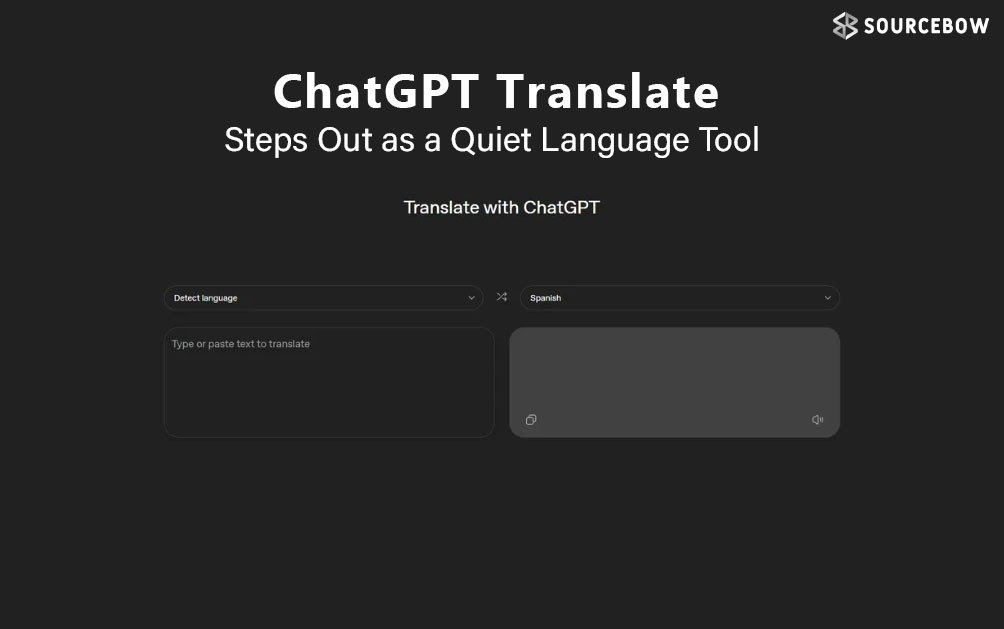
Opening ChatGPT Translate feels oddly familiar. Two boxes sit side by side, one for input and one for output. Language selectors hover above waiting patiently. Anyone who has used Google Translate will recognize the setup instantly, and that’s not an accident. Comfort matters with tools like this. When someone needs a quick translation, there’s no time to learn a new system or hunt for buttons.
- Two boxes sit side by side, one for input, one for output.
- Language selectors hover above, waiting patiently.
- Text can be typed or pasted directly, and the response appears almost immediately.
- There’s no clutter, no distracting panels, no attempts to upsell features.
The site also hints at bigger ambitions. Options for image translation and voice translation are visible, sitting there like unopened doors. They don’t work yet, but their presence suggests this isn’t a finished product. It’s more like a foundation, laid early, waiting for more layers to be built on top once the basics settle.
Language coverage that already feels broad enough with ChatGPT Translate
One of the first questions people ask with any translation tool is simple. Does it support my language. ChatGPT Translate currently covers more than 50 languages, which puts it comfortably into the practical zone. It’s not trying to chase every dialect on day one, but it covers enough ground to be genuinely useful across regions.
- ChatGPT Translate currently covers more than 50 languages.
- For casual users, that range already solves most everyday needs.
- It feels more like a reliable daily companion than a specialist tool.
What stands out is how cleanly it handles the process. There’s no sense of the tool struggling or overthinking. You put text in, you get text out. That simplicity is often underestimated, but it’s exactly what keeps people coming back.
Where ChatGPT Translate quietly separates itself from Google Translate
At first glance, it’s easy to shrug and say this looks the same as Google Translate. In many ways, it does. But once you spend a little time with it, the differences start to surface in softer ways.
| Aspect | ChatGPT Translate | Google Translate |
|---|---|---|
| Tone control | Ability to choose how the translation should sound. | Limited tone customization. |
| Interface focus | Strictly focused on text with minimal clutter. | Includes multiple tools and integrations. |
| Platform behavior | Desktop sticks to text, mobile allows microphone input. | More consistent across devices. |
One notable addition is the ability to choose how the translation should sound. Presets like formal or academic aren’t revolutionary, but they change the tone of the output in ways that feel subtle and useful.
No app yet and why ChatGPT Translate might be deliberate
Unlike Google Translate, there’s no dedicated mobile app for ChatGPT Translate right now. Everything runs through the browser. That might seem like a limitation, but it could also be a conscious choice.
- A web-based tool stays lighter, easier to adjust, and quicker to refine.
- It opens instantly, works anywhere, and doesn’t demand storage space.
- An app will probably arrive eventually.
Why OpenAI separating ChatGPT Translate matters
ChatGPT has been translating text inside conversations for a long time. So why break it out into a separate product. That move suggests something important. Translation isn’t just a trick the chatbot can do. It’s a service people want without distractions.
By giving translation its own space, OpenAI is treating it like infrastructure. Something closer to search or email than to a novelty feature. That shift says a lot about where language tools are heading.
The subtle role of trust and tone in ChatGPT Translate
One thing that often gets overlooked in translation is trust. ChatGPT Translate feels like it leans into this by offering tone control rather than claiming absolute accuracy.
Still early and clearly unfinished
Despite the polished surface, it’s obvious this is an early version. Image and voice translation are teased but not active. Desktop and mobile features don’t fully match.
What ChatGPT Translate could mean going forward
Translation tools are no longer just about converting words. They’re about shaping meaning in ways that fit real situations. Whether ChatGPT Translate overtakes Google Translate isn’t really the point.
In the end, ChatGPT Translate doesn’t demand attention. It doesn’t try to impress. It just sits there, ready, doing one job.